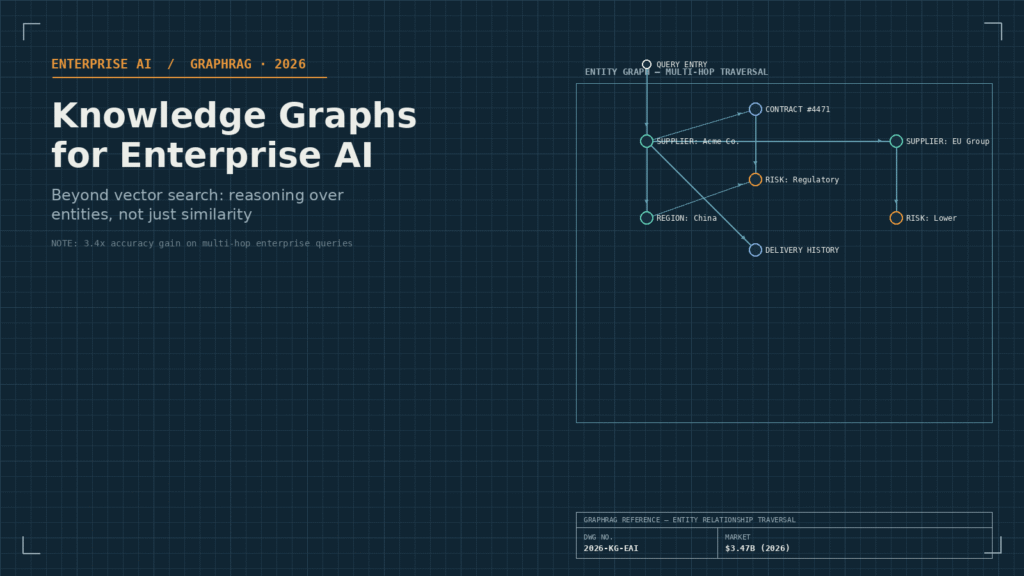
Most enterprise AI failures aren’t model failures. McKinsey’s 2025 research found that 71% of organizations report regular generative AI use, yet only 17% attribute more than 5% of EBIT to it — a wide gap between demos and real production value. That gap is largely an architecture problem, not a capability problem, and knowledge graphs are the piece of architecture most enterprises are missing.
By 2026, an estimated 85% of enterprises are expected to adopt hybrid RAG systems that combine vector and graph databases, according to Neo4j’s LLM integration analysis. That’s not a niche technical preference — it’s a recognition that plain retrieval-augmented generation, on its own, has a structural ceiling that only a graph can push past.
Why Plain RAG Hits a Wall
Traditional RAG works by converting documents into vector embeddings and retrieving the chunks most similar to a query. It’s fast, flexible, and requires no upfront relationship modeling — which is exactly why it became the default architecture for enterprise GenAI. But similarity search answers a different question than the one enterprises actually need answered.
Ask a traditional RAG system “what are the key risks in our supply chain for products manufactured in China, compared to our European suppliers,” and it retrieves document chunks that sound similar to the question. It doesn’t understand that supplier risk connects to manufacturing location, which connects to regulatory exposure, which connects to historical delivery performance — because none of that is an explicit relationship in a vector index. Multi-hop reasoning, the kind that requires following a chain of connected facts across documents, is where vector-only RAG consistently breaks down.
The Accuracy Data Behind GraphRAG
Microsoft’s GraphRAG project — open-sourced in 2024, reaching production maturity with version 1.0 later that year, and still shipping performance updates as recently as March 2026 — is the clearest evidence of how much structure matters. The project has passed 31,600 GitHub stars, with over 3,300 forks and 472 dependent projects, reflecting how quickly it moved from research curiosity to production infrastructure.
The performance case is concrete: GraphRAG systems answer correctly on a majority of enterprise benchmark questions, against roughly 51% for vector-only RAG on the same tests — commonly cited as something close to a 3.4x accuracy improvement on complex, relationship-heavy queries. The gains aren’t evenly spread across every query type. They concentrate specifically where the question requires connecting facts across multiple documents or entities — which happens to be exactly the category of question that matters most in regulated, high-stakes enterprise contexts.
Cost used to be the counterargument. Full GraphRAG indexing is computationally expensive, since it requires an LLM pass to extract entities and relationships from every document before any queries even run. Microsoft’s LazyGraphRAG approach substantially reduced that indexing cost, removing what had been the primary economic obstacle to adoption for mid-size organizations that couldn’t justify a large upfront indexing bill.
The Market Is Growing, But Adoption Is Still Shallow
The numbers on market size are consistent across analysts, even if the exact figures differ by methodology. The enterprise knowledge graph market reached roughly $3.47 billion in 2026, growing at a 21.3% CAGR through 2033. A separate analysis pegs the AI-ready enterprise knowledge graph segment specifically at $1.05 billion in 2026, projected to reach $6.55 billion by 2036 at a 20.1% CAGR — driven largely by GraphRAG enablement services, which alone account for roughly 31% of that market’s 2026 demand.
But market growth and actual enterprise adoption aren’t the same curve. Industry surveys suggest fewer than 15% of enterprises have moved enterprise knowledge graph projects beyond the pilot stage. Most stall on one of three problems: ontology design (deciding how to formally structure relationships before building anything), entity resolution accuracy (correctly determining that “Company A” in one document and “Acme Corp” in another are the same entity), or query performance once the graph reaches real production scale.
That entity resolution number matters more than it sounds. If customer entity-resolution accuracy sits below roughly 85%, the graph will confidently connect purchases, support tickets, and campaign touches across what are actually different people — and every downstream insight built on that connection becomes unreliable. Unlike a poorly governed data warehouse, which tends to just return bad results, a poorly governed knowledge graph actively infers wrong relationships at scale and presents them with the same confidence as correct ones. That’s a meaningfully more dangerous failure mode.
Where the Value Actually Shows Up
The clearest signal for whether a knowledge graph is worth building isn’t industry — it’s query pattern. Enterprise knowledge graphs pay off when teams repeatedly ask the same kind of structural question: “which campaign touches preceded this conversion,” or “how do adoption patterns predict churn.” If query patterns shift week to week, the upfront cost of ontology design and relationship modeling is largely wasted effort, and a flexible SQL warehouse or vector store delivers better ROI.
A few domains consistently show up as the strongest fits:
Legal and compliance. Understanding relationships between contract clauses, obligations, and precedents is inherently a graph problem. A question like “what are our termination rights if a supplier fails quality standards across three consecutive quarters” requires connecting supplier performance data, contract terms, and legal precedent — three different data types linked by explicit relationships, not semantic similarity.
Financial services. Risk modeling, fraud detection, and counterparty exposure analysis all depend on tracing relationships between entities — companies, transactions, ownership structures — where the connection itself is the insight, not any single document.
Healthcare and life sciences. Clinical and genomic datasets are dense with explicit, well-defined relationships (drug interactions, patient histories, trial eligibility criteria) that map naturally onto graph structures rather than flat document collections.
Manufacturing and supply chain. Multi-tier supplier risk, the exact example above, is a canonical multi-hop reasoning problem that vector search alone can’t reliably answer.
Knowledge Graphs Are Becoming a Compliance Requirement, Not Just a Performance Upgrade
There’s a regulatory dimension pushing adoption that’s easy to underweight. Explainability mandates — most notably under the EU AI Act — are turning “can you show your work” from a nice-to-have into a legal requirement for AI systems used in regulated decisions. A vector similarity score doesn’t explain why an AI system reached a conclusion. A graph traversal path does: it shows the explicit chain of entities and relationships that produced the answer, which is a fundamentally more auditable object than a cosine-similarity ranking.
That’s a large part of why enterprise strategy frameworks increasingly describe hybrid architectures — not pure vector, not pure graph — as the default for large-scale AI deployment by 2026. Structured layers enforce compliance in a way unstructured retrieval simply can’t on its own.
The Composed Stack: How This Actually Runs in Production
The 2026 production pattern isn’t “knowledge graph instead of RAG.” It’s a layered architecture where each component does a distinct job: vector search identifies the most relevant documents and entry points into the graph; graph traversal follows relationship edges from those entry points to gather connected context; and a persistent memory layer injects session and user-specific context on top of both. RAG without memory restarts from zero every session. Memory without a knowledge graph can recall a user but can’t reason across entity relationships. It’s the composition of all three — not any single one — that constitutes what production teams are increasingly calling the enterprise context layer.
Underneath all of it sits one more requirement that’s easy to skip past: governed, current, trustworthy data. Stale or ungoverned source data breaks vector retrieval, memory, and knowledge graphs simultaneously — because a knowledge graph doesn’t fix bad data, it amplifies it, confidently, at scale.
The Practical Takeaway
The honest read of the 2026 data is that knowledge graphs are neither hype nor a universal upgrade. They’re a specific architectural answer to a specific class of problem: enterprise questions that require connecting facts across entities rather than finding the single most similar document. Where that’s the actual shape of your queries — legal reasoning, fraud detection, supply-chain risk, clinical relationships — the accuracy gains are large and well-documented. Where it isn’t, a knowledge graph adds ontology overhead without a matching return.
The organizations pulling ahead in 2026 aren’t the ones that picked graph over vector, or vector over graph. They’re the ones that built the boring infrastructure first — entity resolution, data governance, a clear sense of which questions actually repeat — before investing in the graph layer on top of it.
