Imagine your company rolls out an AI assistant that reads contracts, customer records and internal strategy documents. It works beautifully. Then your legal team asks three simple questions. Where exactly is our data stored? Who can legally compel access to it? And what happens if the provider’s rules, prices or political circumstances change?
If nobody can answer confidently, you have a sovereignty problem.
Sovereign AI in 2026 has moved from a government talking point to a board-level business priority. Cloud giants have launched dedicated sovereign offerings, regulators are tightening AI and data rules, and security leaders are rethinking where their most sensitive AI workloads should run.
This guide explains what sovereign AI is, why it matters now, how it compares with standard public cloud AI, what the benefits and trade-offs are, and how businesses can put it into practice without overspending or over-engineering.
1. What Is Sovereign AI?
Sovereign AI means building and running artificial intelligence systems in a way that keeps an organization (or a nation) in control of its data, infrastructure, models and legal exposure. In business terms, it answers one question: Who ultimately controls our AI and the data that feeds it?
It is easy to confuse sovereignty with plain security or privacy, so it helps to separate the ideas:
- Security protects systems from attackers.
- Privacy governs how personal data is collected and used.
- Sovereignty is about control and jurisdiction: whose laws apply, who can access the data, and who can switch the service off.
A system can be very secure and still not be sovereign, for example if it is fully protected but subject to foreign legal demands or run entirely by a provider you cannot replace.
The four layers of sovereign AI
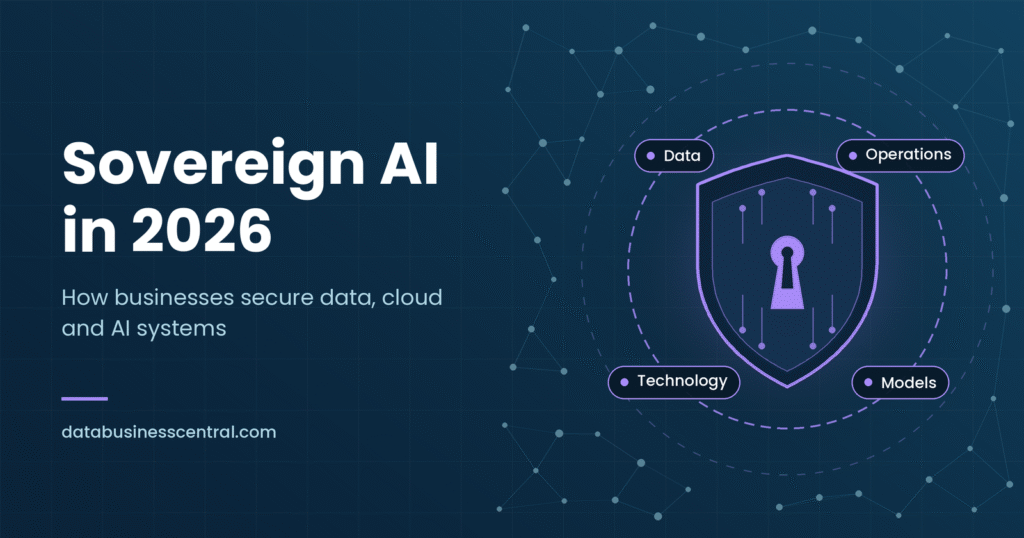
Most frameworks break sovereignty into four layers:
- Data sovereignty. Data is stored and processed in chosen locations and governed by the laws you intend. This is the heart of AI data sovereignty.
- Operational sovereignty. The people who run, support and administer the platform are in approved jurisdictions, with strict limits on who can access what.
- Technological sovereignty. You keep control over encryption keys, software choices and architecture, and you can move workloads without being trapped.
- Model sovereignty. You control which AI models you use, where they run, how they are customized and what they learn from your data.
True sovereignty is a spectrum rather than a switch. Most businesses do not need maximum isolation everywhere. They need the right level of control for each workload.
Data residency vs data sovereignty
These two terms are often used interchangeably, but they are not the same:
| Concept | What it means | Example question it answers |
|---|---|---|
| Data residency | The physical location where data is stored | Is our customer data kept inside the EU? |
| Data sovereignty | Which country’s laws and authorities can claim control over the data | Could a foreign government legally compel access to it? |
| Operational sovereignty | Who administers and supports the systems | Can staff outside our jurisdiction access our environment? |
Storing data in a local data center satisfies residency. It does not automatically guarantee sovereignty, which is why careful data residency and compliance planning looks at ownership, access and legal exposure, not just geography.
2. Why Sovereign AI Matters in 2026
Several forces have converged to push sovereignty up the agenda.
AI now touches your most sensitive data
Earlier software handled well-defined records. Modern AI assistants and agents ingest emails, contracts, source code, medical notes and financial data, then generate new content from it. The more useful the AI becomes, the more sensitive the information it needs.
Regulation is expanding
Governments are moving from principles to enforcement:
- The EU AI Act is being phased in. In 2026, a package of amendments known as the Digital Omnibus on AI entered into force, postponing many high-risk system obligations, with stand-alone high-risk rules now expected from December 2027 and embedded-product rules from August 2028. However, law firms stress that this is not a pause. Several obligations, including many transparency requirements, still apply from August 2026, so organizations should confirm exactly what applies to them.
- GDPR continues to restrict how personal data moves outside the EU.
- Other rules, such as the EU Data Act, DORA for financial entities, NIS2 for critical sectors and India’s data protection law, add further obligations about where and how data is handled.
- In the US, sector rules and standards such as HIPAA, FedRAMP, CMMC and export controls such as ITAR, along with a growing patchwork of state privacy laws, shape where regulated data can live.
Geopolitics has entered the boardroom
Uncertainty around trade, sanctions and cross-border legal powers has made leaders ask what could happen if access to a foreign provider were disrupted or if foreign authorities requested data. A frequently discussed tension involves the US CLOUD Act, under which US-headquartered providers can face legal demands for data even when it is stored overseas, and European privacy rules that restrict such transfers. Reasonable people and lawyers disagree about how far this risk reaches in practice, which is exactly why many organizations want clearer legal and operational separation.
The market has responded
The supply side has changed quickly. Amazon Web Services announced general availability of its AWS European Sovereign Cloud in January 2026, positioned as an independent cloud region with EU-located infrastructure and EU-based operations. Microsoft introduced public and private Sovereign Cloud options in 2025, Google Cloud offers a range of models from data boundaries to air-gapped environments, and Oracle has launched EU sovereign regions. Enterprise software vendors such as Workday have also begun launching EU sovereign cloud versions of their AI-enabled applications.
Industry analysts have observed that European enterprises increasingly treat sovereign cloud not as a niche compliance tool but as core infrastructure for critical workloads and AI platforms. US enterprises with international customers, regulated data or government contracts are following the same path.
Why US companies should care too
Even if you are headquartered in the United States, sovereign AI can affect you when you:
- Serve customers or employees in the EU, UK, India or other regulated markets
- Work with federal, defense or critical-infrastructure clients
- Handle healthcare, financial or legal data under strict rules
- Face customer contracts that demand specific data locations or controls
- Want to avoid dependence on a single provider
3. How Data Sovereignty Works in Enterprise AI
To understand AI data sovereignty in practice, follow your data through a typical AI workflow and see where control can be lost or kept.
The AI data journey
- Collection and storage. Documents, databases and logs are stored somewhere. Control point: location, encryption and ownership.
- Preparation and retrieval. Data is cleaned, indexed and fetched to give AI context. Control point: access permissions and lineage.
- Model processing. A prompt and relevant data are sent to a model to generate an answer. Control point: where the model runs and who can see the inputs.
- Outputs and logs. Responses, prompts and usage logs are stored. Control point: retention rules and who can read the logs.
- Improvement. Feedback may be used to tune or train models. Control point: whether your data is allowed to improve anyone else’s model.
Sovereign AI strategies apply controls at every step, not just at storage.
Key technical building blocks
- Regional processing and storage. Workloads are pinned to approved regions so data never leaves chosen boundaries.
- Customer-controlled encryption keys. You hold the keys, sometimes outside the provider’s systems entirely, so the provider cannot decrypt your data on its own.
- Confidential computing. Hardware-based protection keeps data encrypted even while it is being processed.
- Private networking. AI services are reachable only through private connections, not the open internet.
- Local or self-hosted models. Open-weight and regional models can run inside your own environment, so prompts never leave it.
- Strict identity and access control. Every user, service and AI agent is authenticated and limited to the minimum data it needs.
- Audit trails. Detailed logs show who accessed what, when and why.
Sovereignty models: a spectrum of control
| Model | How it works | Control level | Typical fit |
|---|---|---|---|
| Public cloud, regional | Standard cloud with data stored in a chosen region | Basic | General business workloads |
| Public cloud with data boundary controls | Added controls for data location, keys and access | Moderate | Regulated but flexible workloads |
| Sovereign cloud region | Dedicated, locally operated cloud with local staff and legal structure | High | Sensitive and regulated data |
| Private or dedicated cloud | Single-tenant infrastructure run for one organization | High | Critical systems, strict compliance |
| On-premises or air-gapped | Fully isolated environment inside your own facility | Maximum | Defense, intelligence, highly classified data |
The right choice depends on how sensitive the data is, how strict the rules are and how much operational burden you can handle.
4. Sovereign AI vs Public Cloud AI
The sovereign cloud vs public cloud question is one of the most common ones buyers ask. The honest answer is that public cloud is not “bad” and sovereign cloud is not “automatically better.” They solve different problems.
| Factor | Standard Public Cloud AI | Sovereign AI |
|---|---|---|
| Data location | Chosen regions, but global provider operations | Fixed, often in-country or in-region, with local operations |
| Legal jurisdiction | Typically the provider’s home laws plus local laws | Designed to align with local jurisdiction and reduce foreign legal exposure |
| Operational access | Global support and engineering teams | Restricted to approved personnel and locations |
| Encryption keys | Often provider-managed, with customer options | Customer-controlled or externally held keys are common |
| Service breadth | Widest range of newest AI services | Often narrower or slightly behind at first |
| Cost | Usually lower, with economies of scale | Often higher due to dedicated infrastructure and operations |
| Speed to adopt | Fast; instant access to new features | Slower; more planning and integration |
| Compliance fit | Good for general needs | Stronger for strict data residency, public sector and regulated data |
| Vendor lock-in | Can be high without careful design | Varies; often paired with open standards to reduce it |
| Best for | Innovation, experimentation, non-sensitive workloads | Sensitive data, regulated industries, strategic systems |
It is rarely either/or
Most large organizations take a tiered approach:
- Tier 1: Public cloud for experimentation, marketing content and non-sensitive analytics.
- Tier 2: Public cloud with sovereignty controls for customer data and internal tools needing regional boundaries and customer-managed keys.
- Tier 3: Sovereign or private environments for regulated, confidential or strategically critical workloads.
Classifying workloads first prevents the two classic mistakes: putting everything in the most expensive, restrictive environment, or putting everything in the cheapest one.
A caution from security leaders
Security commentators have pointed out that moving to a sovereign cloud does not by itself fix AI risk. Weak identity controls, over-permissioned AI agents or poor data hygiene can expose sensitive information in any environment. Sovereignty gives you control over location and jurisdiction, but you still need strong governance, access management and monitoring on top.
5. Top 7 Benefits of Sovereign AI for Businesses
Here are the main benefits of sovereign AI for businesses.
1. Stronger regulatory compliance
Keeping data and processing within defined jurisdictions makes it easier to satisfy residency rules, sector regulations and audit requests, and to demonstrate compliance with evidence.
2. Greater control over sensitive data
Customer-held keys, restricted operator access and clear data boundaries reduce the number of parties who can ever see your information.
3. Reduced legal and geopolitical risk
By limiting exposure to foreign legal demands and cross-border disruptions, sovereign designs help protect continuity if political or regulatory conditions change.
4. Improved customer and partner trust
Governments, hospitals, banks and large enterprises increasingly ask suppliers where data lives and who can access it. Being able to answer clearly can win deals and shorten security reviews.
5. Protection of intellectual property
Your proprietary documents, code and know-how fuel your AI. Controlling where models run and ensuring your data does not train anyone else’s models protects competitive advantage.
6. Operational resilience and independence
A sovereign approach reduces dependence on a single vendor or region, and pairs well with portable, open-standard architectures that make switching providers more realistic.
7. Alignment with national and sector priorities
In many countries and industries, using sovereign infrastructure is a requirement or a strong advantage for public-sector contracts, critical infrastructure and regulated services.
6. Data Privacy, Security and Regulatory Compliance
Sovereignty works best when combined with a disciplined security and compliance program. Here is how businesses protect AI data in practice.
The regulatory landscape at a glance
| Regulation or standard | Region | Why it matters for AI |
|---|---|---|
| GDPR | EU/EEA | Governs personal data use and international transfers |
| EU AI Act | EU | Risk-based rules for AI systems, with phased deadlines and transparency duties |
| EU Data Act | EU | Rules on data access, portability and switching cloud providers |
| DORA | EU financial sector | Operational resilience, including third-party ICT and cloud risk |
| NIS2 | EU | Cybersecurity duties for essential and important entities |
| HIPAA | US healthcare | Protects health information used in AI tools |
| FedRAMP and CMMC | US government supply chain | Security baselines for cloud and defense contractors |
| State privacy laws | US states | Consumer data rights and AI-related obligations that vary by state |
| India DPDP Act | India | Personal data protection with cross-border considerations |
Rules change quickly, and this table is a starting point rather than legal advice. Check current requirements with qualified counsel.
How businesses protect AI data: a practical checklist
- Classify your data. Label information by sensitivity and regulatory status before connecting it to AI.
- Map your AI data flows. Document where data goes, which models touch it and where outputs and logs are stored.
- Encrypt everywhere. Use strong encryption in transit and at rest, and use customer-managed or externally held keys for sensitive workloads.
- Apply least-privilege access. Give users, applications and AI agents only the data they need, and enforce it at retrieval time.
- Secure AI agents as identities. Treat agents like employees: unique identities, limited permissions, activity monitoring and the ability to revoke access instantly.
- Control retrieval and context. Make sure the information fed to models respects user permissions. Our guide to AI context engineering explains how to deliver the right data to agents with governance built in.
- Contract carefully. Confirm in writing that your data is not used to train shared models, define retention and deletion, and clarify where support staff are located.
- Use data loss prevention and filtering. Detect and block sensitive data in prompts and outputs.
- Log and audit. Keep tamper-resistant records of prompts, access and model decisions.
- Test adversarially. Run red-team exercises for prompt injection, data leakage and misuse.
- Prepare an incident plan. Know who to notify, how to isolate an AI system and how to meet breach-reporting deadlines.
A clear data governance framework is the backbone of all of these steps, since sovereignty rules are only enforceable if you know what data you have and who owns it.
Do not forget AI-specific risks
Sovereign infrastructure does not remove threats unique to AI, such as prompt injection, data poisoning, model theft and agents that take unintended actions. Build these into your security testing alongside traditional controls.
7. Top Sovereign AI and Cloud Providers
The market is evolving fast, and offerings differ by region, service coverage and level of isolation. Treat the list below as a landscape overview and confirm current capabilities, certifications and regional availability with each vendor.
| Provider | Sovereign approach | Notable points |
|---|---|---|
| AWS | European Sovereign Cloud, independent EU-based region; Dedicated Local Zones and Outposts for on-site deployment | Broad service catalog; designed with EU-based operations and governance |
| Microsoft | Sovereign Public Cloud and Sovereign Private Cloud; external key management options | Strong integration with Microsoft 365 and Azure AI; private and air-gapped options |
| Google Cloud | Sovereign models ranging from data boundary to dedicated and air-gapped, often with local partners | Flexible spectrum of isolation and partner-operated options |
| Oracle | EU Sovereign Cloud regions and dedicated region options | Popular with enterprises running Oracle databases and applications |
| IBM | Sovereign-focused platforms for governing AI and data | Emphasis on hybrid cloud and regulated industries |
| European and regional providers | Examples include OVHcloud, Deutsche Telekom (T-Systems), STACKIT and others | Local ownership and jurisdiction; often attractive for public-sector and regulated buyers |
| Sovereign-minded AI model developers | Examples include Mistral AI and open-weight model communities | Models that can be self-hosted and customized in your own environment |
| Enterprise SaaS vendors | Examples include Workday and other platforms launching regional sovereign editions | Lets you consume AI-enabled applications without building infrastructure |
How to evaluate a sovereign AI provider
Ask these questions in every vendor conversation:
- Who owns and operates the infrastructure, and in which legal jurisdiction?
- Who can administer it, and from which locations?
- Who controls encryption keys, and can you hold them independently?
- Which AI services and models are available, and how current are they compared with the standard cloud?
- What certifications and audit reports can you share?
- How are updates, support and incident response handled within the sovereign boundary?
- What are the exit terms, and can we export our data and workloads easily?
- How transparent are pricing and capacity, including GPU availability? Compute supply is a real constraint, as we explain in our guide to AI chip technology.
Be wary of “sovereign-washing,” where marketing language promises more independence than the contract and architecture actually deliver. Ask for specifics in writing.
8. Challenges of Implementing Sovereign AI
Sovereign AI brings real benefits, but it also brings real trade-offs. Plan for these challenges up front.
| Challenge | Why it happens | How to address it |
|---|---|---|
| Higher cost | Dedicated infrastructure, local operations and smaller scale | Reserve sovereign environments for workloads that truly need them |
| Fewer or later AI features | Sovereign regions may launch new services after the main cloud | Verify feature roadmaps; design workloads to be portable |
| Compute and GPU scarcity | Demand for AI hardware outstrips supply in many regions | Reserve capacity early; consider hybrid and burst strategies |
| Complexity of multi-environment setups | Different clouds, rules and tools to manage | Standardize on common tooling, policies and monitoring |
| Skills gaps | Sovereign architecture, security and compliance expertise is scarce | Train staff, use partners and managed services |
| Unclear legal interpretation | Laws vary by country and keep changing | Involve legal counsel early and review regularly |
| False sense of security | Teams assume sovereignty equals safety | Pair sovereignty with identity governance, monitoring and testing |
| Vendor lock-in in a new form | Sovereign offerings may use proprietary tooling | Prefer open standards, portable models and clear exit terms |
| Data quality and silos | Messy data weakens any AI program | Invest in data quality and cataloging before scaling |
A practical 7-step implementation roadmap
- Define your drivers. Identify why sovereignty matters: regulation, customer demands, risk reduction, strategic independence or all of these.
- Inventory AI use cases and data. List current and planned AI systems, the data they use and who owns it.
- Classify workloads into tiers. Decide which need standard cloud, enhanced controls or full sovereign environments.
- Choose your architecture. Combine sovereign cloud, private infrastructure, regional providers and self-hosted models as appropriate.
- Build governance and security in. Implement key management, access controls, logging and AI-specific protections from day one.
- Pilot with one high-value workload. Prove the approach with measurable results, such as compliance readiness, latency and cost.
- Monitor, audit and adapt. Review regulations, vendor roadmaps and performance regularly, and adjust as conditions change.
Metrics to track
- Share of AI workloads by sovereignty tier
- Audit findings and time to produce compliance evidence
- Number of data access exceptions or policy violations
- Cost per workload compared with the standard cloud baseline
- Latency and availability for sovereign workloads
- Time required to migrate a workload if you needed to switch providers
For example, a bank applying these steps might keep fraud models and customer account data in a regional sovereign environment while running marketing analytics in standard cloud. If you are exploring financial use cases, see our guide to AI fraud detection in 2026.
9. Future of Sovereign AI in 2027
Here is what business leaders should watch as sovereign AI matures.
Sovereignty becomes a standard buying criterion
Expect RFPs and procurement checklists to routinely include questions on jurisdiction, key control and operator access, much as security certifications became standard a decade ago.
Hybrid and multi-cloud sovereign strategies grow
Organizations will blend hyperscaler sovereign regions, regional providers and on-premises systems, orchestrating them with common governance. Portability will be a major selling point.
Smaller, specialized and open models rise
Capable open-weight and compact models make it realistic to run AI inside your own boundary. Many companies will use large frontier models for general tasks and smaller sovereign models for sensitive ones.
Sovereign AI factories and national compute
Governments and large companies are investing in dedicated AI compute capacity within their borders. Expect more regional AI infrastructure, which could ease GPU access for local businesses over time.
Regulation keeps evolving
The EU AI Act timeline has already shifted once, and further adjustments to digital rules are likely. Other regions are developing their own frameworks. Businesses should design for adaptability rather than for a single fixed rule set.
Stronger technical guarantees
Confidential computing, external key management and verifiable attestation will make sovereignty claims easier to prove and audit, shifting the conversation from promises to evidence.
Identity and agent governance take center stage
As AI agents act on behalf of employees, controlling what each agent can access and do becomes as important as controlling where data lives. The strongest programs will treat sovereignty and identity governance as two halves of one strategy.
Practical balance wins
The winners will not be companies that isolate everything, nor those that ignore the issue. They will classify workloads sensibly, apply proportionate controls and keep their options open.
10. Frequently Asked Questions
What is sovereign AI?
Sovereign AI is an approach to building and running AI systems that keeps an organization in control of its data, infrastructure, models and legal jurisdiction. It focuses on who can access data, which laws apply and how independent you are from any single provider.
What is AI data sovereignty?
AI data sovereignty means the data used by AI systems, including training data, prompts, retrieved documents and outputs, is subject to the laws and controls you intend, and cannot be accessed or compelled by unintended parties. It goes beyond storing data in a particular country.
What is the difference between data residency and data sovereignty?
Data residency is about the physical location of data. Data sovereignty is about which legal authority has control over it and who can access it. Data can reside in your country and still be exposed to foreign legal or operational access, which is why both matter for data residency and compliance.
What is the difference between sovereign cloud and public cloud?
Public cloud offers wide service choice, rapid innovation and lower cost, with data in regional locations but operated globally. Sovereign cloud adds stronger guarantees on jurisdiction, local operations, key control and administrator access, often at higher cost and with a narrower service catalog.
Is sovereign AI more secure than public cloud AI?
Not automatically. Sovereign AI gives you more control over location, jurisdiction and access, but security still depends on strong identity management, encryption, monitoring and governance. Both environments can be secure or insecure depending on how they are configured.
Who needs sovereign AI?
Organizations in regulated industries such as finance, healthcare and insurance, public-sector bodies, defense and critical infrastructure providers, and any business with strict customer contracts or significant operations in regions with data localization rules. Many other companies adopt a lighter version for their most sensitive workloads.
Does sovereign AI apply to US companies?
Yes, in many cases. US companies serving EU or other international customers, handling regulated data or working with government agencies often need controls on data location, access and keys. The specifics depend on your industry, customers and the laws that apply to you.
Can we use large AI models like those from major providers in a sovereign setup?
Often yes, through sovereign cloud regions, private deployments or regional partners, though model availability varies by provider and region. Alternatively, you can self-host open-weight models inside your own environment. Confirm current availability with each vendor.
How can businesses protect AI data?
Classify data, map AI data flows, encrypt with controlled keys, apply least-privilege access to people and AI agents, restrict retrieval to what each user is allowed to see, use contracts that prevent your data from training shared models, log and audit activity, and test for AI-specific attacks such as prompt injection.
Is sovereign AI more expensive?
Usually, yes. Dedicated infrastructure and local operations often cost more than standard public cloud. Many organizations control costs by using sovereign environments only for workloads that truly require them.
Will sovereign AI slow down innovation?
It can if applied too broadly. A tiered approach avoids this: use standard cloud for low-risk experimentation and reserve stricter environments for sensitive workloads. Good architecture and portable design help teams keep moving quickly.
Final Thoughts
Sovereign AI in 2026 is not about retreating from the cloud or slowing down innovation. It is about making deliberate choices on where your data lives, who can touch it, which laws apply and how easily you could change course.
The businesses that handle this well share a few habits. They classify their data and workloads before choosing technology. They match the level of sovereignty to the level of risk. They pair control over infrastructure with strong identity, governance and security practices. And they stay flexible, because both technology and regulation are still moving.
Start with an honest inventory of your AI use cases, pick one sensitive workload as a pilot, and build from there. Control earned step by step is far easier to sustain than control bolted on in a crisis.
Want to keep exploring how AI works in the enterprise? Browse more guides in our artificial intelligence category on Data Business Central.
This article is for general information and does not constitute legal advice. Regulations and vendor offerings change frequently, so consult qualified legal and technical advisors for your situation.
