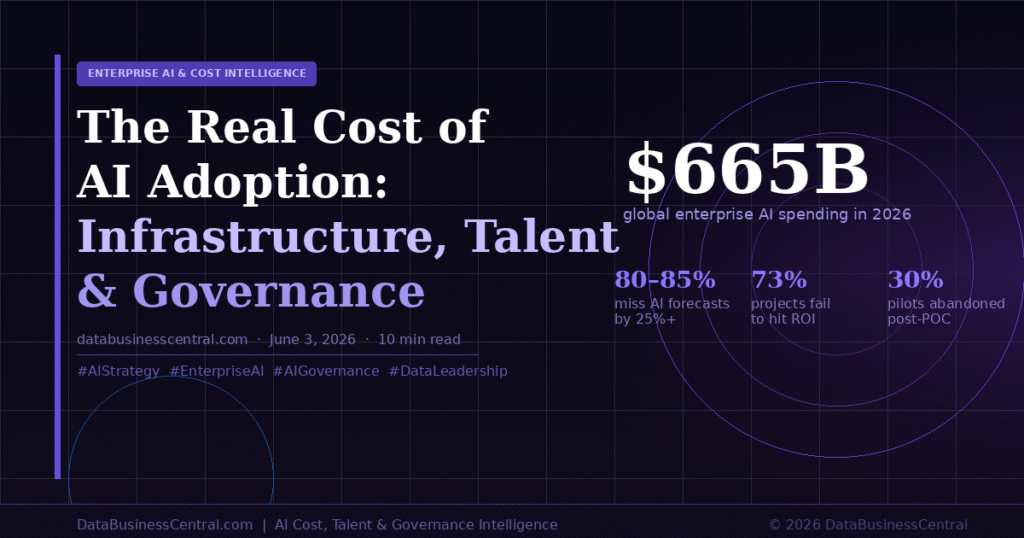
$665 billion in enterprise AI spend. 73% of projects failing to hit projected ROI. 80–85% of organizations missing their own infrastructure forecasts. The real cost of AI adoption in 2026 isn’t on any vendor invoice — it’s buried in the gaps between ambition, execution, and accountability.
There is a number most enterprise technology leaders cite when asked about AI investment: the line item on the cloud budget, or the SaaS license, or the model API fee. That number is almost always wrong — not because it is dishonest, but because it captures roughly a third of what AI actually costs to adopt at scale. The rest lives in infrastructure remediation, talent volatility, change management, data quality debt, governance tooling, regulatory readiness, and the compounding opportunity cost of the 30% of projects that get abandoned after the pilot.
This is a forensic look at where the money actually goes — and why the organizations that understand this are pulling away from the ones that don’t.
1. The illusion of the headline spend
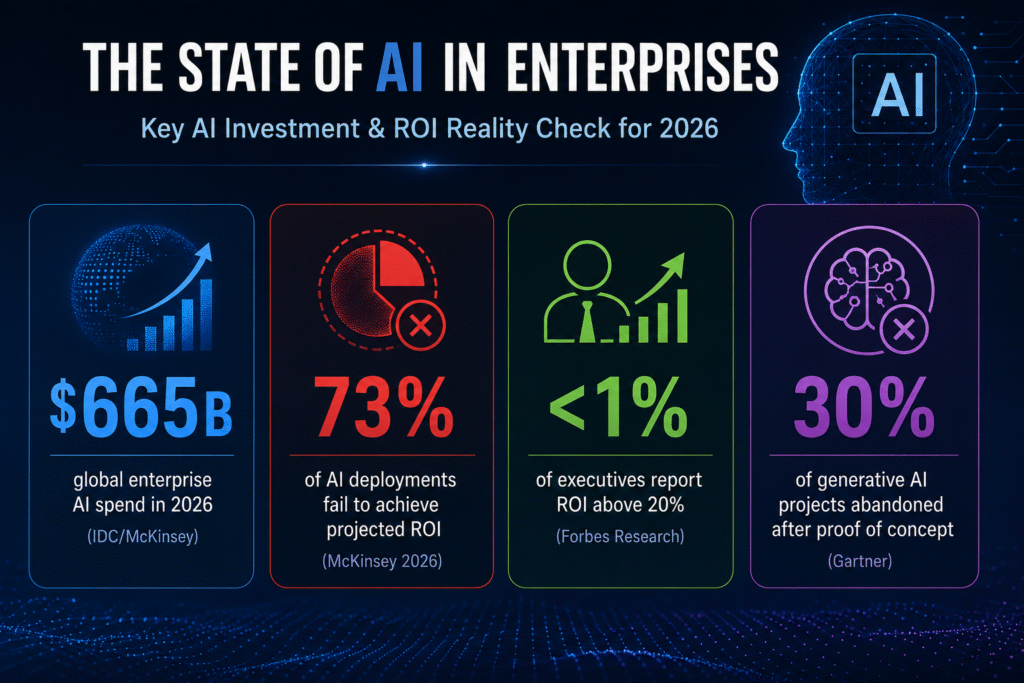
Global enterprise AI spending will hit $665 billion in 2026 — a figure that commands boardroom attention and fills analyst decks. But the headline obscures a troubling pattern underneath it. Companies plan to spend an average of 1.7% of revenue on AI in 2026, more than double 2025 levels. In many enterprises, AI is expected to consume 25–50% of total IT budgets within two years.
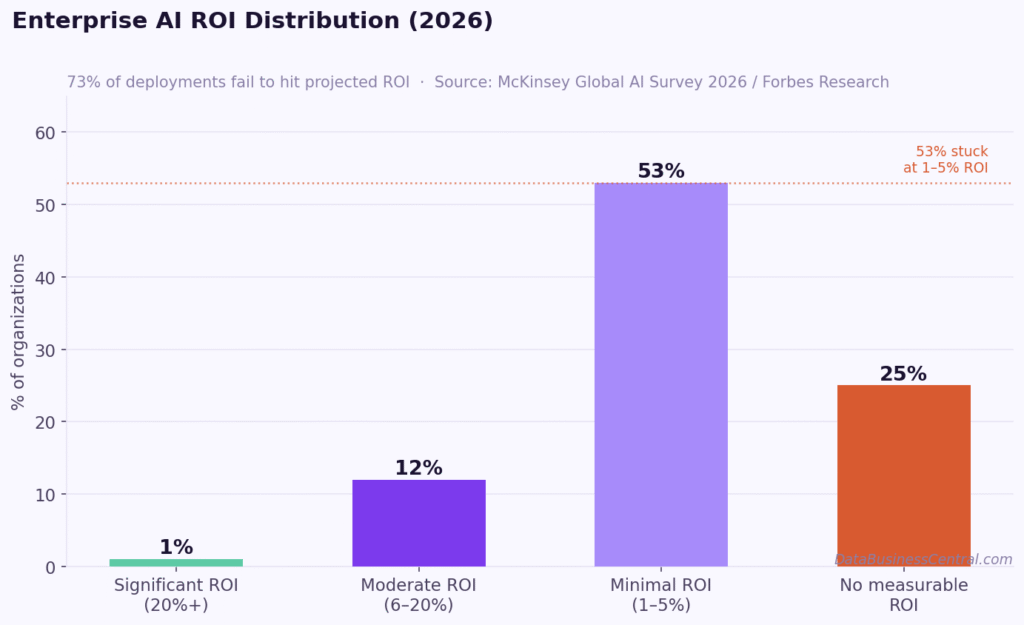
The return on that investment tells a different story. Fewer than 1% of executives report significant ROI of 20% or more. 53% report only 1–5% returns. 73% of deployments fail to achieve their projected return on investment entirely — a figure that has remained stubbornly consistent despite improvements in tooling, model capabilities, and practitioner expertise.
The defining paradox of 2026
Over $547 billion of 2025’s $684 billion in enterprise AI investment produced no measurable results. Not low returns — none. Yet AI budgets keep growing. The question is no longer whether to invest in AI. It is whether your organization has the cost architecture to make that investment generate value.
2. The infrastructure cost iceberg
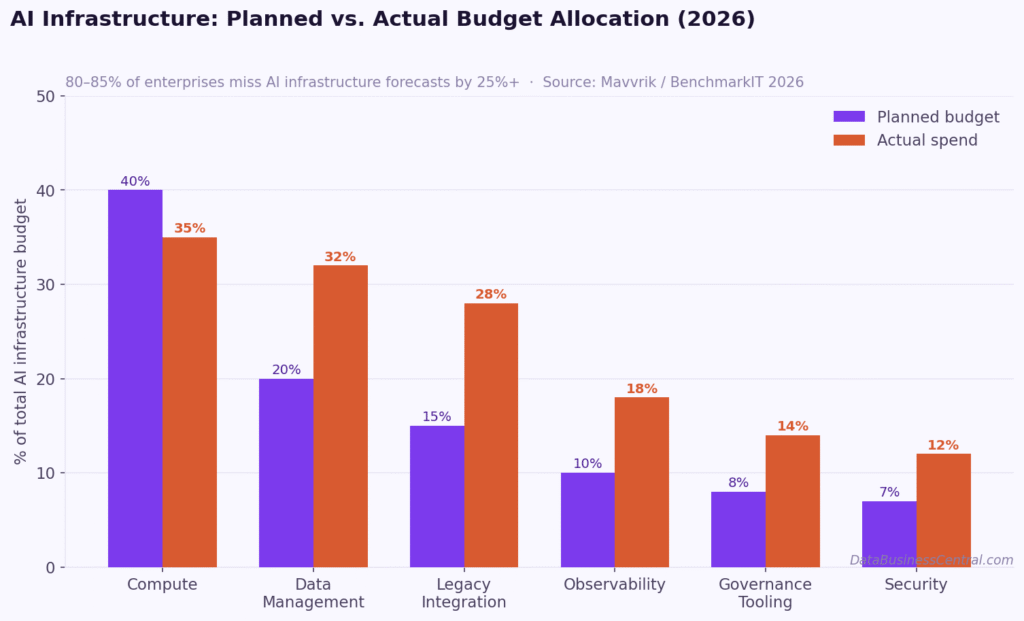
Ask a CFO what AI infrastructure costs and they will quote compute and cloud. Ask their infrastructure team and the number grows by a factor of two or three. 80–85% of enterprises miss their AI infrastructure forecasts by more than 25% — not rounding errors, but fundamentally broken budgets. The reasons cluster into predictable categories that traditional IT planning misses entirely.
Data center and compute: the energy problem
Major tech companies are estimated to spend $650 billion on AI data centers in 2026 — and those costs are flowing downstream. In Virginia, data centers already consume 26% of the state’s total electricity. In Ireland, the figure is 21%. The cascade effect is real: a homeowner in Manassas, Virginia saw his electricity bill jump from $100 to $281 in a single month in early 2026 as grid pressure from AI infrastructure grew. Lawmakers in over 30 states have introduced more than 300 bills on data center policy so far in 2026.
For enterprises, this translates directly into cloud cost unpredictability. GPU scarcity — driven by a global memory supply shortage triggered by the AI compute boom — has inflated compute costs for mid-market organizations that cannot lock in long-term hyperscaler contracts. The organizations most exposed are those that built AI roadmaps on 2023 infrastructure cost curves and are now facing 2026 pricing realities.
Legacy integration: the silent budget killer
Organizations that discover significant data quality, integration, and cloud architecture gaps after committing production AI budgets typically incur an additional 60–120% of the original AI project cost in foundational remediation. In manufacturing, legacy system integration consumes 58% of total AI project resources before a single model goes live.
The 8-month delay problemA system projected to generate $2M in operational savings in Year 1 generates zero savings during an 8-month legacy integration delay — while remediation consumes budget. In competitive industries where AI efficiency translates to pricing power, the opportunity cost compounds further with each quarter of delay.
Data quality: the silent executioner
Data quality is responsible for an estimated 60–73% of AI project failures, yet it rarely appears as a line item in pre-project budgets. Companies see data volumes increase 40–60% year over year once AI adoption takes hold, creating cascading storage and processing costs. Organizations spend 15–25% of their infrastructure budget on observability tools alone — and Gartner research shows 36% spending over $1 million on observability annually.
| Infrastructure cost category | Visibility | Typical budget miss | Risk level |
|---|---|---|---|
| GPU / compute | High | +15–30% from price volatility | Medium |
| Data management & storage | Medium | +40–60% from volume growth | High |
| Legacy system integration | Low | +60–120% of original project cost | Critical |
| Observability & monitoring | Low | Often entirely unbudgeted | High |
| Data quality remediation | Very low | Drives 60–73% of project failures | Critical |
| Energy & cooling (on-premise) | Medium | +100%+ YoY for AI workloads | Medium |
3. The talent cost no one budgets for
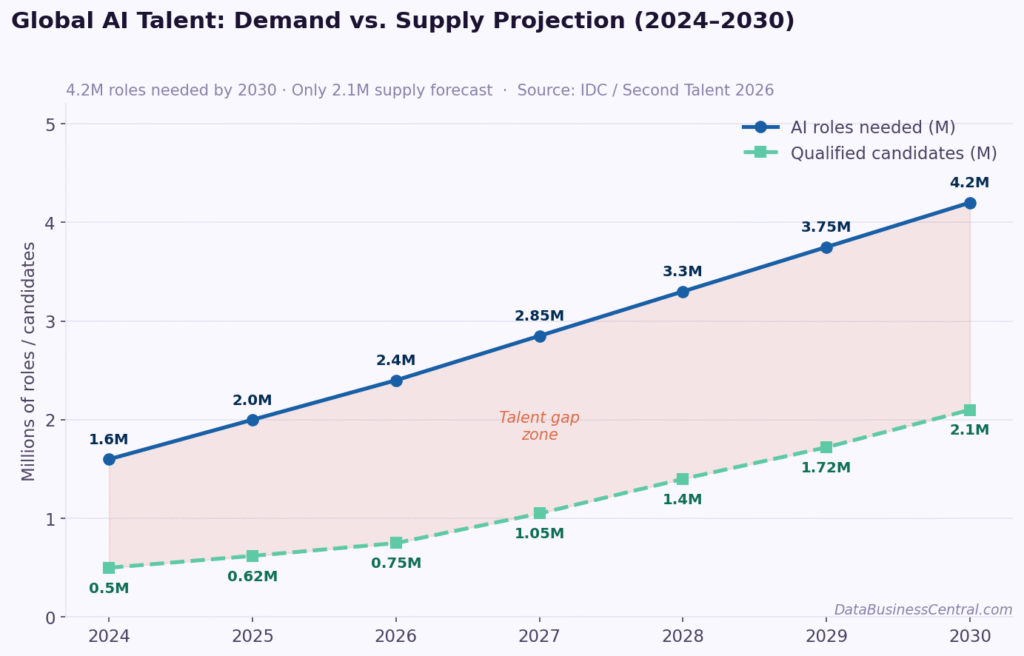
AI talent is expensive, scarce, and volatile in ways that standard HR planning frameworks are not designed to handle. AI roles command a 67% salary premium over traditional software positions, with 38% year-over-year salary growth across all experience levels. The average time-to-fill for senior AI roles in financial services and healthcare has stretched to 6–7 months — during which projects stall, priorities shift, and opportunity cost accumulates.
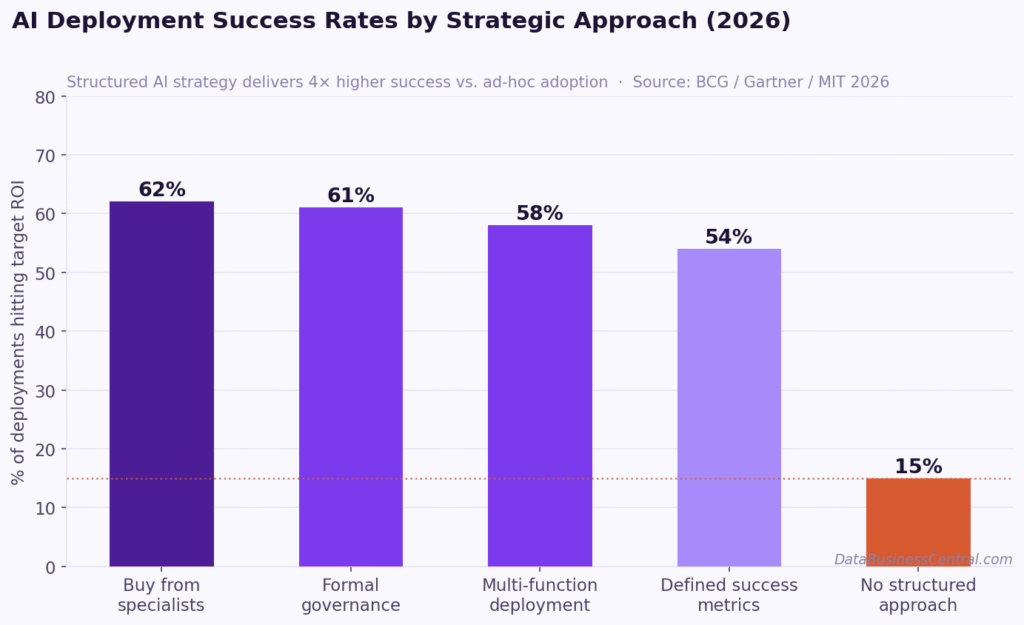
But the harder cost is the one that doesn’t show up in compensation benchmarks: the cost of getting talent strategy wrong. 45% of organizations still cite talent shortages as their top AI barrier, yet 75% of those organizations are attempting to build custom AI solutions internally — a strategy that fails three times out of four. The organizations buying from specialized vendors succeed at double the rate of those building internally, yet the “build” instinct persists because the true cost of build failure is never properly attributed to the talent decision that caused it.
2.3× Faster AI adoption
Organizations with structured internal AI training programs achieve 2.3× faster deployment vs. those relying on external hiring alone — at a fraction of the cost per capability unit (BCG 2026).
6–7 mo Average hiring lag
Time-to-fill for senior AI roles in financial services and healthcare. During that lag, projects go into stasis and competing priorities absorb the roadmap slot — a cost that never appears on any invoice.
95% GenAI pilot failure rate
MIT’s GenAI Divide report found a 95% failure rate for enterprise generative AI projects defined as not showing measurable financial returns within 6 months — almost always traceable to talent or readiness gaps, not model capability.
57% Unrealistic expectations
57% of organizations that experienced AI failure attributed it to expecting too much, too fast (Gartner April 2026). Teams assumed AI would immediately automate complex tasks without the data foundation to support it.
4. The governance deficit — and its price tag
Governance is where the most sophisticated organizations separate themselves — and where the largest hidden costs accumulate for everyone else. The average data breach reached $4.44 million in 2026, with nearly a third tied to lost business costs. Remediation costs for governance failures average 15–25 times the investment required for proper governance implementation at the start.
Only 52% of enterprises have formal generative AI governance policies, while 31% are still developing them. That leaves a substantial number operating AI systems without the frameworks that determine whether those systems are compliant, accountable, auditable, or safe. The costs that result are not hypothetical — they are appearing in litigation, regulatory investigations, and reputational damage with increasing regularity in 2026.
The governance math most organizations are not doing
Proper governance implementation at the start of an AI program costs 4–8% of total project budget. Retroactive remediation after a governance failure costs 15–25× that. The organizations treating governance as bureaucratic overhead are making a financial decision — they are simply making it with bad math.
The EU AI Act and regulatory cost reality
For organizations operating in or selling into the European market, the EU AI Act has moved from a future concern to a present compliance cost. High-risk AI systems — covering categories from credit scoring to employment screening — require conformity assessments, technical documentation, human oversight mechanisms, and ongoing monitoring. Estimates for first-year compliance costs for a mid-sized enterprise deploying high-risk AI systems range from $250K to $1.5M, with ongoing annual costs of $150K–$800K depending on deployment scope. These numbers are absent from the vast majority of AI business cases written before 2025.
5. Shadow AI: the cost hiding in plain sight
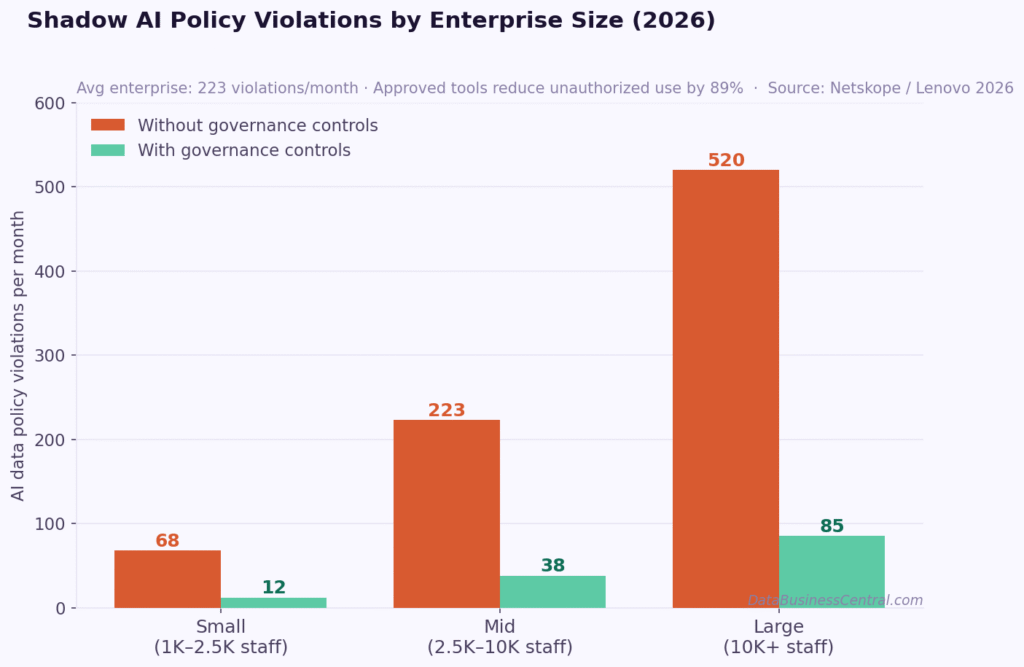
Perhaps the most structurally underestimated cost in enterprise AI is not the system that was approved — it is the 70% of AI usage happening without IT oversight. Lenovo’s 2026 Work Reborn Report found that more than 70% of employees use AI weekly, with up to one-third operating beyond IT oversight. Nearly 47% of generative AI users access tools through personal accounts, bypassing enterprise controls entirely.
The financial consequence is direct and measurable. Shadow AI added an average of $670,000 to breach costs in incidents where unauthorized AI usage was implicated. 20% of organizations reported breaches specifically caused by shadow AI. The average enterprise experiences 223 data policy violations per month related to AI usage — and only 37% have detection or governance policies in place to catch them.
The one intervention that works When enterprises provide approved, enterprise-grade AI alternatives, unauthorized AI tool usage drops by 89%. The shadow AI problem is not a discipline problem — it is a supply problem. Employees who have good approved tools stop looking for workarounds.
6. What smart organizations do differently
The data on this is consistent across BCG, McKinsey, and Gartner: the 5% of organizations achieving significant AI ROI share a small number of structural practices that the majority do not. None of them are exotic. All of them require deliberate organizational decisions.
They treat AI cost as a distinct FinOps domain
AI cost patterns are structurally different from conventional cloud costs — unpredictable token consumption, GPU spot pricing, model versioning complexity, and continuous retraining requirements don’t fit standard IT budget templates. Leading organizations have created dedicated AI FinOps functions with AI-specific forecasting models, real-time cost telemetry, and cross-functional governance that connects finance, engineering, and business ownership in a single accountability structure.
They define success before the first line of code
73% of failed AI projects had no agreed definition of success before starting. Projects with quantified success metrics defined upfront achieve a 54% success rate — versus 12% for those without. The organizations winning on AI ROI in 2026 treat the definition of “done” as a pre-condition of approval, not an afterthought of delivery.
They buy before they build
Organizations buying AI from specialized vendors succeed at double the rate of those building internally. Yet the default posture for enterprise technology teams is still to build. The calculation changes when the true cost of custom development — including the talent cost, the failure probability, and the opportunity cost of IT bandwidth — is honestly modeled against the vendor alternative.
They deploy across functions, not in pilots
The $3.70 return per $1 invested in AI is not evenly distributed — it concentrates in the organizations deploying across multiple business functions simultaneously, not the ones running isolated experiments. The pilot-to-scale failure rate is partially a governance and change management problem, but it is also a strategic one: organizations that treat AI as an experiment will get experimental returns.
7. Building a true AI cost model
The organizations that get AI economics right start with a cost model that looks nothing like a traditional IT project budget. A genuine AI cost model accounts for five layers that most projects ignore until they become problems.
| Cost layer | What it includes | Typical % of total |
|---|---|---|
| Layer 1: Direct compute | GPU/TPU costs, cloud inference, API fees, storage | 25–35% |
| Layer 2: Data foundation | Data quality remediation, pipeline engineering, labeling, lineage tooling | 20–30% |
| Layer 3: Talent & change | Hiring, upskilling, change management, organizational redesign | 20–28% |
| Layer 4: Governance & compliance | Observability, audit infrastructure, regulatory compliance, AI risk tooling | 10–20% |
| Layer 5: Integration & legacy | Legacy system remediation, API integration, security hardening | 10–20% |
Most enterprise AI business cases budget heavily for Layer 1 and assume Layers 2–5 are either negligible or someone else’s problem. They are neither. The organizations closing that gap — by modeling all five layers before committing to a deployment — are the ones generating the returns the headline statistics suggest are possible but the detailed data shows are rare.
The bottom line
The real cost of AI adoption in 2026 is not the amount on the vendor invoice. It is the sum of the infrastructure bets made on outdated cost curves, the talent decisions made without understanding the market, the governance gaps that accumulate silently until a breach or a regulatory finding makes them visible, and the shadow AI risk embedded in every employee who found a workaround to a tool they needed. The organizations building durable AI advantages are not spending less — they are spending with far greater accuracy, and holding themselves to outcomes that justify every layer of that investment. The math is available to everyone. The discipline to do it is what separates the 5% from the rest.
