The org chart is changing — quietly, irreversibly, and faster than most executive teams anticipated.
In 2026, enterprise AI agents are no longer a pilot project or a proof of concept. They’re showing up in headcount conversations, budget reallocations, and workforce planning documents. The question that was once theoretical — can AI agents replace human employees? — has become operational. And the data arriving from early enterprise deployments is more nuanced, more surprising, and more strategically important than either the AI optimists or the skeptics predicted.
This is not a piece about whether AI will take your job. It’s about what the 2026 enterprise data actually shows — where AI agents outperform, where humans remain irreplaceable, and what the smartest organizations are doing at the intersection of both.
Setting the Stage: What We Mean by AI Agents in 2026
The term “AI agent” covers significant ground. For the purposes of enterprise ROI analysis, we’re focused on autonomous AI systems capable of:
- Perceiving inputs across multiple data sources simultaneously
- Reasoning through multi-step goals without explicit instruction for each action
- Using tools — APIs, databases, communication platforms, code execution environments — independently
- Adapting strategies based on intermediate outcomes
- Operating continuously, in parallel, across organizational functions
This is meaningfully different from the AI of 2022 or 2023. Today’s enterprise AI agents don’t just generate text. They execute workflows, make decisions within defined parameters, coordinate across systems, and produce measurable business outputs. They are, in the most practical sense, a new category of organizational resource — and that’s why the workforce comparison has moved from philosophy to finance.
The Productivity Numbers: Where AI Agents Are Winning
Let’s start with what the deployment data is showing.
Speed and Volume: No Contest
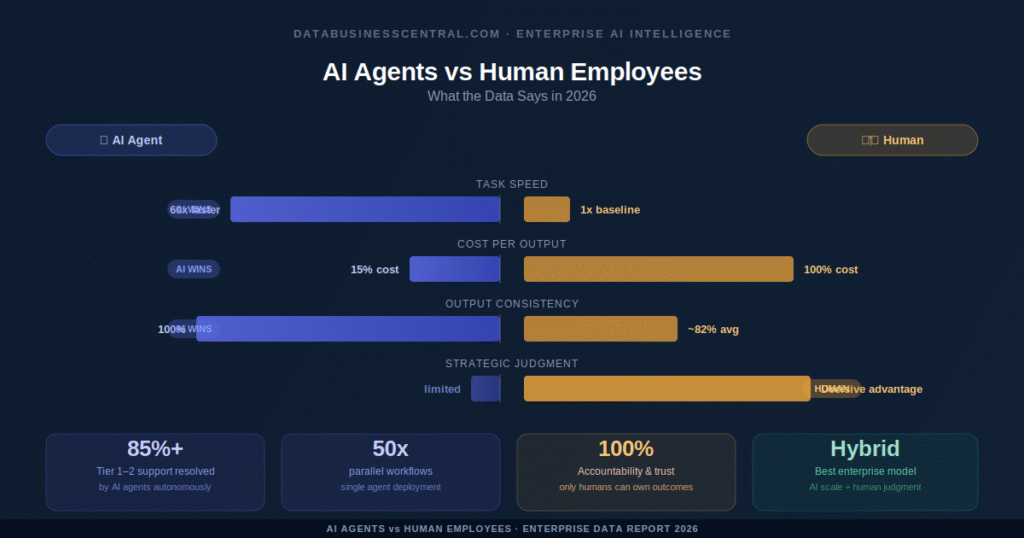
In structured, high-volume cognitive workflows, AI agents are lapping human employees by margins that were unimaginable three years ago. Enterprise deployments in financial services, insurance, and data operations are reporting AI agents completing document processing tasks 40–60x faster than human equivalents. In legal due diligence workflows, AI agents are reviewing and summarizing thousands of contracts in the time a human associate team takes to review dozens.
For customer support operations, AI agents trained on enterprise knowledge bases are resolving Tier 1 and Tier 2 inquiries — which historically represented 65–75% of total support volume — with resolution rates exceeding 85%, at zero marginal cost per additional ticket.
The volume story is equally dramatic. An AI agent doesn’t have a daily throughput ceiling. It doesn’t have queue anxiety or cognitive fatigue. A single enterprise AI agent deployment in a data analytics function can run the equivalent of 50 parallel analyst workflows simultaneously — not faster than a human, but at a scale that makes the human-vs-AI comparison almost categorical rather than marginal.
Cost Per Output: The CFO’s Perspective
The cost comparison is where enterprise AI conversations move fastest. When you strip away infrastructure costs, licensing, and governance overhead — and look purely at cost per unit of output — AI agents in mature deployments are running at 10–25% of the fully-loaded cost of human equivalents for the specific task categories they handle well.
For CFOs modeling AI workforce strategy, that math is impossible to ignore. But the sophisticated enterprise finance teams are quick to add two caveats: the task categories AI agents handle well are still bounded, and the upfront investment in AI infrastructure, integration, and governance is substantial. The ROI curve is real — but it isn’t immediate, and it isn’t universal.
Consistency and Compliance: A Human Liability Story
One of the most compelling enterprise AI agent arguments isn’t about speed or cost — it’s about consistency. Human employees introduce natural variance: a tired analyst produces different work on Monday morning than Thursday afternoon; a customer service rep has good days and bad days; a compliance reviewer might catch 92% of issues on average but miss the 8% that carry the most regulatory risk.
AI agents, within their domain of competence, produce consistent outputs at consistent quality — every time, without drift. For regulated industries where compliance consistency is existential, this isn’t a productivity argument. It’s a risk management argument, and it’s one of the strongest cases for AI agents in enterprise settings
Where Humans Still Win — and by How Much
If the data above made you think AI agents are simply better employees, the second half of the dataset recalibrates that view significantly.
Judgment Under Genuine Ambiguity
AI agents excel at well-defined problems. They struggle — sometimes catastrophically — with problems that require genuine contextual judgment in novel situations. The enterprise data is clear: when AI agents encounter scenarios that fall outside their training distribution or encounter genuinely ambiguous ethical tradeoffs, their failure modes are more unpredictable than human failure modes.
A senior enterprise sales leader navigating a deteriorating strategic account relationship isn’t executing a workflow. She’s reading body language, detecting organizational politics, processing relationship history, and making real-time intuitive judgments that no current AI agent can replicate reliably. The high-stakes relationship work that defines enterprise revenue remains stubbornly human.
Creative Problem Framing
There is a critical distinction between solving a well-framed problem and framing the problem correctly in the first place. AI agents are increasingly powerful at the former. They remain weak at the latter.
The best enterprise strategists, product leaders, and innovators spend most of their cognitive energy not executing known solutions but questioning whether they’re solving the right problem at all. This meta-cognitive capability — stepping back from the workflow to interrogate whether the workflow itself makes sense — is where human judgment currently has no AI equivalent.
Stakeholder Trust and Accountability
In 2026, one of the most underrated advantages human employees hold over AI agents is simple: humans can be held accountable in ways that create organizational trust.
When a major client calls to discuss a sensitive situation, they want a human who owns the relationship and the outcome. When a board asks why a critical decision was made, they want a human who can explain their reasoning, take responsibility, and be trusted with future decisions. AI agents produce outputs; humans produce accountability. For an enormous range of enterprise functions — leadership, client relationships, institutional reputation management — accountability is the product.
Emotional Intelligence and Organizational Culture
Enterprise organizations are not just information-processing machines. They are communities of humans with values, emotions, relationships, and cultural norms. Managing those dynamics — mentoring a struggling team member, navigating a sensitive HR situation, rallying a demoralized team, reading the room in a high-stakes negotiation — requires emotional intelligence that current AI agents simply do not possess.
The data from enterprises that have moved fastest on AI agent deployment is consistent on this point: the organizations that retained strong human culture and relationship management functions alongside their AI deployments outperformed those that treated all functions as equally automatable.
The 2026 Enterprise Reality: Hybrid Workforce Architecture
The most important finding from the 2026 enterprise AI deployment data isn’t about AI agents winning or humans winning. It’s about a new organizational architecture emerging — one that most workforce planning frameworks weren’t designed to handle.
Leading enterprises are converging on what organizational researchers are calling the “tiered intelligence model” — a deliberate division of cognitive labor between AI agents and human employees based not on job titles or departments, but on the nature of the cognitive work itself.
AI agents own: high-volume structured workflows, data synthesis and pattern recognition at scale, compliance monitoring, first-pass analysis, customer interaction at tier 1-2, continuous process monitoring, reporting automation, and research aggregation.
Humans own: strategic judgment under ambiguity, stakeholder relationship management, creative problem framing, organizational culture, accountability and governance, ethical oversight of AI systems, and innovation leadership.
The critical overlap zone: complex decision-making where AI agents generate options and analysis, and humans apply contextual judgment to make the final call. This is the human-in-the-loop model at its most mature — and it’s where the highest-performing enterprise functions are concentrating their design energy.
The enterprises seeing the strongest AI workforce ROI in 2026 are not those that automated the most. They’re those that redesigned work from the ground up around what AI agents do effortlessly and what humans do uniquely — and built seamless handoff points between the two.
What the Data Says About Job Displacement
The workforce displacement question deserves honest treatment, because the data is both reassuring and sobering depending on which lens you apply.
At the task level, AI agents are displacing human work at significant scale. The data is unambiguous: roles that consist primarily of structured information processing — data entry, first-pass document review, standard report generation, Tier 1 customer support, basic research aggregation — are seeing 40–70% of task volume shift to AI agents in organizations that have deployed them at scale.
At the role level, the picture is more complex. Many of those displaced tasks were embedded in jobs that also contained higher-judgment work that AI cannot yet handle. The result, in most enterprise deployments studied, has been role transformation rather than wholesale elimination — at least in the near term. The analyst who spent 60% of her time pulling and cleaning data now spends that time interpreting and strategizing. The customer service team that handled tier 1 inquiries now focuses entirely on complex escalations and relationship recovery.
At the workforce level, the honest answer is that we’re in the early innings of a structural labor market transition that will take a decade to fully manifest. The enterprises navigating this most responsibly are investing in reskilling infrastructure alongside AI deployment — treating the human workforce development budget as inseparable from the AI deployment budget.
The Strategic Imperative: Building for Both
The data from 2026 enterprise AI deployments sends a clear strategic message: the competitive advantage doesn’t belong to the companies that deploy the most AI agents or retain the most human employees. It belongs to the companies that architect the most effective collaboration between the two.
This requires abandoning the replacement mindset entirely. AI agents are not cheaper humans. They are a fundamentally different kind of organizational resource — with different strengths, different failure modes, different cost structures, and different roles in the enterprise intelligence stack.
The organizations winning in 2026 are asking a different question than “should we hire AI agents instead of humans?” They’re asking: “What new things become possible when we combine AI agent scale and consistency with human judgment and accountability?”
The answer to that question — not the displacement debate — is where the real enterprise value lives.
Key Data Points to Take Into Your Next Strategy Session
- AI agents complete structured document processing tasks 40–60x faster than human equivalents in mature deployments
- Cost per output for well-scoped AI agent tasks runs at 10–25% of fully-loaded human equivalent costs
- AI agents resolve 85%+ of Tier 1–2 customer support volume in enterprise deployments with mature knowledge bases
- Consistency advantage: AI agents eliminate the natural human performance variance that creates compliance and quality risk
- Human judgment advantage remains decisive in: strategic ambiguity, creative problem framing, stakeholder trust, and emotional intelligence
- The highest-performing 2026 enterprise deployments use a tiered intelligence model — not AI-only or human-only
- Role transformation is outpacing role elimination in current deployments; the full structural labor impact will unfold over 5–10 years
- Organizations investing in reskilling infrastructure alongside AI deployment are seeing stronger workforce retention and higher AI ROI
The Bottom Line
The 2026 data doesn’t validate the AI maximalists who said human employees would be obsolete by now, nor the AI skeptics who dismissed enterprise AI agents as overhyped demos. It validates something more interesting and more actionable: a new kind of enterprise is emerging, built on the complementary strengths of AI agent scale and human intelligence.
The organizations that understand this — and design their workforce architecture around it — will not just survive the AI transition. They’ll define what comes next.
Data Business Central delivers enterprise AI strategy, workforce intelligence, and data-driven transformation insights for technology and operations leaders. Subscribe for weekly analysis on enterprise AI deployment, ROI benchmarking, and the future of intelligent work.
Tags: AI agents, AI workforce, AI employees, enterprise AI, AI vs human workers, future of work 2026, intelligent automation, human-in-the-loop, AI workforce strategy, AI productivity data, enterprise AI ROI, agentic AI deployment, AI job displacement, workforce transformation, hybrid AI workforce, tiered intelligence model, AI compliance, AI cost analysis, reskilling AI workforce, autonomous AI enterprise
Related blogs:

2 thoughts on “AI Agents vs Human Employees: What the Data Says in 2026”
Pingback: AI Agents in Business: 25 Use Cases in 2026
Pingback: Data Teams Need an AI Provenance Apprenticeship