There’s a moment every enterprise hits — usually somewhere between the pilot phase and the boardroom presentation — where someone asks the question no one fully prepared for: “What happens when the AI gets it wrong?”
Not “if.” When.
Large Language Models are not infallible oracles. They hallucinate facts, inherit biases from training data, produce outputs that can contradict company policy, and occasionally generate content that lands squarely in legal gray zones. For a startup running a chatbot on their blog, these are inconveniences. For a Fortune 500 enterprise processing thousands of customer interactions daily, they’re existential risks.
And yet, the race to deploy is relentless. The competitive pressure to ship AI features, automate workflows, and “move fast” has organizations plugging LLMs into production pipelines before the ink is dry on their acceptable-use policies — let alone a proper governance framework.
This is the governance gap. And it’s wider than most enterprises realize.
What Is an AI Governance Framework, Really?
Strip away the buzzwords and an AI governance framework is simply the architecture of accountability around how your organization uses AI. It defines who decides what, who’s responsible when things go sideways, and what guardrails exist to prevent the system from drifting outside acceptable boundaries.
Think of it less as a rulebook and more as an operating system for AI decision-making. It sits beneath your individual use cases — the customer support bot, the contract summarizer, the sales forecasting engine — and provides the shared infrastructure of policies, oversight mechanisms, and risk management practices that make all of them sustainable at scale.
A mature framework typically spans four interconnected layers:
Governance Structure — Who owns AI decisions? Is there an AI ethics board? A Chief AI Officer? Clear escalation paths when a model’s behavior is flagged?
Risk Classification — Not all AI use cases carry equal risk. A generative tool helping HR draft internal communications carries different stakes than an LLM recommending credit decisions. Your framework needs a taxonomy for this.
Operational Controls — The technical and procedural guardrails: prompt filtering, output logging, human-in-the-loop requirements, and model versioning policies.
Audit and Accountability Mechanisms — How do you know what your LLM actually did last Tuesday? Traceability, documentation, and review cycles aren’t bureaucratic overhead — they’re your evidence trail.
The Compliance Landscape Has Already Changed
Here’s what enterprises tend to underestimate: AI governance is no longer optional by virtue of good intentions. The regulatory environment is hardening, and fast.
The EU AI Act, now in force, classifies AI systems by risk level and places mandatory obligations on high-risk deployments — including documentation requirements, human oversight mandates, and conformity assessments. Organizations operating in European markets, or serving European customers, are already on the clock.
In the United States, sector-specific regulators are moving independently. The EEOC has signaled scrutiny of AI used in hiring. The CFPB has put financial services firms on notice regarding algorithmic decision-making. The FDA is actively shaping guidance for AI in healthcare applications. This isn’t a future concern — enforcement conversations are happening now.
Meanwhile, enterprise customers themselves are raising the bar. Procurement teams increasingly request AI risk assessments as part of vendor due diligence. Institutional investors are folding AI governance practices into ESG evaluations. If you can’t answer basic questions about how you oversee your models, you’re already behind in conversations that matter.
The compliance case for governance, in short, is no longer philosophical. It’s practical and immediate.
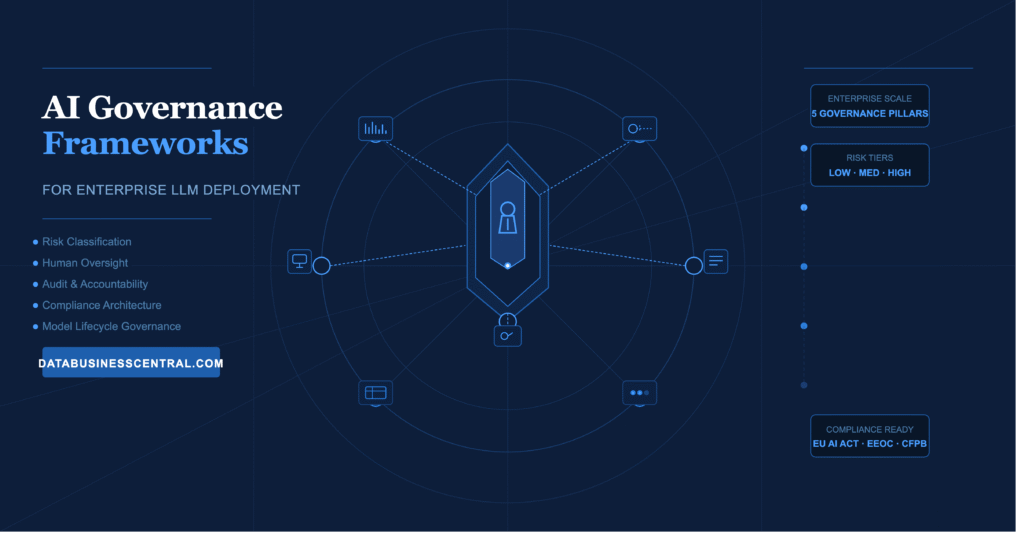
The Five Pillars of an Enterprise AI Governance Framework
1. Model Inventory and Risk Classification
Before you can govern something, you need to know what you have. Most enterprises deploying LLMs are running more models than they think — embedded in SaaS tools, standing up in departmental pilots, integrated through third-party APIs. Step one is building a living inventory.
For each model or AI-enabled system, document its purpose, its data inputs, the decisions it influences, and who the end users are. From there, assign a risk tier. A common and workable approach uses three levels:
- Low risk: Internal productivity tools, first-draft generation, summarization with human review
- Medium risk: Customer-facing applications, content moderation, decision-support tools
- High risk: Anything affecting credit, employment, healthcare, legal rights, or public safety
Risk tier determines the depth of controls applied. Not everything needs the same level of scrutiny — but everything needs some level of it.
2. Data Governance and Privacy Architecture
LLMs are only as trustworthy as the data flowing through them. Governance frameworks must address two distinct data problems: what goes into the model, and what comes out of it.
On the input side, this means enforcing data minimization principles — ensuring that sensitive personal data, confidential business information, and protected categories aren’t being fed into model prompts unnecessarily. It also means understanding your third-party model providers’ data retention policies. When you send a query to a commercially hosted LLM, where does that data live? For how long? Is it used for training?
On the output side, the challenge is different. LLMs can surface information that wasn’t intended to be surfaced — reconstructing training data, exposing patterns that approximate personal information, or generating outputs that constitute regulated communications under securities, healthcare, or financial services law. Output review protocols and content filters are governance tools, not just quality controls.
3. Human Oversight Architecture
The question of when a human must be in the loop is one of the most consequential design decisions in enterprise AI deployment — and it’s frequently answered by default rather than intention.
A governance framework should define, explicitly, which decisions an LLM can make autonomously, which require human review before action, and which require human initiation with AI support only. This isn’t a binary. It’s a spectrum, and different use cases land at different points.
Critically, “human in the loop” has to mean something. A rubber-stamp review that takes thirty seconds and never results in a rejected AI recommendation isn’t oversight — it’s liability theater. Effective oversight requires reviewers who have meaningful authority to intervene, sufficient information to evaluate AI outputs critically, and accountability for the decisions they approve.
Build this into workflow design from the start, not as an afterthought when something goes wrong.
4. Transparency and Explainability Standards
Enterprise users of AI outputs — whether they’re loan officers, physicians, HR professionals, or procurement managers — have a legitimate interest in understanding the basis for recommendations they’re asked to act on. So do the individuals those decisions affect.
Your framework should define explainability requirements by use case. For internal productivity tools, a light touch may be appropriate. For consequential decisions affecting individuals, being able to articulate why a system produced a particular output — at least at a process level — is both an ethical obligation and an increasingly legal one.
Practically, this shapes which models you choose (fine-tuned, purpose-built models often offer more interpretability than general-purpose ones), how you structure prompts, and what documentation you maintain around model behavior and known limitations.
5. Continuous Monitoring and Model Lifecycle Management
Deploying a model is not the finish line. Models drift. The world changes. Data distributions shift. A customer service LLM trained on 2022 interactions will behave differently against 2025 queries — and not always in ways that surface immediately.
Your governance framework needs a monitoring layer that tracks output quality, flags anomalies, and triggers review cycles. It also needs a model lifecycle policy: how long a model version is supported, what triggers a retraining, how changes are tested and promoted, and how prior decisions made by deprecated model versions are handled if they become subject to audit or dispute.
This is the operational discipline piece that separates organizations that govern AI responsibly from those that simply installed it.
Building the Governance Muscle: Organizational Design
Frameworks don’t run themselves. Governance requires people, roles, and decision-making authority.
Most mature enterprises establishing AI governance create some combination of:
An AI Oversight Body — A cross-functional committee with representation from Legal, Compliance, IT, Business Units, and ideally an independent voice (external advisor or ethics board member). This group sets policy, reviews high-risk deployments, and handles escalations.
AI Risk Owners — Business unit leaders who own accountability for AI deployments within their domains. Governance can’t live entirely in a central team. The people closest to the use case need to own the risk.
Technical Governance Leads — Engineers or AI/ML specialists responsible for translating policy requirements into technical controls: prompt engineering standards, logging architecture, model evaluation protocols.
An AI Incident Response Process — When an LLM does something unexpected, harmful, or non-compliant, you need a defined response path. Who gets notified? What’s the escalation sequence? When does a model get taken offline pending review? Document this before you need it.
What “Good” Actually Looks Like
For enterprises earlier in their governance journey, the distance between current state and “mature framework” can feel paralyzing. It doesn’t need to be. The goal isn’t perfection — it’s defensibility.
A defensible governance posture means you can demonstrate:
- You knew what AI systems you were running and why
- You assessed the risks proportionate to the use case
- You had controls in place commensurate with those risks
- You monitored performance and responded when things deviated
- You documented your decisions and can reconstruct your reasoning
That’s not an abstract ideal. It’s the standard regulators, auditors, customers, and boards are increasingly applying when they look under the hood.
The Real Competitive Advantage
Here’s the perspective shift that separates enterprises winning with AI from those managing AI-shaped crises: governance isn’t the brake on AI deployment. It’s the accelerant.
Organizations that build governance infrastructure early move faster in the long run, because they’re not stopping to untangle every new use case from scratch. They have frameworks that can be applied. They have risk vocabulary that lets business and technical teams communicate efficiently. They have audit trails that shorten due diligence cycles with partners and regulators.
The enterprises dragging their feet on governance today will be the ones pausing deployments, pulling products, and explaining incidents to boards twelve months from now. The ones investing in the infrastructure now will be the ones scaling confidently — because they’ve built the foundation that makes speed responsible.
The question was never whether your enterprise can afford to govern AI. It’s whether you can afford not to.
key words:
enterprise AI compliance , LLM risk management ,AI deployment , AI governance policy
