Two technologies are competing for the same line item in your AI budget. Both promise transformation. Both carry impressive demos. But they operate on fundamentally different assumptions about how AI creates value — and choosing the wrong one for your enterprise context can cost you millions in opportunity cost, rework, and stalled adoption.
AI agents vs AI copilots is the defining architectural debate of 2026. And the answer to which delivers better enterprise ROI is more nuanced — and more consequential — than most decision-makers realize.
Let’s cut through the hype and get to the numbers.
Defining the Battlefield
Before ROI can be calculated, the terms must be precise.
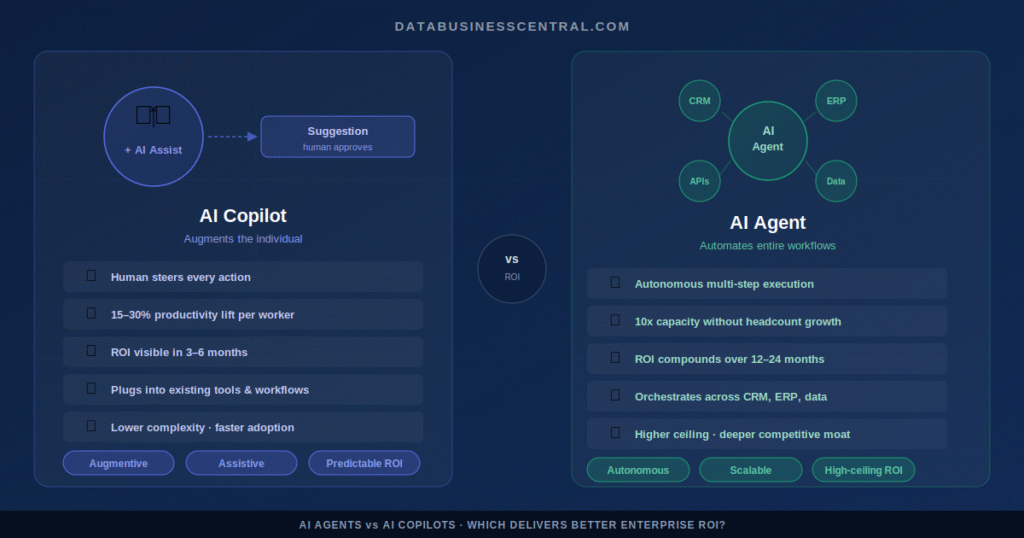
AI copilots are human-assistive AI systems designed to augment individual productivity. They sit alongside a user, interpret context, and generate suggestions, drafts, analysis, or recommendations — but the human remains in control of every action taken. Microsoft Copilot in Word, GitHub Copilot in VS Code, Salesforce Einstein Copilot in CRM workflows — these are canonical examples. The human steers; the AI accelerates.
AI agents are autonomous AI systems designed to independently pursue goals through multi-step reasoning, tool use, and self-directed action. They don’t wait to be prompted. They plan, execute, monitor outcomes, and adapt — often across multiple systems, APIs, and data sources simultaneously. An AI agent tasked with “reduce customer churn in the enterprise accounts segment by Q3” will autonomously analyze CRM data, identify at-risk accounts, draft and execute outreach sequences, monitor response rates, and escalate anomalies — without step-by-step human instruction.
The distinction is not subtle. One enhances human effort. The other replaces it — selectively, deliberately, and at scale.
The ROI Framework: What Are You Actually Measuring?
Enterprise ROI for AI investments typically breaks down across five value dimensions:
Productivity Gains — time saved per knowledge worker per day Error Reduction — cost of rework, compliance violations, and manual mistakes avoided Speed to Insight — compression of decision cycles from weeks to hours Scalability Premium — value created by doing more without proportional headcount growth Competitive Differentiation — market position advantages from faster execution and superior intelligence
AI copilots and AI agents each attack these dimensions differently — and at different magnitudes.
Where AI Copilots Win: Individual Productivity at Scale
AI copilots deliver the most predictable, measurable, and immediately realizable ROI in the enterprise landscape. The value equation is straightforward: give every knowledge worker an AI-powered accelerant, and watch aggregate output multiply.
The data is compelling. Studies from early Microsoft 365 Copilot deployments showed knowledge workers completing drafting tasks up to 29% faster, summarizing meetings in real time, and reducing email processing time by as much as a third. For enterprises with thousands of knowledge workers, even a 15–20% productivity uplift translates into tens of millions of dollars in recovered capacity annually.
But the real value of AI copilots isn’t just speed — it’s quality democratization. A mid-level analyst with an AI copilot can now produce executive-grade data narratives. A junior developer with GitHub Copilot ships production-quality code at the pace of a senior engineer. A customer success manager with an AI-assisted CRM can manage twice the account load without sacrificing relationship depth.
This is enterprise-wide capability leveling — and it has profound implications for talent strategy, hiring economics, and organizational design.
Where AI copilots deliver strongest ROI:
Content-heavy roles — legal, marketing, finance, HR — where AI-assisted drafting compresses high-effort tasks from hours to minutes. Software development teams where code completion, test generation, and documentation assistance directly accelerate release velocity. Sales organizations where AI copilots generate personalized outreach, prepare for customer calls, and surface next-best-action recommendations within existing CRM workflows.
The deployment friction is also lower. Copilots plug into existing tools. Adoption curves are gentle. Change management is manageable. For enterprises looking for fast, broadly distributed, measurable ROI within a 6–12 month window, AI copilot deployments are a strong play.
Where AI Agents Win: Autonomous Value Creation at Depth
If AI copilots multiply what individuals can do, AI agents multiply what the organization can do — including things it previously couldn’t do at all, not for lack of talent, but for lack of capacity.
Consider the economics of enterprise data operations. A world-class data analytics team might take 2–3 weeks to complete a comprehensive competitive intelligence report: scoping the request, pulling data from multiple sources, cleaning and reconciling discrepancies, building visualizations, and drafting the narrative. An AI agent completes a comparable workflow in 90 minutes — and can run 50 parallel instances simultaneously.
The ROI math changes fundamentally when you can replace weeks of analyst time with hours of compute, run processes in parallel that previously ran sequentially, and extend operating hours to 24/7/365 without overtime or burnout.
The multiplier effect of agentic AI ROI comes from three sources:
Elimination of cognitive bottlenecks. Many high-value enterprise workflows are bottlenecked not by process inefficiency but by scarce expert attention. AI agents can autonomously handle the majority of the cognitive load, freeing senior talent for the judgment-intensive work that actually requires their expertise.
Cross-system orchestration. AI agents can simultaneously access and coordinate across CRM, ERP, data warehouse, marketing automation, support ticketing, and external data sources — something no human (and no copilot) can do at the same scale and speed. This multi-system intelligence unlocks insights and actions that are structurally impossible with human-in-the-loop approaches.
Compound improvement over time. Unlike copilots, which deliver consistent value per session but don’t inherently improve, well-designed AI agent systems learn from outcomes, refine their strategies, and compound value over deployment horizons. The ROI of an AI agent in Month 12 is materially higher than Month 1 — not because you added more users, but because the system itself got smarter.
Where AI agents deliver strongest ROI:
Supply chain risk monitoring and autonomous response. Financial services compliance surveillance and reporting. Enterprise sales prospecting, nurturing, and pipeline management at scale. IT operations including autonomous incident detection, triage, and resolution. Customer intelligence workflows requiring synthesis across structured and unstructured data sources at volume.
The Head-to-Head: ROI Comparison by Enterprise Function
| Function | AI Copilot ROI Driver | AI Agent ROI Driver |
|---|---|---|
| Finance | Faster report drafting, meeting summaries | Autonomous reconciliation, anomaly detection |
| Sales | Call prep, personalized outreach drafts | End-to-end pipeline management, lead scoring |
| Engineering | Code completion, documentation | Autonomous testing, incident response, CI/CD |
| Legal | Contract review acceleration | Compliance monitoring, regulatory change tracking |
| Data & Analytics | Faster query building, dashboard narratives | Autonomous research, cross-system data synthesis |
| HR | Job description drafting, candidate summaries | Talent pipeline monitoring, onboarding automation |
| Customer Success | Call summaries, next-step recommendations | Churn prediction, proactive intervention workflows |
The pattern is clear: copilots optimize existing human workflows; agents create new workflows that humans couldn’t sustain at all.
The Hidden Costs That Skew the ROI Calculation
Raw productivity gains tell only half the story. True enterprise ROI requires accounting for deployment costs, risk exposure, and organizational change burden.
AI copilot hidden costs: Seat-based licensing at enterprise scale adds up fast. Microsoft 365 Copilot pricing runs at premium tiers, and without structured adoption programs, utilization rates often disappoint — enterprises frequently pay for seats that see minimal use. Change management investment is also underestimated: training, workflow redesign, and culture shifts are real costs that must be modeled against productivity gains.
AI agent hidden costs: Agentic AI deployments carry higher upfront complexity. Integration architecture, data governance frameworks, security permissioning, and audit trail infrastructure all require investment before value is realized. The failure mode risk is also asymmetric — a copilot error affects one person; an agent error can propagate across thousands of records or trigger cascading downstream actions. Robust guardrails, monitoring systems, and human-in-the-loop checkpoints are not optional — they are the cost of responsible deployment.
Both cost profiles are manageable. Neither is prohibitive. But organizations that model only the top-line productivity gain and ignore deployment infrastructure costs routinely underperform their projected ROI.
The Strategic Answer: It’s Not Either/Or
Here is the insight that most AI ROI analysis misses: AI agents and AI copilots are not substitutes. They are complements operating at different layers of enterprise intelligence.
The highest-performing enterprises in 2026 are deploying both — deliberately, with architectural clarity about which problems each solves:
Copilots sit at the individual layer, accelerating human decision-makers and knowledge workers within their existing workflows. Agents sit at the process and systems layer, autonomously orchestrating complex workflows that span multiple systems, data sources, and organizational functions.
The mental model that works: think of AI copilots as power tools — they make skilled workers dramatically more effective. Think of AI agents as autonomous systems — they execute entire categories of work without requiring a skilled worker to initiate each step.
A financial services firm might deploy copilots for every analyst, investor relations professional, and risk officer — accelerating their daily work by 20–30%. Simultaneously, they deploy AI agents to autonomously monitor regulatory filings across 50 jurisdictions, flag compliance exposures, and generate preliminary responses — a workflow that previously required a team of 12 and still took two weeks to complete.
The combined ROI of this architecture is multiplicative, not additive.
Making the Investment Decision
For enterprise leaders structuring their AI ROI strategy, three questions cut through the noise:
What is your primary constraint — individual throughput or organizational capacity? If your best people are spending too much time on routine cognitive tasks, start with copilots. If entire categories of high-value work aren’t getting done because you don’t have the headcount, start with agents.
What is your risk tolerance and governance maturity? Copilots are lower-risk, faster to deploy, and easier to govern. Agents require more investment in oversight architecture but unlock proportionally larger returns. Match deployment complexity to your current AI governance capability — and build the governance capability in parallel with the ambition.
What is your time horizon? Copilots deliver measurable ROI in 3–6 months. Agents take 6–18 months to reach full ROI maturity, but the ceiling is substantially higher — and the competitive moat they create is harder to replicate.
The Bottom Line
The AI agents vs AI copilots debate is not about which technology is superior. It’s about which deployment architecture best fits your enterprise context, constraints, and strategic ambition.
Copilots deliver broad, fast, measurable ROI by making every knowledge worker more effective. Agents deliver deep, transformative ROI by automating entire categories of complex work at a scale and speed humans cannot match.
The enterprises that will define competitive advantage over the next five years aren’t choosing between them. They’re mastering both — and building the organizational capability to deploy each where it creates the most value.
The question isn’t which delivers better enterprise ROI. The question is: how quickly can you deploy both?
Key Takeaways
- AI copilots accelerate individual knowledge workers within existing workflows; AI agents autonomously orchestrate multi-step processes across systems
- Copilots deliver predictable 15–30% productivity gains broadly across the enterprise; agents deliver larger ROI in specific high-complexity, high-volume workflows
- True ROI calculation must include deployment costs, governance infrastructure, and change management — not just productivity gains
- The optimal enterprise architecture deploys both layers: copilots at the individual level, agents at the process and systems level
- Time horizon matters: copilots return value in months; agents compound value over 12–24 months but build a higher and more defensible ROI ceiling
Data Business Central covers enterprise AI strategy, ROI analytics, and data-driven transformation for technology leaders. Subscribe for weekly intelligence on AI deployment, business intelligence trends, and enterprise data strategy.
Tags: AI Agents vs AI Copilots, Enterprise AI ROI, Agentic AI, AI Productivity Tools, Microsoft Copilot, GitHub Copilot, Autonomous AI Agents, AI Business Value, Intelligent Automation, AI Decision Making, Knowledge Worker Productivity, AI Workflow Automation, Enterprise Digital Transformation, AI Strategy 2026, Human-in-the-Loop AI, AI Governance, Multi-Agent Systems, AI for Business, Copilot vs Agent, AI Cost Analysis
Related blogs

1 thought on “AI Agents vs AI Copilots: Which Delivers Better Enterprise ROI?”
Pingback: AI Agents vs Human Employees: 2026 Data