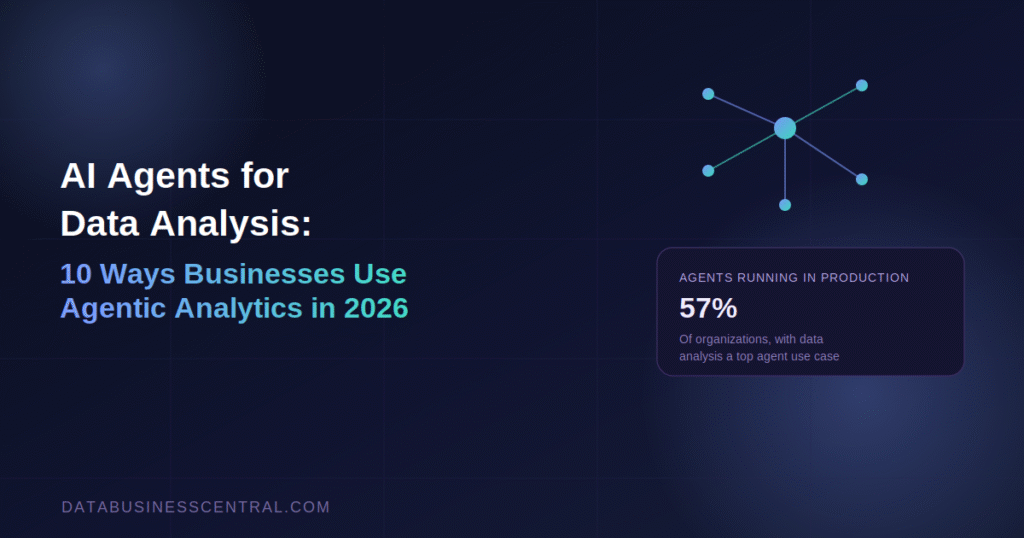
A dashboard waits to be asked a question. An AI agent doesn’t. That single difference is quietly reshaping how businesses use data in 2026, and the adoption numbers show it isn’t a niche experiment anymore. According to LangChain’s 2026 State of AI Agents survey of more than 1,300 professionals, research and data analysis is now the second most common agent use case overall, at 24.4% of deployments — and 57% of organizations report they’re already running agents in production, not just testing them in a sandbox.
Gartner’s forecasts point in the same direction. The firm predicts 40% of enterprise applications will include task-specific AI agents by the end of 2026, and by 2027, roughly half of all business decisions are expected to involve an AI agent somewhere in the process. AI agents for data analysis have moved from an experimental corner of the analytics world into one of its fastest-growing categories — and this piece breaks down exactly how businesses are actually putting them to work, not just what the technology promises in theory.
What Are AI Agents for Data Analysis, Exactly?
An AI agent for data analysis is autonomous software that continuously monitors business data, investigates problems on its own, and delivers finished insights — often with recommended actions — without waiting for someone to type a question first. Gartner’s 2026 Market Guide for Agentic Analytics defines the category formally as applying AI agents across the entire data-to-insight workflow, orchestrating tasks either semi-autonomously or fully autonomously toward a stated goal.
The distinction that matters most: traditional AI analytics tools are fundamentally reactive. A dashboard shows you what you ask it to show, and nothing more. An AI agent for data analysis is proactive — it doesn’t wait to be queried, it’s always watching, and when it finds something worth flagging, it decomposes the contributing factors and delivers a citation-backed explanation directly to the person who needs it.
The Four Ways Businesses Deploy AI Agents in Analytics
Before diving into specific use cases, it helps to understand the basic deployment patterns, since picking the wrong format for your situation is one of the most common mistakes businesses make with this technology.
Chat-based agents work as self-service tools — a business user types a plain-language question, and the agent pulls the relevant data, builds a chart, and explains what it found. Background agents run 24/7, silently monitoring KPIs a team has configured in advance without anyone needing to check in constantly. Single agents handle one specific, well-defined workflow — a fraud check, a churn score, an inventory alert. Multi-agent systems coordinate a small team of specialized agents, each handling a piece of a larger, end-to-end operation, with an orchestrator keeping them synchronized so they don’t duplicate work or contradict each other.
10 Ways Businesses Are Using Agentic Analytics in 2026
1. Self-Service Natural Language Querying
The most visible shift agentic AI data analysis has brought to business is putting query power directly in the hands of non-technical employees. A sales manager or operations lead can type “why did conversions drop in the Midwest last week” and get a real answer — chart, explanation, and root cause — without routing the request through an already-overloaded data team. This is the clearest example of chat-based agents at work, and it’s often the easiest entry point for organizations testing agentic analytics for the first time.
2. 24/7 KPI Monitoring and Anomaly Detection
Background agents configured to watch specific metrics — revenue, churn, inventory levels, conversion rates — catch problems the moment they emerge, rather than waiting for someone to notice a stale number in next week’s report. Instead of a human scanning a dashboard once a day, the agent scans continuously and only surfaces an alert when something actually deviates from the expected pattern. For finance and operations teams especially, this shift from periodic checking to continuous monitoring has become one of the most widely adopted agentic analytics use cases.
3. Autonomous Root Cause Investigation
This is where agentic analytics genuinely separates itself from a smarter dashboard. Rather than simply flagging that revenue dropped, the best platforms decompose the contributing factors automatically — which product line, which region, which customer segment drove the change — and deliver that breakdown with source citations attached. Industry analysis of leading platforms in this space consistently identifies autonomous root cause investigation as the single most important differentiator separating genuine agentic analytics from tools that just added a chatbot on top of an existing report.
4. Predictive Maintenance in Manufacturing
Equipment sensors feed continuously into agents that model wear patterns, predict failure windows, and schedule maintenance proactively — a meaningful shift from calendar-based servicing to condition-based intervention. Rather than waiting for a scheduled inspection or, worse, an actual breakdown, the agent recognizes early signs of degradation in the sensor data and triggers a maintenance action before the equipment actually fails. This is autonomous data analysis delivering measurable, dollar-denominated value in asset-heavy industries.
5. Inventory and Supply Chain Automation
Agentic systems now track inventory levels, demand signals, competitor pricing, and customer behavior simultaneously, and when stock for a high-demand product drops below a set threshold, the agent doesn’t just send an alert — it initiates a reorder, adjusts pricing dynamically, and updates the promotional calendar accordingly. That’s genuinely end-to-end automated data analysis, running without a human approving every individual step along the way, and it represents one of the clearest examples of agents moving from insight into direct action.
6. Fraud and Risk Detection
Domain-specific fraud and risk agents check very different signals than a general-purpose analytics tool would — transaction velocity, device fingerprints, behavioral anomalies specific to financial services. The most effective implementations are tuned specifically to a business domain rather than deployed as a generic tool, because domain-specific agents use the right terminology, follow the right investigative playbooks, and are simply easier for risk teams to trust than a one-size-fits-all model.
7. Early Warning Systems in Healthcare
AI agents in clinical settings monitor patient vitals, lab results, and historical records simultaneously, and when a combination of signals suggests elevated risk — early sepsis indicators, for example — the system flags it immediately, without waiting for a physician to manually review each data point one at a time. This is AI-powered data analysis working in a genuinely time-sensitive, high-stakes context, where the speed advantage of continuous agent monitoring over periodic human review can directly affect patient outcomes.
8. Marketing Performance and Campaign Optimization
Marketing teams increasingly deploy agents that continuously evaluate campaign performance across channels, reallocating budget toward what’s working and flagging underperforming spend before a human would catch it in a weekly report. Because marketing data spans so many disconnected platforms — ad networks, CRM, web analytics — an agent capable of synthesizing all of it into one coherent recommendation removes a genuinely tedious, error-prone manual task from a marketing analyst’s plate.
9. Financial Forecasting and Scenario Planning
Multi-agent systems are increasingly handling complex financial forecasting, where one agent pulls and cleans data, a second builds the forecast model, and a third stress-tests it against different economic scenarios — all coordinated by an orchestrator that keeps their outputs consistent. This is where the deployment format genuinely matters: financial forecasting spans too many interdependent variables for a single agent to handle cleanly, making it a natural fit for the coordinated, multi-agent approach rather than a simpler chat-based tool.
10. Data Reliability and Quality Monitoring
A newer but fast-growing use case involves agents that monitor the data pipeline itself — catching schema changes, data drift, or broken upstream feeds before they corrupt a downstream report or, worse, an AI model trained on that data. Since every other use case on this list depends entirely on trustworthy underlying data, data reliability agents function as a kind of foundational layer, protecting the accuracy of everything built on top of them.
Real-World Results Businesses Are Already Seeing
The value of agentic analytics becomes clearer when grounded in what’s actually happening inside organizations deploying it today, rather than treated as a purely theoretical capability.
Manufacturing companies running predictive maintenance agents report catching equipment issues during scheduled downtime instead of during an unplanned failure, protecting both production schedules and maintenance budgets that would otherwise be spent reactively. Retailers running inventory and pricing agents describe a genuine shift in how stockouts get handled — instead of a manager noticing low inventory during a weekly review, the agent has often already triggered a reorder and adjusted pricing before anyone on the team would have caught the signal manually.
In fraud and risk functions specifically, domain-tuned agents are increasingly trusted with a first-pass review that used to consume significant analyst time, freeing risk teams to focus on the smaller number of genuinely ambiguous cases an agent flags for human judgment rather than reviewing every transaction from scratch. And across data teams broadly, self-service chat-based agents are consistently cited as reducing the volume of routine, repetitive requests routed to already-stretched analysts, letting those analysts spend more time on complex, judgment-heavy work instead of pulling the same basic report for the fifth time in a week.
The common thread across every one of these examples: the value isn’t just speed for its own sake. It’s the compounding effect of catching a problem — a failing machine, a stockout, a fraudulent transaction, a stale report request — earlier in its lifecycle, when the cost of addressing it is still small.
Choosing the Right Type of Agent for Your Business
Matching the deployment format to your actual situation matters more than chasing the most sophisticated-sounding option available.
- If your data team is constantly fielding the same basic questions, a chat-based, self-service agent is usually the right starting point — it takes pressure off analysts immediately and gets answers to people faster.
- If you have specific metrics that matter continuously — revenue, churn, inventory — a background monitoring agent configured around those signals is a natural next step.
- If you have one well-defined, repeatable workflow — fraud checks, churn scoring — a single-purpose agent focused narrowly on that task will be easier to trust and validate than a broader system.
- If your process spans multiple systems and departments, a multi-agent system is worth the added complexity, though it requires real investment in orchestration and shared context to avoid agents working at cross-purposes.
Security and Governance Considerations
Handing autonomous systems access to business data raises real questions that shouldn’t be an afterthought. Enterprise-grade platforms enforce role-based access controls, support SOC 2, HIPAA, and GDPR compliance requirements depending on industry, and automatically redact personally identifiable information based on a user’s clearance level before an answer ever reaches them. Every query typically gets logged in a tamper-proof audit trail, and connections to underlying data sources are read-only by default, with write access — the ability for an agent to actually change something — gated behind explicit governance controls rather than granted automatically.
A semantic layer underpins all of this in the platforms doing it well. This is the configuration that maps an organization’s specific business definitions — what “active customer,” “qualified pipeline,” or “at risk” actually means in your business — into the analytics system, ensuring every agent gives a consistent answer across every team asking a related question, rather than each agent quietly interpreting ambiguous terms differently.
Best AI Data Analysis Tools and Platforms in 2026
The category spans a genuinely wide range of tools, from consumer-facing options that let non-technical users chat with an uploaded spreadsheet, to full enterprise agentic analytics platforms built for governed, autonomous investigation at scale. On the accessible end, tools like Julius.ai and general-purpose assistants like ChatGPT let individuals analyze data conversationally without any setup. In the middle sit natural-language-to-SQL and collaborative analytics workspaces used by data teams directly, including Snowflake’s Cortex and Intelligence capabilities, Databricks Genie, and Hex. At the enterprise end, platforms like Tellius combine governed conversational analytics with autonomous root cause investigation and continuous KPI monitoring in one system — the kind of full agentic capability increasingly expected from AI data analyst tools built for serious production use, not just experimentation.
How to Get Started with Agentic Analytics
A disciplined rollout beats an ambitious one that stalls. A practical path looks like this:
- Start with one narrow, high-value use case — self-service querying or KPI monitoring are usually the easiest entry points — rather than attempting a multi-agent system on day one.
- Invest in your semantic layer before your agent. An agent built on top of inconsistent or undefined business metrics will produce confidently wrong answers regardless of how sophisticated the underlying model is.
- Keep humans in the loop for consequential actions initially, letting the agent earn trust on lower-stakes decisions before extending it toward autonomous execution.
- Set clear governance and access controls from the start, not as something retrofitted after a security concern surfaces.
- Expand deliberately, adding a second or third use case only once the first is reliably delivering value your team actually trusts and uses.
Final Thoughts
AI agents for data analysis represent a genuine shift in how businesses interact with their data — not a faster dashboard, but a system that watches continuously, investigates on its own, and increasingly acts without waiting for a human to notice a problem first. From self-service querying and 24/7 KPI monitoring to autonomous supply chain reordering and healthcare early-warning systems, the ten use cases here reflect where AI business analytics is actually delivering value right now, not where vendors promise it might eventually land. The businesses gaining real advantage in 2026 aren’t the ones with the most agents deployed — they’re the ones that matched the right agent format to a real problem, built a trustworthy semantic foundation underneath it, and let that foundation earn broader autonomy over time.
Frequently Asked Questions
How is an AI agent for data analysis different from a traditional AI data analyst tool? Traditional analytics tools are reactive, answering questions only when asked, while AI agents are proactive — they monitor data continuously, investigate anomalies on their own, and can deliver or even act on insights without a human prompting them first.
Do small businesses use AI agents for data analysis, or is this only for large enterprises? Adoption spans both — smaller businesses often start with accessible, chat-based tools for self-service querying, while larger enterprises invest in full multi-agent systems for complex, cross-departmental workflows like financial forecasting.
What’s the biggest risk in adopting autonomous data analysis agents? The most common risk is deploying an agent on top of inconsistent or poorly governed data and business definitions, which produces confidently wrong answers — strong semantic layer governance and clear access controls matter as much as the agent’s underlying capability.
Can AI agents for data analysis replace human data analysts entirely? Not currently, and most enterprise deployments keep humans in the loop for consequential decisions — agents excel at continuous monitoring and routine investigation, freeing analysts to focus on complex, judgment-heavy work rather than eliminating the need for human analytical expertise altogether.
