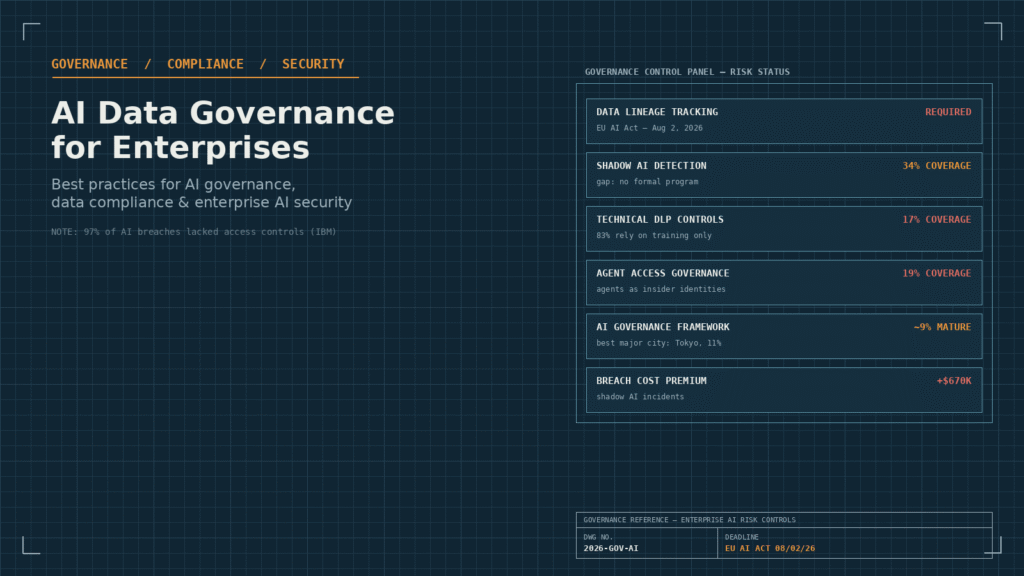
Ninety-seven percent of organizations that reported an AI-related breach in IBM’s 2025 Cost of a Data Breach Report were found to be lacking proper AI access controls. That single number tells you most of what you need to know about where enterprise AI governance actually stands in 2026: not that the risks are unknown, but that the controls aren’t there yet, even at organizations sophisticated enough to already be running AI in production.
This isn’t a fringe problem. It’s the default state. Shadow AI — AI tools used without IT approval or oversight — now adds roughly $670,000 to the average cost of a breach, and shows up in about one in five breached organizations. Meanwhile, the average cost of a data breach overall hit $4.88 million in 2024, the highest figure ever recorded, with AI-related incidents carrying a premium on top of that baseline. Getting AI data governance right isn’t a compliance checkbox anymore — it’s one of the more measurable cost-avoidance levers available to an enterprise security or data team right now.
Why AI Data Governance Is a Different Problem Than Traditional Data Governance
Traditional data governance was built around structured enterprise data: databases, warehouses, defined schemas. AI systems break that model in several specific ways. Sensitive information gets embedded directly into neural network weights during training, not just stored in a queryable table. Prompt injection introduces an entirely new attack vector that has no equivalent in traditional data pipelines. And autonomous AI agents inherit whatever access permissions the data they touch already carries — meaning an agent given read access to a repository “for context” can end up with a sprawling, undocumented permission footprint that nobody explicitly approved.
That last point matters more than it might sound. Without governance, an agent doesn’t just risk exposing data — it actively leaks data it shouldn’t, because it has no inherent concept of which data it’s allowed to use for which purpose. Data governance for AI has to cover not just the data itself, but the interfaces agents use to reach it and the testing standards that keep their outputs trustworthy.
The Data Behind the Risk
The scale of ungoverned AI use inside the average enterprise is larger than most governance programs are sized to handle. Roughly 78% of AI users at work report bringing their own unauthorized tools, and 27% of employees admit to entering confidential company data into public AI tools. The volume of data flowing into these tools has grown accordingly: data shared with AI tools increased by 485% year-over-year. Adoption isn’t concentrated at the edges of the organization, either — mid-level employees are the heaviest shadow AI users, out-pacing their own managers by roughly 3.5x, largely because they’re using these tools to do legitimate work faster, not because they intend to create risk.
The detection gap is arguably worse than the adoption numbers themselves. Only 34% of organizations have a formal shadow AI detection program, and just 17% have technical controls in place to actually stop employees from uploading confidential data to public AI tools — the other 83% are relying on training, warning emails, or nothing at all. Gartner projects shadow AI incidents will triple by the end of 2026, and organizations without established AI governance controls are estimated to spend roughly 2.5x more on incident remediation than those that have them in place.
Governance maturity itself remains thin almost everywhere. Economist Impact’s city-level data found Tokyo leading among major global cities with just 11% of organizations maintaining a comprehensive AI governance framework — New York followed at 10%, London at 8%, Singapore at 5%, Sydney at 4%. Even in the best-performing city measured, close to nine in ten organizations are operating without complete governance infrastructure. In India, IBM research found only 4% of organizations have robust frameworks for managing AI-related risk.
What Regulation Is Actually Forcing Right Now
Regulatory deadlines are turning “we should improve governance” into “we need to be ready by a specific date,” which changes how these conversations land with executives. The EU AI Act’s general provisions apply from August 2, 2026, requiring organizations running high-risk AI systems to implement concrete data governance controls — including automated data lineage tracking and audit trail documentation, not just written policy. The NIST AI Risk Management Framework, organized around four functions — Govern, Map, Measure, Manage — remains the most widely adopted voluntary guidance for managing AI risk across the full system lifecycle. ISO 42001 certification, increasingly requested by enterprise customers and partners, typically takes three to six months for organizations that already hold ISO 27001, involving a two-stage audit followed by annual surveillance audits.
Best Practices That Hold Up Against the Data
1. Build governance around a five-stage lifecycle, not a one-time policy. A recurring framework across current governance guidance is Charter, Classify, Control, Monitor, Improve — defining scope and ownership first, classifying data by sensitivity and use case, applying controls proportional to risk, monitoring continuously rather than auditing annually, and iterating as new AI use cases emerge. Static policy documents don’t hold up against a threat landscape and tool ecosystem that changes monthly.
2. Automate data lineage and audit trails from day one. This is no longer optional under the EU AI Act for high-risk systems, and it’s the single control most cited as underestimated by organizations that later fail an audit. If you can’t show where a piece of training or inference data came from and how it was transformed, you can’t defend an AI system’s output when it’s questioned by a regulator, an auditor, or a customer.
3. Close the technical-control gap, not just the policy gap. With 83% of organizations relying on training and warning emails rather than actual technical controls to stop confidential data leaving through AI tools, this is the highest-leverage gap to close. Data loss prevention tooling that specifically covers AI tool endpoints, not just traditional file-sharing channels, is a measurable step most governance programs haven’t taken yet.
4. Treat AI agents as identities requiring access governance, not as passive tools. Only 19% of organizations classify AI agents as equivalent to human insiders for access-control purposes — a classification gap that shows up directly in breach data. An agent’s permissions should be scoped, reviewed, and revocable the same way an employee’s are, including a documented, tested process for shutting an agent down mid-incident; 39% of professionals currently don’t know whether their organization even has one.
5. Treat governance as an organizational accountability problem, not just a technical one. The consistent finding across current governance research is that the technical and policy layers are the easier parts to solve. The harder part is getting executives to treat AI risk accountability the way they treat financial accountability — with real consequences for non-compliance, not just recommendations for improvement. Regulatory deadlines like the EU AI Act’s August 2026 enforcement date are useful specifically because they give governance and compliance leaders a concrete external forcing function to raise in executive conversations.
6. Fund governed enablement over prohibition. With 78–89% shadow AI adoption already the norm across departments, blocking tools outright has consistently failed as a strategy — usage simply moves further out of sight. The more durable approach documented across current governance guidance is providing sanctioned, governed alternatives that are genuinely as convenient as the unsanctioned tools employees have already adopted.
The Bottom Line
The AI governance market itself is projected to reach $16.5 billion by 2033, growing at a 25.5% compound annual rate — a reasonable proxy for how seriously enterprises are starting to take this, at least on the spending side. But spending on governance tooling and actually closing the gap between policy and enforced technical control are two different things, and the data above shows that gap is still wide almost everywhere it’s been measured.
The organizations narrowing it fastest aren’t necessarily the ones with the most sophisticated AI models. They’re the ones treating data lineage, access control, and agent permissions as infrastructure requirements with the same rigor as financial controls — before a regulator, an auditor, or a $670,000 shadow AI incident makes that decision for them.
