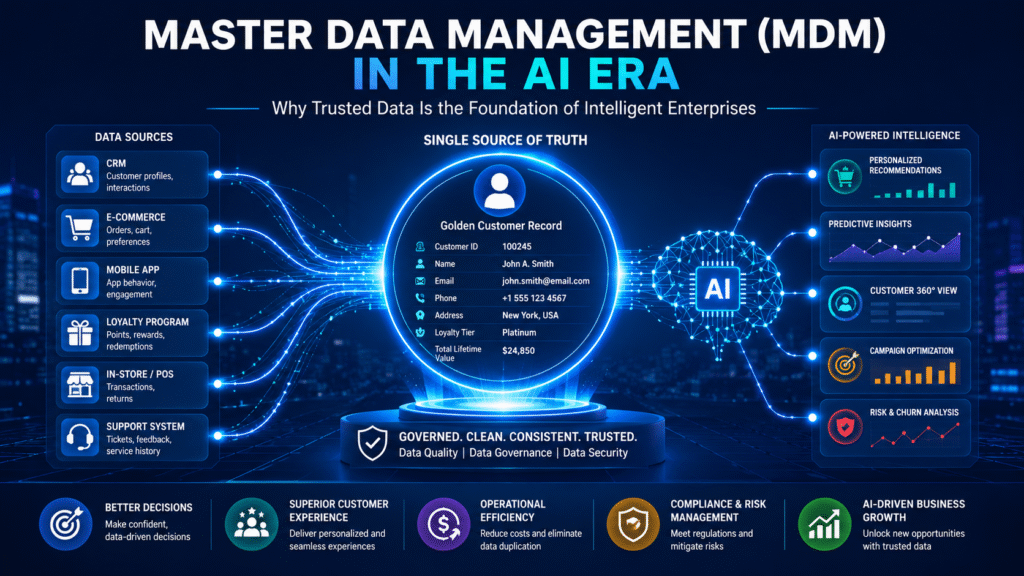
Artificial Intelligence is transforming how organizations operate, make decisions, and engage with customers. From predictive analytics and intelligent automation to generative AI assistants, businesses are investing heavily in AI-driven initiatives. However, there is one critical factor that determines whether AI delivers meaningful business value or becomes an expensive experiment: data quality.
At the heart of data quality lies Master Data Management (MDM)—the discipline of creating a single, trusted view of critical business entities such as customers, products, suppliers, employees, and locations.
In the AI era, MDM is no longer just a data governance initiative. It has become a strategic business capability that directly impacts AI accuracy, trustworthiness, compliance, and business outcomes.
What Is Master Data Management (MDM)?
Master Data Management is a framework of processes, technologies, governance policies, and standards that ensures critical business data remains:
- Accurate
- Consistent
- Complete
- Unique
- Governed
- Accessible across the organization
MDM creates a single source of truth by consolidating data from multiple systems and eliminating duplicates, inconsistencies, and errors.
Common Master Data Domains
| Domain | Examples |
|---|---|
| Customer Data | Customer profiles, contacts, preferences |
| Product Data | SKUs, descriptions, specifications |
| Supplier Data | Vendor information, contracts |
| Employee Data | HR records, organizational structures |
| Location Data | Stores, warehouses, regions |
Without MDM, organizations often struggle with fragmented data spread across ERP, CRM, e-commerce, marketing, finance, and operational systems.
Why AI Makes MDM More Important Than Ever
Traditional analytics could tolerate some level of data inconsistency. AI cannot.
AI models learn patterns directly from enterprise data. If that data contains errors, duplicates, or conflicting records, the outputs become unreliable.
This challenge is commonly summarized as:
“Garbage In, Garbage Out (GIGO).”
In the AI era, poor data quality leads to:
- Incorrect predictions
- Hallucinated responses
- Customer targeting errors
- Compliance violations
- Biased decision-making
- Loss of stakeholder trust
MDM acts as the foundation that ensures AI systems learn from trusted, governed, and consistent information
Real-World Example: Customer MDM and AI-Powered Marketing
Imagine a global retail company operating across:
- Online store
- Mobile app
- Physical stores
- Loyalty program
A single customer may appear as:
| System | Customer Record |
|---|---|
| CRM | John Smith |
| E-Commerce | Jonathan Smith |
| Mobile App | J. Smith |
| Loyalty Program | John A. Smith |
Without MDM, AI may treat these as four separate customers.
Consequences
The marketing AI might:
- Send duplicate offers
- Miscalculate customer lifetime value
- Recommend irrelevant products
- Produce inaccurate segmentation
With MDM
MDM resolves identities and creates one trusted customer profile:
Customer ID: 100245
- John A. Smith
- Purchase history consolidated
- Loyalty points synchronized
- Unified preferences
Now AI can generate:
- Personalized recommendations
- Accurate churn predictions
- Better customer segmentation
- Higher marketing ROI
This directly improves customer experience while reducing operational costs.
Real-World Example: Product MDM for Generative AI Commerce
Many organizations are deploying Generative AI shopping assistants.
Consider a manufacturer selling thousands of products globally.
Product data may exist across:
- ERP systems
- Product catalogs
- Supplier portals
- E-commerce platforms
If product descriptions differ across systems, an AI assistant may provide conflicting answers.
Example
One system lists:
Laptop Battery Life: 8 Hours
Another lists:
Laptop Battery Life: 12 Hours
A customer asks an AI chatbot:
“How long does this laptop battery last?”
The response becomes unreliable.
How MDM Helps
Product MDM creates:
- Standardized product attributes
- Verified specifications
- Approved product descriptions
- Consistent metadata
The AI assistant now responds with accurate information based on trusted master data.
The Rise of AI-Driven MDM
Traditionally, MDM initiatives required significant manual effort.
Today, AI is helping improve MDM itself.
Organizations are using AI for:
Intelligent Data Matching
AI can identify duplicate records even when names differ.
Example:
- ABC Technologies Ltd.
- ABC Tech Ltd.
- A.B.C. Technologies
Machine learning algorithms recognize these as the same entity.
Automated Data Classification
AI automatically categorizes:
- Customers
- Products
- Vendors
- Documents
Reducing manual governance effort.
Data Quality Monitoring
AI continuously identifies:
- Missing values
- Invalid records
- Outliers
- Suspicious changes
Before they impact business processes.
Data Enrichment
AI can supplement records with:
- Industry classifications
- Geographic information
- Risk indicators
- Market intelligence
Creating richer master data assets.
MDM and Generative AI: A Critical Relationship
Generative AI systems such as enterprise copilots, customer support assistants, and knowledge bots rely heavily on trusted enterprise data.
Without MDM:
- Multiple versions of the same customer exist
- Product information becomes inconsistent
- Supplier records contain duplicates
- Business terminology varies across departments
The result is reduced confidence in AI-generated outputs.
MDM Enables
✔ Trusted Retrieval-Augmented Generation (RAG)
✔ Consistent enterprise knowledge graphs
✔ Reliable AI recommendations
✔ Better conversational AI experiences
✔ Explainable AI decisions
Organizations that invest in MDM often experience significantly higher trust in AI-generated insights.
Industry Use Cases
Healthcare
Master patient records across hospitals and clinics enable AI systems to:
- Improve diagnostics
- Reduce duplicate testing
- Enhance patient care coordination
Banking
Customer MDM supports:
- Fraud detection
- Risk assessment
- Regulatory compliance
- Personalized financial services
Manufacturing
Product and supplier MDM enables:
- Predictive maintenance
- Supply chain optimization
- Inventory forecasting
Retail
Customer and product MDM powers:
- Recommendation engines
- Dynamic pricing
- Personalized shopping experiences
Key Challenges Organizations Face
Despite its benefits, MDM implementation is not easy.
Common challenges include:
Data Silos
Business units often maintain independent systems and standards.
Lack of Data Governance
Without ownership and accountability, master data quality deteriorates quickly.
Legacy Systems
Older applications frequently contain inconsistent and duplicate data.
Scaling Across the Enterprise
As organizations grow, maintaining a single source of truth becomes increasingly complex.
Best Practices for AI-Ready MDM
Organizations preparing for AI transformation should focus on:
1. Establish Strong Data Governance
Define:
- Data owners
- Data stewards
- Quality standards
- Governance policies
2. Prioritize Critical Data Domains
Start with:
- Customer data
- Product data
- Supplier data
These typically deliver the fastest AI value.
3. Implement Continuous Data Quality Monitoring
Track:
- Accuracy
- Completeness
- Consistency
- Timeliness
In real time.
4. Leverage AI to Improve MDM
Use machine learning for:
- Entity resolution
- Data cleansing
- Classification
- Enrichment
5. Align MDM with AI Strategy
MDM should not be viewed as a standalone data project.
It should directly support:
- Generative AI initiatives
- Analytics programs
- Customer experience strategies
- Digital transformation goals
The Future of MDM
As AI adoption accelerates, MDM is evolving from a back-office data management function into a strategic business enabler.
Future MDM platforms will increasingly incorporate:
- AI-powered data stewardship
- Real-time master data synchronization
- Knowledge graph integration
- Semantic data models
- Autonomous data quality management
Organizations that combine strong MDM practices with AI innovation will be better positioned to deliver trusted insights, superior customer experiences, and sustainable competitive advantages.
Conclusion
AI may be the engine driving digital transformation, but Master Data Management is the fuel that powers it.
The success of AI initiatives depends on the quality, consistency, and trustworthiness of the underlying data. Organizations that invest in modern MDM capabilities can unlock more accurate AI predictions, stronger governance, improved customer experiences, and greater business value.
In the AI era, the question is no longer whether companies need Master Data Management. The real question is:
Can organizations achieve trustworthy AI without it?
For most enterprises, the answer is increasingly becoming no.
Related Keywords: AI data governance, customer master data, product master data, AI-ready data, enterprise data management, data quality for AI, MDM strategy, generative AI data foundation.
