For a decade, “Python vs Rust” was mostly a message-board argument. In 2026, it’s a budget line. As AI systems move from research notebooks into production infrastructure serving real traffic at real cost, the language underneath that infrastructure stopped being a stylistic preference and started showing up directly in latency, memory bills, and incident reports. This isn’t a theoretical comparison — it’s a look at what the numbers actually say about where each language belongs in a modern AI stack.
The Headline Numbers
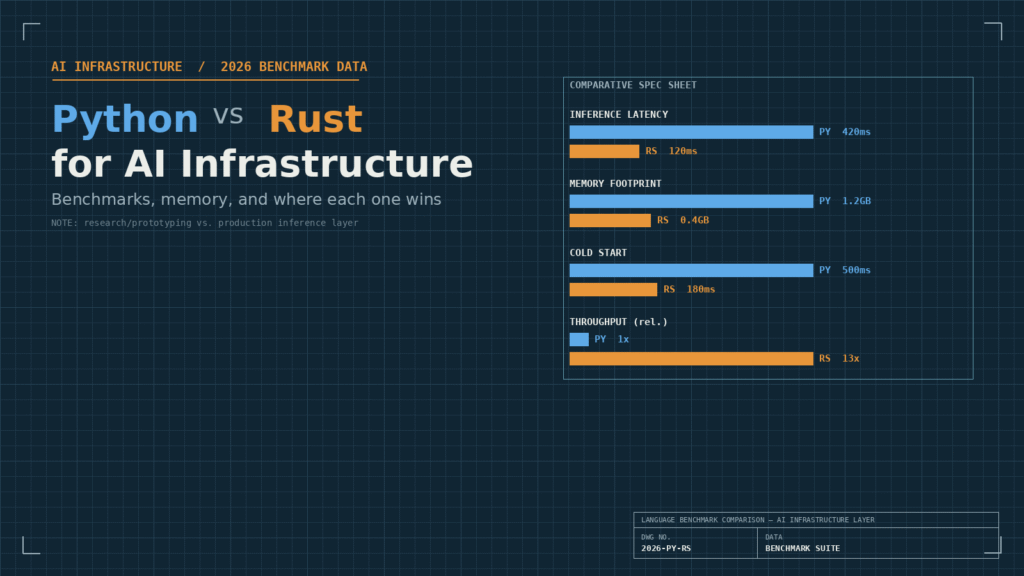
Start with raw performance, because it’s the easiest thing to measure and the easiest thing to misread. Rust is roughly 25 to 100 times faster than Python on CPU-bound workloads, based on 2026 benchmark-suite data, and it typically uses five to ten times less memory for equivalent tasks. In a side-by-side AI tooling comparison, Python inference sat around 420ms with roughly 1.2GB of memory use, while a Rust equivalent came in near 120ms and 0.4GB.
Cold start is where the gap gets uncomfortable for production systems. A simple Python agent server built on FastAPI idles at 80–150MB of RAM with a 200–500ms cold start before any business logic runs. Rust-native agent frameworks report cold starts around 180 milliseconds down from multi-second Python startup times, because there’s no interpreter to initialize, no dependency graph to resolve, and no garbage collector to configure.
None of that means Python is losing. It means the two languages are winning different races.
Why Python Still Owns AI Research and Prototyping
Python’s advantage was never raw execution speed — it was ecosystem depth, and that hasn’t moved. Python’s package ecosystem sits above 530,000 packages against roughly 155,000 Rust crates, and the AI-specific gap is even more lopsided: PyTorch, TensorFlow, Hugging Face, NumPy, and pandas remain industry standards with no serious Rust alternative for model development. When a library like NumPy or PyTorch delegates the actual computation to optimized C or CUDA code underneath, Python’s own interpreter overhead becomes close to irrelevant for the workload that matters most: training.
That’s why training workloads remain overwhelmingly Python-based even as the rest of the stack shifts. PyTorch’s autograd system is deeply embedded in research workflows, and the performance overhead of Python is easy to absorb when the GPU, not the language runtime, is already the bottleneck.
The job market reflects the same split. Python job postings outnumber Rust postings by roughly 12 to 1 in the US market — around 215,000 Python listings against 18,000 for Rust as of early 2026. If you’re hiring for research, data science, or rapid prototyping, Python’s labor pool is simply deeper.
Where Rust Is Actually Winning Ground
The interesting story isn’t Python vs. Rust for training — it’s what’s happening downstream, in the part of the stack that runs continuously, under load, against a service-level agreement. That’s inference infrastructure, agent runtimes, tokenizers, and the systems code wrapped around the model rather than the model itself.
A few forces are converging here:
The GIL becomes a hard ceiling at scale. Python’s Global Interpreter Lock is manageable for a handful of concurrent agents. Analysis of production agentic systems suggests it becomes an architectural constraint somewhere between 50 and several hundred concurrent CPU-bound agents. Python 3.14’s free-threaded mode (PEP 703) narrows this — reducing single-threaded overhead from roughly 40% in Python 3.13 to something closer to 5–10% — but free-threading isn’t the CPython default yet, and many packages with C extensions still re-enable the GIL automatically because their extensions haven’t been rebuilt for it.
Garbage collection introduces latency you can’t fully control. A GC pause is a rounding error in a research notebook. It’s a tail-latency problem in an inference server with a strict SLA. Rust’s ownership model removes that non-determinism entirely, at compile time, without a runtime collector.
Agents now have real permissions. Early Python agent frameworks like early LangChain and AutoGPT mostly called APIs and returned strings — the blast radius of a bug was contained. The 2026 generation of agents runs shell commands, manages files, spawns processes, and controls browsers, often with elevated permissions. When an autonomous agent has that kind of access, memory safety stops being a nice-to-have and starts being a control requirement — which is a large part of why Rust-based agent frameworks have gained traction specifically for the runtime layer, not the reasoning layer.
Throughput at scale changes the cost math. One 2026 distributed key-value store benchmark showed a Rust implementation reaching 30,000 transactions per second on a 16-core machine, compared with roughly 3,000 TPS for an equivalent Java version — and the same performance gap generally holds against Python. Independent benchmarks of Rust-native agent frameworks report throughput near 2,400 tasks per second, on the order of 13 times higher than comparable Python orchestration frameworks, alongside roughly 25–44% latency improvements and up to 5x memory reduction.
The Pattern Production Teams Are Actually Converging On
The most useful signal in the 2026 data isn’t “Rust is replacing Python.” It’s that mature teams have stopped treating this as a single-language decision. The emerging default architecture looks like: Python for research and interfaces, Rust for the computational and systems core underneath.
You can see this pattern already shipping in tools most Python developers use every day:
- Pydantic V2 rewrote its validation engine in Rust, keeping Python’s developer-friendly API on top while achieving 5–50x performance gains underneath.
- Hugging Face’s tokenizers library follows the same split — Rust for the hot path, Python for the interface.
- Ruff, the Python linter, checks codebases 10–100x faster than pure-Python linters like Pylint because the linter itself is written in Rust.
- uv, the Rust-built Python package manager, installs dependencies 10–100x faster than pip, and is steadily consolidating a tooling landscape that used to be split across pip, venv, and half a dozen other tools.
This “Python interface, Rust engine” pattern is also visible at the infrastructure level: major AI platforms have adopted Rust cores for performance-critical components like inference servers and embedding pipelines, while continuing to expose Python-facing APIs on top. It’s not a replacement — it’s a division of labor, and it’s becoming the normal shape of a production AI stack rather than an exception.
There’s also a third factor worth naming honestly: developer sentiment. Rust has been the most admired language in developer surveys for ten consecutive years, and infrastructure-focused adoption surveys point to expanding use specifically in backend services, infrastructure, and AI tooling — the layer just below the model, not the model itself.
A Practical Decision Framework
Benchmarks are only useful with context attached. Based on the 2026 data, here’s a reasonable way to split the decision:
Choose Python when:
- You’re training, fine-tuning, or doing research-stage model development
- Ecosystem breadth matters more than raw throughput (there’s no Rust equivalent to PyTorch’s maturity)
- Traffic is under roughly 5,000 requests per second, where faster development time tends to beat infrastructure efficiency on total cost
- You need to hire quickly from a large talent pool
Choose Rust when:
- You’re building the inference-serving or agent-runtime layer that runs continuously in production
- You’re above roughly 50,000 sustained requests per second, where infrastructure efficiency usually wins on total cost of ownership
- Agents or services have file, shell, or network permissions where memory safety is a control requirement, not a preference
- Cold-start time and memory footprint directly affect your cloud bill (container orchestration, serverless, edge deployment)
Use both when:
- You’re building anything at meaningful production scale. The Pydantic, tokenizers, and Ruff pattern — Python surface, Rust core — is the most reproducible pattern in this entire dataset, and it’s the one most teams should default to before considering a full rewrite in either direction.
The Honest Bottom Line
Nobody serious is proposing a wholesale rewrite of PyTorch codebases into Rust, and nobody should be. Python’s research and prototyping advantage is not shrinking — if anything, ecosystem depth compounds over time. What’s shrinking is the assumption that Python has to carry the entire stack, all the way down to the systems layer, just because that’s where the model lives.
The practical move for most teams isn’t picking a side. It’s identifying which specific components in your stack are latency-sensitive, permission-sensitive, or cost-sensitive at scale — and being willing to let those specific components speak Rust, while everything upstream of them keeps speaking Python.
