Data engineering stopped being the plumbing behind the dashboard a while ago. In 2026, it’s the layer everything else depends on: the global data engineering market now exceeds $120 billion in combined tooling, cloud spend, and platform investment, and roughly 90% of AI and ML projects depend directly on data engineering pipelines just to function. Enterprises now report managing an average of more than 400 distinct data sources, and organizations still spend 60–70% of their total data budgets on engineering, integration, and pipeline maintenance rather than on the models or dashboards sitting on top.
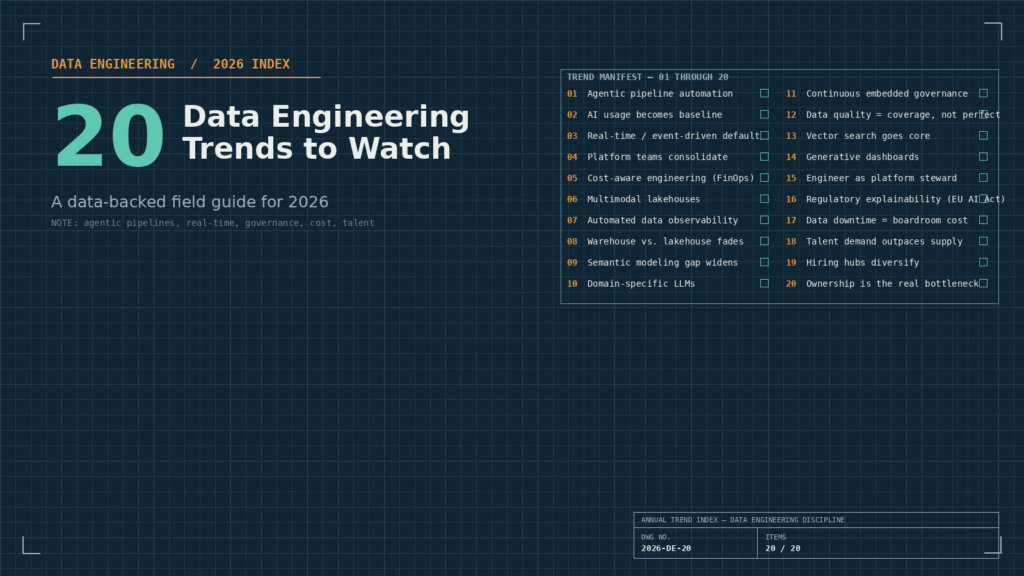
That’s the backdrop for this list. These are the 20 trends actually showing up in 2026 survey data, market reports, and hiring signals — not speculation about what might matter someday, but what’s already shifting budgets, job descriptions, and architecture decisions this year.
1. Agentic AI starts building and maintaining pipelines
Gartner names AI agents its top strategic trend for 2026, and the shift is visible in practice: agentic tools now generate, test, and iterate on transformation code from natural-language descriptions, and survey respondents rank “writing code” as the single highest-value AI use case in their workflow.
2. AI usage becomes table stakes, not a differentiator
82% of data professionals now use AI daily in their work. The competitive question has moved past adoption entirely — it’s whether AI is embedded into core workflows or just used for tactical, one-off tasks, since only around 10% of organizations have reached the former.
3. Real-time and event-driven architecture becomes the default
The data pipeline tools market is projected to grow from roughly $11.2 billion in 2024 to $13.7 billion in 2025, with event-driven architecture cited as the primary driver. Batch isn’t disappearing, but it’s no longer the assumed starting point for new pipeline design.
4. Data platform teams consolidate around internal products
Instead of every team building its own ingestion and monitoring stack, organizations are centralizing standardized building blocks under dedicated platform teams. Enterprises running this platform-centric model report 20–25% lower operational overhead from reduced duplication and clearer ownership.
5. Cost-awareness becomes a core engineering skill
After years of cloud-first spending, FinOps discipline is back. Engineers are increasingly expected to attribute spend to specific pipelines and teams, right-size compute deliberately, and evaluate architecture choices through a cost lens rather than a pure scalability lens.
6. Multimodal lakehouses go mainstream
Unified platforms handling structured tables alongside images, text, video, and vector embeddings are consolidating around open table formats — Apache Iceberg, Delta Lake, and Hudi are the clear leaders, with strong support from both Databricks and Snowflake.
7. Automated data observability becomes standard infrastructure
Gartner forecasts that 50% of organizations with distributed architectures will adopt advanced observability platforms by 2026, up from just 20% in 2024 — a direct response to pipelines that fail 30–40% of the time on a weekly basis at many organizations.
8. The “warehouse vs. lakehouse” debate quietly ends
Rather than one architecture winning, 2026 data suggests the honest answer is “both.” Winning teams are blending batch and real-time pipelines with built-in schema evolution and auditability, instead of forcing every workload into a single paradigm.
9. Semantic modeling becomes a bigger gap, not a smaller one
89% of data professionals report meaningful pain points around data modeling, yet only about 5% currently use semantic models. That gap between the acknowledged problem and the adopted solution is one of the widest in the entire field right now.
10. Domain-specific LLMs replace generic models for engineering tasks
Specialized models trained on industry-specific compliance requirements and vocabulary are emerging — healthcare platforms trained on HIPAA and clinical terminology, financial systems tuned for risk calculations and regulatory reporting — delivering measurably better accuracy than general-purpose models on these tasks.
11. Governance moves from a checkpoint to a continuous process
Automated lineage, policy enforcement, and explainability tooling are increasingly embedded directly into transformation workflows rather than bolted on afterward. Organizations that embed governance this way report an 18% improvement in forecast accuracy from fewer downstream corrections.
12. Data quality shifts from perfection to coverage
Years of investment in row-level data quality tooling haven’t produced the outcomes many teams expected. The field is increasingly optimizing for data coverage that’s “good enough” for A/B testing, reporting, and ML rather than chasing column-by-column perfection.
13. Vector search becomes a first-class pipeline citizen
As retrieval-augmented and agentic systems scale, embeddings and vector indexes are moving from bolt-on add-ons into core pipeline design — a direct consequence of multimodal lakehouse adoption and the broader shift toward AI-native data platforms.
14. Generative dashboards start replacing static BI
Gartner predicts that by 2028, GenAI-powered narrative and visualization tools will replace 60% of today’s existing dashboards, letting natural-language queries generate visualizations on demand instead of requiring pre-built report configuration.
15. The data engineer becomes a platform steward
The role is shifting from writing individual pipelines to defining service-level expectations, failure modes, and upgrade paths for shared infrastructure — less “build this ETL job,” more “own this system’s reliability contract.”
16. Regulatory pressure pushes explainability into the pipeline
Requirements like the EU AI Act are accelerating demand for transparent, auditable data workflows, not just accurate ones — pushing lineage and explainability from a nice-to-have into a compliance requirement across regulated industries.
17. Data downtime becomes a boardroom cost conversation
31% of organizations report direct revenue loss tied to data lag or downtime, and large organizations report data reliability failures costing millions annually. Latency and uptime are no longer purely technical metrics — they’re now tracked as business risk.
18. Talent demand keeps outpacing supply, AI notwithstanding
The data engineering sector employs over 150,000 professionals globally, with the US Bureau of Labor Statistics projecting 36% growth in data-related roles through 2033 — even as AI automates a growing share of routine pipeline-writing tasks.
19. Data hiring hubs diversify beyond the usual cities
While Bangalore, London, and New York remain dominant hiring centers, secondary markets like Pune and Madrid are showing steady growth in 2026, as remote work widens access without fully erasing the gravitational pull of established tech hubs.
20. Organizational dysfunction remains the real bottleneck
Technical debt (26%) and lack of leadership direction (22%) still outrank most tooling complaints as the top challenges data engineers report. More AI in the pipeline doesn’t fix unclear ownership — it tends to make the consequences of it more visible, faster.
The Common Thread
Read across all twenty trends and one pattern repeats: the technology is rarely the bottleneck anymore. Multimodal lakehouses, agentic pipeline tools, and generative dashboards are all mature enough to deploy today. What’s actually gating progress is ownership, governance, and cost discipline — the unglamorous organizational layer sitting underneath the architecture diagrams.
That’s arguably good news. Tooling gaps get closed by procurement. Ownership gaps get closed by leadership. Teams that treat 2026’s data engineering shift as a people-and-process problem first, and a tool-selection problem second, are the ones most likely to be ahead of this list by 2027 rather than still catching up to it.

1 thought on “Top 20 Data Engineering Trends in 2026”
Pingback: The Rise of Autonomous Data Platforms: 2026 Data