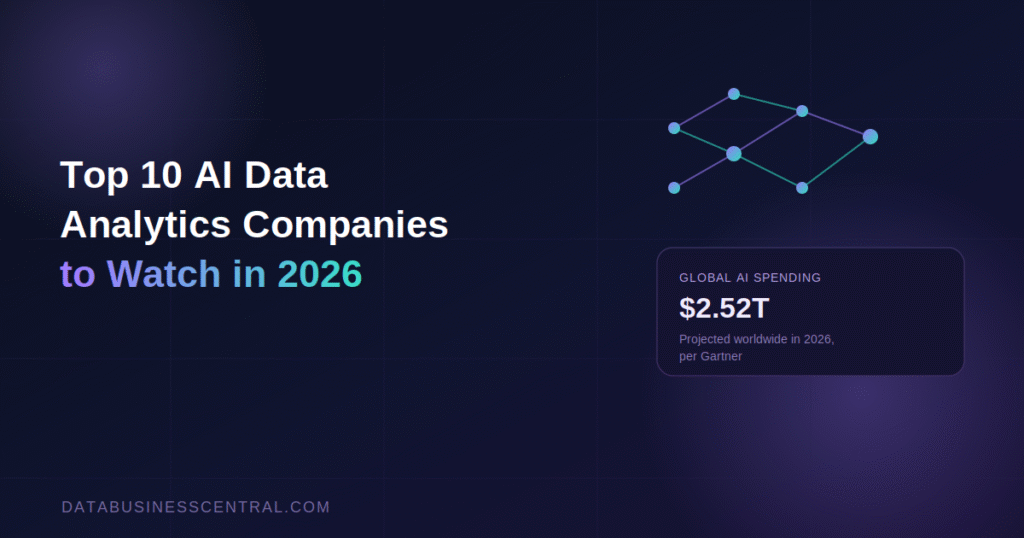
There’s a meaningful difference between a company that sells analytics software and one that sells an AI system built to think about your data. In 2026, that difference has become the line separating the platforms enterprises are excited about from the ones quietly getting replaced. Global AI spending is projected to reach roughly $2.52 trillion this year, and a growing share of that money is going toward analytics platforms that don’t just visualize data — they interpret it, predict what happens next, and increasingly act on it without waiting for a human to click a button.
That said, spending big doesn’t automatically mean winning big. Research from McKinsey and others has repeatedly found that organization-wide returns on AI remain difficult to capture when companies lack clear KPIs, reliable data foundations, and real changes to how teams actually work. The AI data analytics companies worth watching in 2026 aren’t just the ones with the most impressive model — they’re the ones helping enterprises close that gap between AI investment and AI results.
Here’s our independent breakdown of the platforms actually doing that.
What Makes a Data Analytics Company “AI-Powered” in 2026?
Every vendor claims an AI angle now, so the label alone doesn’t tell you much. The companies that matter fall into a few genuine categories: platforms with AI built into the core architecture rather than bolted on as a chatbot, tools that generate predictions and recommendations automatically instead of waiting for a human to build a model, and increasingly, systems that take autonomous action — reordering inventory, flagging fraud, adjusting a price — within boundaries a business has approved in advance. That last category, often called agentic analytics, is the newest and fastest-growing frontier heading into 2026.
1. Palantir Technologies
Palantir remains the clearest example of AI analytics built for decision execution rather than dashboard viewing. Its AIP (Artificial Intelligence Platform) connects live enterprise data to autonomous workflows, letting organizations move from insight straight to action inside regulated, auditable guardrails. Once known primarily for government and defense work, Palantir has expanded aggressively into commercial manufacturing, healthcare, and logistics, and its valuation trajectory reflects just how seriously the market is taking that shift — some analysts now project it could become a trillion-dollar company as its commercial AI footprint keeps expanding.
2. Databricks
Databricks has pushed its lakehouse platform deep into AI territory with Mosaic AI and its growing suite of agent-building tools, letting enterprises train, fine-tune, and deploy models directly against governed data without exporting it elsewhere. Its Unity Catalog gives AI systems and human analysts the same governed access to data, which matters increasingly as companies worry about AI models acting on ungoverned or unreliable information. For enterprises building custom AI applications on top of their own data, Databricks remains one of the most complete platforms available.
3. Snowflake
Snowflake’s Cortex layer embeds large language model access and AI functions directly inside SQL, letting analysts run AI-powered queries without ever leaving the warehouse they already know how to use. That approach — meeting analysts where they already work, rather than asking them to learn a separate AI tool — has made Cortex one of the more quietly effective AI rollouts in the industry. Snowflake’s continued expansion into governed data sharing also positions it well as enterprises look for AI-ready data that’s trustworthy enough to act on.
4. Microsoft
Microsoft’s Copilot integration across Fabric and Power BI has turned natural-language analytics into something available to nearly every enterprise employee already using Microsoft 365, not just data teams. Ask a plain-English question and Copilot generates the visualization, the summary, or the underlying query automatically. Because so many organizations already run on Microsoft’s ecosystem, this built-in AI layer gives Microsoft a distribution advantage that pure-play AI analytics vendors simply can’t match at the same scale.
5. Google Cloud
Google Cloud pairs BigQuery with Vertex AI and its Gemini model family to offer a genuinely end-to-end path from raw data to a deployed AI application, all inside one serverless environment. Its native vector search and BigQuery ML functions let teams build and query AI models using familiar SQL syntax, lowering the barrier for teams without dedicated machine learning engineers. For data-heavy industries like ad tech, media, and e-commerce that need both scale and AI sophistication, Google Cloud remains a top-tier option.
6. C3.ai
C3.ai focuses specifically on building production-grade enterprise AI applications rather than general-purpose analytics tooling, targeting industries like energy, manufacturing, and defense where predictive maintenance and operational AI deliver measurable, dollar-denominated returns. Its model-driven architecture is designed to accelerate deployment of AI applications that would otherwise take large in-house engineering teams months to build from scratch. For enterprises in asset-heavy industries specifically, C3.ai’s narrower, deployment-focused approach remains a differentiated pitch against broader data platforms.
7. DataRobot
DataRobot has built its reputation on automating the machine learning lifecycle itself — data preparation, model selection, training, and deployment — reducing what used to require a specialized data science team into a workflow business analysts can largely manage themselves. Its MLOps capabilities also help enterprises monitor models in production, catching accuracy drift before a stale model starts generating bad predictions. As more organizations try to scale AI analytics beyond a handful of pilot projects, DataRobot’s automation-first approach addresses one of the most common bottlenecks: not enough skilled people to build and maintain every model manually.
8. H2O.ai
H2O.ai has carved out a strong niche in open-source, transparent AI, appealing to regulated industries like banking and insurance where explainability isn’t optional. Its platform gives enterprises interpretable predictions rather than pure black-box outputs, which matters enormously when a model’s decision has to be justified to a regulator or an auditor. As AI governance requirements tighten across financial services and healthcare, H2O.ai’s emphasis on explainable AI has become less of a nice-to-have and more of a genuine competitive advantage.
9. ThoughtSpot
ThoughtSpot’s Spotter AI agent goes beyond answering questions to proactively surfacing insights and anomalies a human analyst might not think to ask about. Combined with its original search-driven interface, ThoughtSpot has positioned itself as one of the more accessible AI analytics tools for frontline business users, not just centralized data teams. Its recognition among the industry’s most notable AI-focused analytics vendors this year reflects how far the platform has moved from a search-based BI tool toward genuine autonomous insight generation.
10. Starburst
Starburst takes a different approach entirely, focusing on federated data access that lets enterprises query and govern data across on-premises systems, multiple clouds, and hybrid environments without physically moving it. That matters increasingly for AI, since models need broad, governed access to context spread across an organization’s entire data estate — not just whatever happens to sit in one warehouse. Having surpassed $100 million in annual recurring revenue and earned recognition among the industry’s hottest AI data and analytics vendors this year, Starburst has become a genuine contender for enterprises trying to make fragmented data AI-ready without a costly migration.
How to Choose the Right AI Data Analytics Partner
With so many capable AI data analytics companies competing for enterprise attention, the right fit depends on what you’re actually trying to solve:
- Decision execution vs. insight generation: Palantir and emerging agentic tools act on data directly; most others still require a human to interpret and act on the output.
- Build vs. buy: Databricks and Google Cloud suit enterprises building custom AI applications; C3.ai and DataRobot suit teams that want faster, more prescriptive deployment.
- Ecosystem fit: Heavy Microsoft or Google Cloud shops gain faster time-to-value from that provider’s native AI tooling.
- Governance and explainability: Regulated industries should prioritize platforms like H2O.ai that treat interpretability as a core feature, not an afterthought.
- Data fragmentation: Organizations with data scattered across clouds and legacy systems should evaluate federated platforms like Starburst before attempting a costly full migration.
Real-World Use Cases Driving This Shift
The theory behind AI data analytics only matters if it changes what actually happens inside a business. A few patterns are showing up repeatedly across the companies adopting these platforms in 2026.
Manufacturing and energy companies are using platforms like C3.ai and Databricks to predict equipment failure before it happens, shifting maintenance from a fixed calendar schedule to one triggered by actual sensor data. That single change alone has become one of the most measurable AI analytics wins in asset-heavy industries, often paying for the platform investment through avoided downtime alone.
Financial services firms lean heavily on explainable platforms like H2O.ai for credit decisions and fraud detection, where a model’s prediction has to be justified to a regulator, not just trusted on faith. Interpretability isn’t a nice technical feature here — it’s often a legal requirement.
Retailers increasingly rely on Snowflake’s and Google Cloud’s AI layers to personalize offers and forecast demand at the individual product level, catching shifts in buying behavior in near real time rather than waiting for a monthly sales report to reveal a trend that’s already cost them revenue.
Government and large enterprise operations teams use Palantir’s AIP to connect fragmented data sources into a single operational view, then trigger workflows directly from that view instead of routing every decision through a separate system. This is the clearest example of analytics moving from “tell me what happened” to “handle it.”
Across every one of these examples, the underlying shift is the same: the AI isn’t just summarizing data anymore. It’s shortening the distance between a pattern appearing in the data and something actually happening because of it.
The Gap Between AI Spending and AI Results
It’s worth being honest about why this category is exciting and frustrating at the same time. Enterprises are spending more on AI analytics than ever, yet plenty of that investment still isn’t translating into measurable business value. The companies actually closing that gap tend to share a few habits: they define clear KPIs before deploying a model, they invest in the unglamorous work of data quality and governance first, and they change how teams actually operate around the insight — not just the technology sitting behind it. The vendor matters less than the discipline a company brings to using it.
Final Thoughts
The top AI data analytics companies to watch in 2026 are increasingly defined less by how big their model is and more by how directly they connect insight to action. Palantir and emerging agentic platforms are pushing toward autonomous decision execution, Databricks and Google Cloud are giving enterprises the infrastructure to build custom AI applications, and specialists like C3.ai, DataRobot, and H2O.ai are solving narrower but genuinely painful problems around deployment speed and explainability. As the market matures past the hype cycle, the vendors that survive will be the ones that helped their customers turn AI spending into results that actually show up on a balance sheet.
Frequently Asked Questions
What’s the difference between a data analytics company and an AI data analytics company? Traditional data analytics tools primarily report on and visualize what already happened, while AI data analytics platforms add predictive and often autonomous capabilities that forecast outcomes or take action directly on that data.
Why do some companies struggle to see returns from AI analytics despite heavy investment? Research consistently shows the biggest blockers are unclear success metrics, unreliable underlying data, and a failure to change actual business workflows around the new AI capability, not the technology itself.
Is agentic AI analytics ready for widespread enterprise use in 2026? Adoption is accelerating quickly but remains concentrated in narrow, well-governed use cases — most enterprises still keep a human reviewing AI recommendations before fully autonomous action becomes standard practice.
How should a business decide between a broad AI platform and a specialized AI analytics vendor? Broad platforms like Databricks or Google Cloud make sense when a business needs to build multiple custom AI applications over time, while specialized vendors like C3.ai or H2O.ai tend to deliver faster results for one well-defined, high-value problem.
