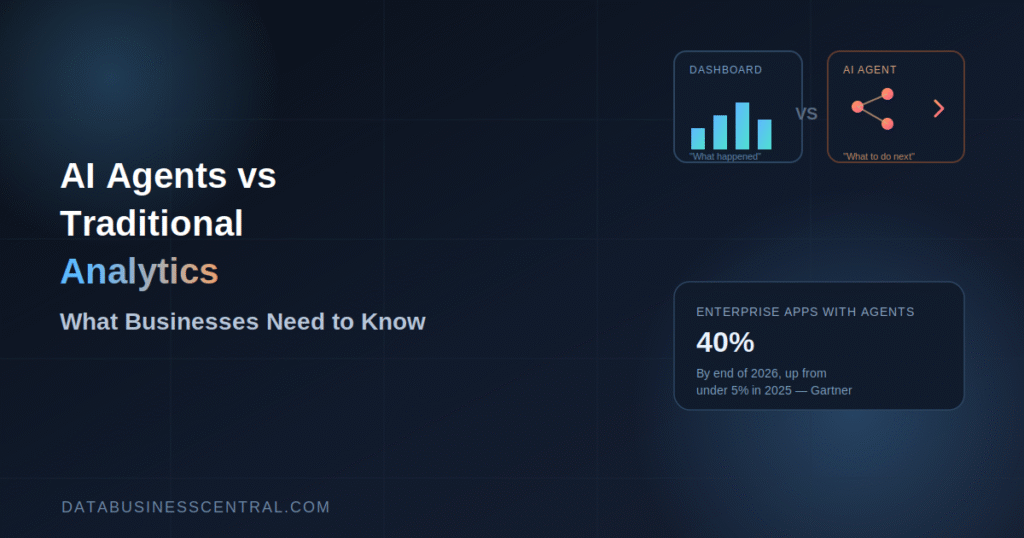
Picture this: a key metric drops on a Tuesday morning, but nobody notices until Friday’s report lands. By then, the window to act on it has already closed. That gap between a problem appearing in the data and someone actually doing something about it is exactly what’s pushing businesses to rethink analytics in 2026 — and it’s why the debate over AI agents vs traditional analytics has moved from a niche technical question to a genuine board-level conversation.
The numbers behind that shift are hard to ignore. Gartner expects 40% of enterprise applications to include task-specific AI agents by the end of 2026, up from under 5% just a year earlier. Enterprise spending on generative AI tripled in a single year, jumping from $11.5 billion in 2024 to $37 billion in 2025. And in sales specifically, 83% of B2B teams using AI reported measurable revenue growth, compared to 66% of teams working without it.
But adoption isn’t the same as success. Gartner also predicts that more than 40% of agentic AI projects will be canceled by the end of 2027 due to escalating costs, unclear value, or weak risk controls. This guide breaks down what actually separates AI agents from traditional analytics, where each one genuinely wins, and how to avoid becoming one of those cancellation statistics.
What’s the Real Difference?
Traditional business intelligence is fundamentally a reporting discipline. Engineers model the data, analysts build dashboards, and business users consume whatever view someone decided in advance was worth tracking. When a new question comes up that the dashboard wasn’t built to answer, it joins a backlog and waits for someone with the right access and the right skills to build it.
An AI agent is a different kind of tool entirely. It’s software that can perceive its environment, make decisions, and take action toward a specific goal without waiting for constant human input. Instead of waiting for someone to ask the right question, an agent monitors data continuously, investigates anomalies on its own, and — depending on how it’s configured — can act on what it finds rather than simply reporting it.
The simplest way to frame the difference: traditional BI answers “what happened.” AI agents increasingly answer “why it happened” and “what should we do about it” — without a human having to ask each question one at a time.
How Traditional Analytics Still Works — and Where It Wins
It’s worth being fair to traditional BI before comparing it to anything newer. It solved a real problem. Before dashboards existed, understanding business performance meant manually pulling numbers from spreadsheets and hoping everything lined up correctly.
Traditional BI remains genuinely excellent at a specific job: showing consistent, trusted metrics that someone already decided matter. A finance team reviewing monthly revenue against budget doesn’t need an autonomous agent — it needs a reliable, auditable number that means the same thing every time it’s pulled. That reliability is traditional BI’s core strength, and it’s not going away.
The limitation is baked into the same design that makes it reliable. A human decided in advance exactly what the dashboard would show, so it answers that question well and essentially no others. Anything outside the pre-built view requires a new request, a new build cycle, and a wait.
How AI Agents Work Differently
AI agents operate on three principles that traditional dashboards simply don’t have: autonomy, adaptability, and goal orientation.
Autonomy means the agent can execute multi-step workflows without requiring a human to approve every individual action along the way. Adaptability lets it adjust its approach when conditions change — a new data source appears, a metric shifts unexpectedly, or the structure of the underlying data evolves. Goal orientation means the agent isn’t just retrieving information; it’s working toward a specific outcome, like flagging fraud, reallocating a budget, or resolving a customer issue.
A concrete comparison makes this tangible. Traditional marketing automation follows rigid if-then rules: if cost-per-click exceeds a set threshold, send an alert. An AI agent, by contrast, can recognize that CPC is rising because a competitor just launched a campaign, compare that pattern against historical data, recommend a specific budget reallocation across channels, and — if given permission — execute that shift automatically.
Real Business Results: AI Agents in Action
The theory matters less than what’s actually happening inside companies using this technology. A few documented results stand out.
Energy company AES cut audit time from 14 days down to just 1 hour using AI agents, achieving roughly 99% cost savings on that process alone. Paper and pulp producer Suzano gave 50,000 employees instant, self-service access to company data, enabling queries that run about 95% faster than before. And on the vendor side, Salesforce’s Agentforce platform has become one of the clearest revenue signals in this space, generating roughly $800 million in annual recurring revenue — up 169% year over year.
Independent benchmarking backs up the underlying capability jump. According to the 2026 Stanford AI Index, agent task success on the OSWorld benchmark climbed from just 12% to roughly 66%, with real-world task success now reaching about 77.3%. That’s a meaningful leap in how reliably these systems can complete complex, multi-step work without constant supervision.
The Honest Risk Side: Why So Many Agentic Projects Fail
None of this means every company should rush to replace its dashboards. The gap between adoption and real transformation remains wide. Nearly nine in ten organizations use AI somewhere, and roughly four in five say they’re adopting agents in some form — yet fewer than one in four companies is actually scaling an agentic system in production. Only about 6% of organizations currently qualify as true AI “high performers,” where AI meaningfully moves the bottom line.
Gartner’s prediction that more than 40% of agentic AI projects will be canceled by 2027 comes down to three recurring causes: escalating costs that weren’t planned for, unclear business value that was never properly measured, and risk controls that weren’t built in from the start. There’s also a sharper warning specific to analytics: an agentic layer that’s confidently wrong is worse than the dashboard it replaced, because it removes the human who would have caught the mistake before it caused damage.
AI Agents vs Traditional Analytics: Side-by-Side
For a quick reference, here’s how the two approaches stack up across the dimensions that matter most to a business making this decision:
| Dimension | Traditional Analytics | AI Agents |
|---|---|---|
| Core question answered | What happened? | Why did it happen, and what should we do? |
| How it’s triggered | Human builds a report, then checks it | Monitors continuously, flags issues on its own |
| Flexibility | Fixed to pre-built views | Adapts to new questions and data in real time |
| Speed to insight | Often days or weeks (report cycles) | Minutes to hours |
| Best suited for | Auditable KPIs, compliance, board reporting | Anomaly detection, investigation, repetitive workflows |
| Risk profile | Low — output is predictable and reviewed by design | Higher — requires accuracy checks and governance |
| Typical owner | Data/BI team | Data team plus the business function it serves |
This table isn’t a scorecard where one column “wins” — it’s a reminder that the two tools are built for different jobs, and the strongest analytics strategies in 2026 draw from both columns deliberately.
A Common Misconception Worth Clearing Up
One of the most persistent misunderstandings in this space is treating an AI agent as simply “a smarter dashboard” or a chatbot bolted onto existing BI tools. That framing undersells what’s actually different. A chatbot that answers questions about pre-existing data is still fundamentally reactive — it waits to be asked. A genuine AI agent plans and runs its own multi-step investigation, deciding what to check next based on what it finds, rather than following a single pre-scripted query. That distinction is exactly why agent accuracy and governance matter so much more than they did for a static dashboard: an agent that reasons on its own can also reason its way to a confidently wrong conclusion if the guardrails aren’t there to catch it.
When Should You Use Which?
Neither approach wins every situation — the right tool depends on what you’re actually trying to solve.
- Use traditional BI when: you need a consistent, auditable number that means the same thing every time — financial reporting, compliance metrics, board-level KPIs.
- Use AI agents when: the value is in speed and investigation — catching an anomaly the moment it happens, monitoring metrics continuously, or automating a well-defined, repetitive workflow.
- Use both together when: your organization needs reliable baseline reporting and the ability to investigate anything that dashboard doesn’t cover — which, in practice, describes most mature enterprises today.
The two aren’t really competitors. Traditional BI tells you what the number is. AI agents tell you why it moved and what to do next. The businesses getting real value in 2026 are the ones using each for the job it’s actually good at.
How to Adopt AI Agents Without Becoming a Cancellation Statistic
Given that over 40% of agentic AI projects are expected to be scrapped, a disciplined rollout matters more than speed. A few practices consistently separate the companies that succeed from the ones that don’t:
- Start with one narrow, well-defined workflow — like anomaly monitoring or a specific reporting task — rather than attempting to automate broad decision-making all at once.
- Build in accuracy checks from day one. An agent that’s confidently wrong is more dangerous than a slow dashboard, precisely because nobody’s double-checking it in real time.
- Set clear success metrics before deployment, not after — unclear business value is one of the top reasons Gartner cites for project cancellation.
- Keep a human in the loop for consequential actions until the agent has earned a track record of reliability on lower-stakes decisions.
- Treat governance as part of the build, not an afterthought. Risk controls added after deployment are far harder — and more expensive — to retrofit than ones designed in from the start.
Final Thoughts
The debate over AI agents vs traditional analytics isn’t really about picking a winner — it’s about matching each tool to the job it’s actually built for. Traditional BI still earns its place wherever consistency and auditability matter most. AI agents earn theirs wherever speed, investigation, and continuous monitoring create real value that a static dashboard simply can’t. The businesses pulling ahead in 2026 aren’t the ones that replaced their dashboards overnight — they’re the ones that figured out, deliberately and one workflow at a time, where an agent actually beats a report.
Frequently Asked Questions
Do AI agents replace business intelligence entirely? No. Traditional BI remains the more reliable choice for consistent, auditable reporting, while AI agents add investigation and autonomous action on top — most mature organizations use both together rather than choosing one exclusively.
Why do so many agentic AI projects get canceled? Gartner attributes most cancellations to escalating costs, unclear business value that was never properly measured before deployment, and inadequate risk controls — not a fundamental failure of the underlying technology.
Is my business too small to benefit from AI agents? No. Roughly 38% of small and midsized businesses already use AI assistants or workflow automation for tasks like customer service and marketing, often through accessible, no-code tools rather than custom-built enterprise systems.
