The corner office looks different in 2025. Alongside the usual cast of VPs, directors, and department heads, a new kind of workforce has quietly taken up residence inside the world’s most powerful companies — one that never sleeps, never asks for a raise, and can simultaneously execute thousands of tasks across every time zone on earth.
Welcome to the era of the AI agent workforce.
Fortune 500 giants from JPMorgan Chase to Walmart, from Microsoft to Johnson & Johnson, are no longer just using artificial intelligence as a tool. They are hiring it — deploying autonomous AI agents as a structured, scalable, orchestrated layer of their operational DNA. And the companies that understand this shift earliest are pulling ahead in ways that will define competitive advantage for the next decade.
What Exactly Is an AI Agent Workforce?
Before we dive into the strategic playbook, it’s worth being precise. An AI agent is not a chatbot. It’s not a search engine dressed up in a trench coat. An AI agent is an autonomous system that perceives its environment, reasons over goals, takes multi-step actions, and adapts based on outcomes — without a human needing to babysit each decision.
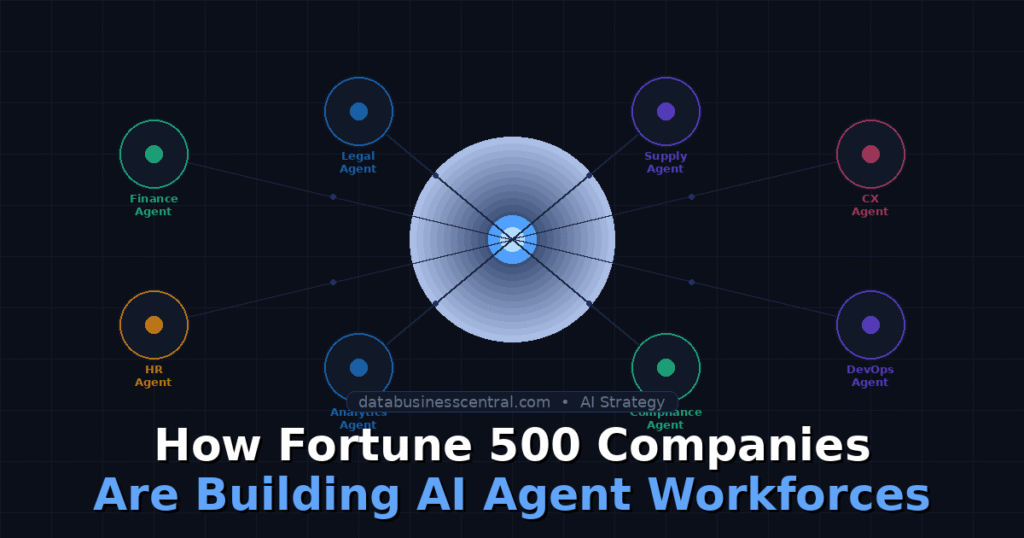
A multi-agent workforce takes this further. It’s an orchestrated ecosystem of specialized AI agents working in concert: one agent monitors supplier contracts, another detects anomalies in financial data, a third drafts compliance reports, and a fourth flags everything to a human decision-maker when thresholds are crossed. Together, they function like a hyper-efficient, always-on department — without the overhead of a department.
Key technologies powering this shift include large language models (LLMs), agentic AI frameworks, retrieval-augmented generation (RAG), robotic process automation (RPA), and increasingly, multi-modal AI systems capable of processing text, images, audio, and structured data simultaneously.
Why Fortune 500 Companies Are Moving Now
The timing of this enterprise AI revolution isn’t accidental. Several forces have converged to make 2024–2025 the tipping point:
The cost of LLMs has collapsed. What cost millions of dollars in compute two years ago now costs thousands. Enterprise-grade AI inference is no longer a luxury line item — it’s a competitive necessity.
Agentic AI frameworks have matured. Platforms like Microsoft AutoGen, LangChain, CrewAI, and Anthropic’s Claude have developed robust tooling for building, deploying, and monitoring AI agent pipelines at enterprise scale.
The ROI case is now undeniable. McKinsey estimates that AI automation could unlock $4.4 trillion in annual productivity gains globally. For a Fortune 500 company operating at scale, even a 5% efficiency improvement across knowledge work translates into hundreds of millions of dollars.
Talent economics are shifting. Enterprise AI agents don’t replace human creativity and judgment — but they do absorb enormous volumes of routine cognitive labor: data aggregation, report generation, process monitoring, compliance checking, and customer query resolution. This frees skilled workers to focus on higher-order problems.
The Architecture of an Enterprise AI Agent Workforce
Building an AI agent workforce isn’t like deploying a SaaS tool. It requires a deliberate enterprise AI strategy built around several architectural pillars.
1. The Agent Orchestration Layer
At the center of every sophisticated AI agent deployment is an orchestration engine — the conductor that assigns tasks to specialized agents, manages dependencies, handles failures, and routes outputs to the right destinations (human or automated).
Companies like Salesforce have built this into their Agentforce platform, enabling businesses to deploy AI agents across sales, service, and marketing pipelines with centralized governance. Microsoft’s Copilot Studio allows enterprises to build custom AI agents that plug directly into their Microsoft 365 ecosystems — from Teams to SharePoint to Azure.
2. Specialized Vertical Agents
The most effective enterprise AI workforces don’t rely on one general-purpose agent doing everything. They deploy specialized agents optimized for specific domains:
- Finance agents that monitor real-time cash flow, flag payment anomalies, and auto-generate FP&A reports
- Legal & compliance agents that scan regulatory databases, cross-reference contracts, and surface risk exposure
- Supply chain agents that predict disruptions, reorder inventory, and coordinate with vendor APIs autonomously
- Customer experience agents that handle Tier 1 and Tier 2 support at scale while escalating complex issues to humans
- HR agents that screen resumes, schedule interviews, and onboard new hires through automated workflow sequences
3. Human-in-the-Loop Design
The most sophisticated AI agent workforces are not fully autonomous — they’re human-AI collaborative systems. Intelligent routing logic determines which decisions agents can finalize autonomously and which require human approval. This design philosophy, sometimes called AI augmentation, ensures accountability while maximizing throughput.
JPMorgan Chase’s COiN (Contract Intelligence) platform — perhaps the most cited enterprise AI case study of the decade — uses AI agents to review commercial loan agreements in seconds that previously took legal teams 360,000 hours annually. Critically, human attorneys still sign off on final decisions. The agents handle the research and drafting; the humans own the judgment.
4. Enterprise Knowledge Graphs and RAG Infrastructure
AI agents are only as smart as the data they can access. Leading Fortune 500 companies are investing heavily in enterprise knowledge graph construction and retrieval-augmented generation (RAG) pipelines — essentially giving their agents an always-updated, proprietary brain fed by internal databases, ERP systems, CRM platforms, and external data feeds.
Companies like Google (internally) and Walmart have built sophisticated data mesh architectures that allow AI agents to query the right data source dynamically, rather than hallucinating answers from stale training data.
Real-World Deployment Patterns
Goldman Sachs: Automating the IPO Preparation Process
Goldman Sachs has deployed AI agents to assist with the preparation of IPO documentation, regulatory filings, and due diligence processes. Tasks that previously required teams of junior analysts working through the night can now be completed by AI agents in hours, with human review focused on strategic content rather than mechanical aggregation.
Walmart: Intelligent Supply Chain at Planetary Scale
Walmart operates one of the most complex supply chains in human history — 10,500+ stores across 24 countries, hundreds of thousands of SKUs, millions of daily transactions. Their AI agent infrastructure monitors inventory levels, predicts demand surges (correlated with weather, local events, even social media trends), and autonomously triggers reorder workflows — all without manual intervention. The result: significant reductions in both overstock and stockout scenarios simultaneously.
Microsoft: Copilot Agents Embedded Across the Enterprise Stack
Microsoft has arguably gone further than any company in embedding AI agents into the fabric of enterprise software. Their Copilot AI agents are now integrated into Dynamics 365 (ERP/CRM), Azure DevOps (software engineering), Power Platform (automation), and Teams (communication). Employees across departments interact with AI agents as a standard part of their workflow — not as a separate application, but as an ambient intelligence layer in the tools they already use.
The Governance Challenge: Managing an AI Workforce Responsibly
Building an AI agent workforce isn’t purely a technology problem — it’s a governance and trust problem. Fortune 500 companies are learning hard lessons about the risks of deploying autonomous systems at scale:
Bias and fairness: AI agents trained on historical data can perpetuate and amplify existing biases. Enterprise AI governance frameworks must include bias auditing as a continuous process, not a one-time deployment check.
Hallucination and error propagation: In a multi-agent pipeline, a hallucinated output from one agent can cascade downstream, producing compounding errors before any human notices. Robust output validation layers and confidence-scoring mechanisms are essential architectural components.
Explainability and audit trails: Regulated industries — banking, healthcare, insurance — require that AI-driven decisions be explainable and auditable. The black-box nature of many LLM-based agents creates genuine compliance risk without proper logging and reasoning transparency.
Data security and privacy: AI agents that have access to sensitive enterprise data create new attack surfaces. Zero-trust security architectures, role-based access controls, and data masking layers are critical infrastructure investments.
Leading enterprises are establishing AI Centers of Excellence (AI CoEs) — internal governance bodies that set standards, audit deployments, manage vendor relationships, and ensure that AI agent workforces operate within defined ethical and operational boundaries.
The Competitive Moat Is Being Built Right Now
Here is the uncomfortable truth for companies still in “AI exploration mode”: the Fortune 500 leaders building AI agent workforces today are not just improving current operations — they are constructing durable competitive moats.
Every month an AI agent operates within a company’s systems, it accumulates institutional knowledge, process optimization data, and feedback loops that make it more effective. The companies that start building now will have AI agents that are meaningfully smarter, faster, and more integrated than competitors who wait another two years to begin.
AI agent workforce maturity is becoming a new dimension of enterprise capability — alongside financial strength, brand equity, and supply chain efficiency — that will separate market leaders from followers in the years ahead.
The question for every C-suite today is not “Should we build an AI agent workforce?” It’s “How quickly can we build one — and how well?”
What This Means for Business Leaders
If you’re a business leader reading this, here are the strategic imperatives that emerge from the Fortune 500 playbook:
Start with high-volume, well-defined processes where AI agents can demonstrate value quickly and safely. Don’t begin with your most complex, ambiguous workflows.
Invest in data infrastructure first. AI agents are only as capable as the data they can access. A poorly governed data environment produces poorly performing agents.
Build human-AI collaboration frameworks from day one. Define clearly which decisions agents own autonomously, which require human review, and what escalation paths look like.
Treat AI governance as a core competency, not an afterthought. The companies that get this right will earn the trust of regulators, customers, and employees simultaneously.
Finally, resist the temptation to think of AI agents as a cost-cutting exercise alone. The most transformative value comes from using AI agent workforces to do things that were previously impossible at scale — not just doing existing things more cheaply
The AI agent workforce revolution is not coming. It’s already here — quietly rewriting the org charts of the most powerful companies in the world. The race to build, deploy, and govern this new class of enterprise intelligence is the defining business competition of our era.
The only question is whether your company is in it.
Published by DataBusinessCentral.com — Covering the intersection of data, AI strategy, and enterprise innovation.
Tags: AI agent workforce, enterprise AI strategy, Fortune 500 AI, autonomous AI agents, agentic AI, multi-agent systems, AI automation, LLM enterprise, generative AI business, AI governance, digital transformation, AI workforce management, intelligent automation, AI orchestration, enterprise machine learning
