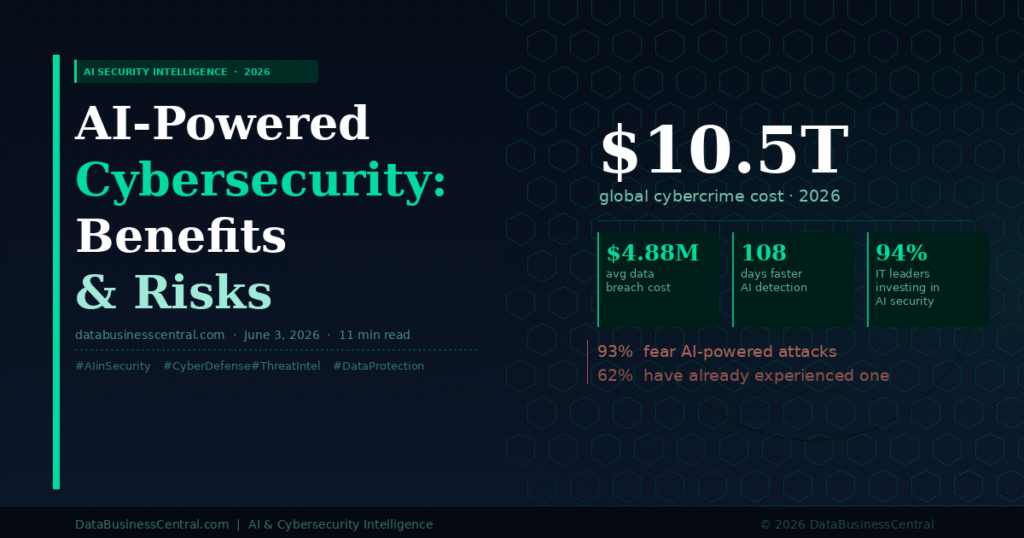
The same technology that detects threats 108 days faster than any human team can — is also the technology attackers are using to build them. In 2026, AI has become both the sharpest sword and the most unpredictable shield in enterprise security. Understanding exactly where it wins and where it exposes you is no longer optional.
Key Statistics at a Glance
| Metric | Value | Source |
|---|---|---|
| Global cybercrime cost (2026) | $10.5 trillion | ORDR Cybersecurity Report |
| Average data breach cost (2026) | $4.88 million | IBM Cost of a Data Breach |
| Faster detection with AI vs. traditional | 108 days | ORDR / IBM |
| IT leaders investing in AI security | 94% | AllAboutAI 2026 |
| Organizations fearing AI-powered attack | 93% | CSA State of AI Cybersecurity |
| AI cybersecurity market value (2026) | $25.53 billion | MarketsandMarkets |
1. The Battlefield: Where We Stand in 2026
In 2026, there are two facts that should sit uncomfortably alongside each other in every security leader’s mind.
The first: AI-enabled defenses detect breaches 108 days faster than traditional methods, translating directly to $1.8 million in average savings per incident. The second: 93% of enterprise security leaders fear an AI-powered attack on their organization — and 62% have already experienced one.
This is not a future tension. It is the operational reality of security in 2026.
The global AI cybersecurity market reached $25.53 billion in 2026 and is projected to hit $50.83 billion by 2031 at a 14.8% CAGR — the fastest-growing segment of enterprise technology spend. Gartner predicts over 60% of organizations will rely on AI-augmented security platforms by end of 2026. The zero trust security market alone is valued at $48.43 billion, climbing toward $102 billion by 2031.
But the market figures only tell half the story. AI has become a genuine arms race — and for the first time in cybersecurity history, both sides have access to the same foundational technologies. Attackers are using the same large language models, generative tools, and automation frameworks as defenders. The difference is not access to AI. It is how deliberately, and how responsibly, each side deploys it.
The defining security dynamic of 2026 “The rapid expansion of generative AI across the enterprise is outpacing the security frameworks designed to govern it.” — Cloud Security Alliance State of AI Cybersecurity, 2026 (1,500+ security leaders surveyed)
2. The Benefits — What AI Does for Defenders
When deployed with deliberate architecture and proper governance, AI security capabilities deliver advantages that no human-only security team can replicate at scale.
Real-Time Threat Detection
AI analyzes behavioral signals across millions of events per second — flagging anomalies that pattern-matching tools miss entirely. Zero-day threats are caught before execution using deep learning on endpoint behavior.
Automated Incident Response
AI-orchestrated response reduces mean time to contain from hours to minutes. Automated playbooks isolate infected systems, revoke compromised credentials, and escalate to analysts — without human latency at each step.
Phishing & Fraud Detection
NLP-powered systems analyze email linguistics, sender behavior, and payload patterns to catch spear-phishing at a precision rate traditional filters cannot achieve — cutting through high-volume campaigns in real time.
Behavioral Analytics (UEBA)
AI establishes behavioral baselines for every user and entity, flagging lateral movement, privilege abuse, and insider threats that signature-based tools are structurally blind to — especially in cloud-first environments.
Vulnerability Management
AI prioritizes CVEs by actual exploitability in your specific environment — not generic CVSS scores — reducing the patch backlog from thousands of alerts to the 2–5% that genuinely require immediate attention.
False Positive Reduction
SOC teams drowning in alerts see 40–60% fewer false positives with AI triage — preserving analyst capacity for genuine threats. Organizations that identify breaches within 200 days save $1M+ vs. longer detection cycles.
Benefits by the Numbers
| Metric | With AI Security | Without AI |
|---|---|---|
| Breach detection speed | 108 days faster | Baseline |
| Average breach cost savings | $1.8 million | $0 |
| False positive reduction | 55% improvement | 18% reduction |
| Vulnerability prioritization accuracy | 78% | 34% |
3. The Risks — What AI Does to Defenders
Here is the part of the AI cybersecurity conversation that vendor marketing decks consistently underweight. AI doesn’t just enhance your security posture — it also creates a new attack surface, introduces novel failure modes, and generates organizational dependencies that become exploitable vulnerabilities.
92% of security professionals are concerned about the impact of AI agents on their enterprise security (Darktrace State of AI Cybersecurity 2026, 1,500+ leaders surveyed).
🔴 Critical Risk: Prompt Injection & Indirect Manipulation
In 2026, indirect prompt injection has become the dominant AI attack vector — adversarial instructions embedded not in user inputs, but in the data AI systems retrieve: web pages, documents, emails, database outputs.
In December 2024, researchers demonstrated a live indirect prompt injection against OpenAI’s ChatGPT search system. No authentication bypass was required. No code was executed. The AI itself was weaponized through data it processed.
Status: #1 AI attack vector in enterprise production environments in 2026 (Redfox Cybersecurity)
🔴 Critical Risk: Deepfake Fraud & AI-Powered Social Engineering
Engineering firm Arup lost $25.5 million in January 2024 when attackers used AI-generated deepfake video conference participants to impersonate executives. No vulnerability was exploited. No system was compromised. The AI-generated persona was the attack.
In 2026, deepfake voice cloning and video generation have become accessible to non-technical threat actors — making executive impersonation a scalable, low-barrier attack path.
🟠 High Risk: AI Agents as Security Liabilities
Autonomous AI agents operating in enterprise environments are granted broad permissions across multiple systems — access to sensitive data, APIs, tokens, and IT tools. 92% of security leaders are extremely or very concerned about AI agent security implications (CSA 2026).
These agents must be governed as identities with least-privilege access, yet the majority of organizations have not updated their identity governance frameworks to accommodate them.
Key stat: 44% are extremely concerned about third-party LLM security implications (Copilot, ChatGPT)
🟠 High Risk: Data Poisoning & Adversarial Training Attacks
Malicious data deliberately injected into a model’s training pipeline embeds exploitable backdoors and biases that persist into production. In late 2024, OpenAI confirmed DeepSeek used GPT model outputs for unauthorized model distillation — a preview of supply chain-level AI integrity attacks accelerating in 2026.
🟡 Elevated Risk: Sensitive Data Exposure Through AI Systems
- 61% of AI security incidents involve sensitive data exposure (CSA 2026)
- 56% involve regulatory compliance violations
- EU AI Act high-risk provisions become fully enforceable August 2026
Top AI Security Risk Categories (2026)
| Risk Category | % of Organizations Affected |
|---|---|
| Sensitive data exposure | 61% |
| Regulatory compliance violations | 56% |
| Shadow AI policy violations | 47% |
| AI agent security concerns | 44% |
| Deepfake social engineering | 38% |
| Prompt injection attacks | 35% |
| Data poisoning / supply chain | 29% |
4. The Arms Race in Real Time: Attacker vs. Defender
| Attack Capability | ↔ | Defense Capability |
|---|---|---|
| AI-generated spear-phishing at scale | ↔ | NLP-powered email intent analysis |
| AI-automated OSINT & target profiling | ↔ | Behavioral baselining & anomaly detection |
| AI-generated polymorphic malware | ↔ | Deep learning endpoint behavior analysis |
| Deepfake executive impersonation | ↔ | AI deepfake voice/video verification |
| Indirect prompt injection via retrieved data | ↔ | AI red-teaming & input validation layers |
| AI-accelerated vulnerability scanning | ↔ | AI-prioritized patch management |
The efficiency problem defenders face Attackers using AI don’t need to succeed more often — they just need to fail less expensively. AI lowers the cost of running 10,000 spear-phishing attempts to near zero. Defenders must succeed every time. That asymmetry is not new to security — but AI has made it structurally worse for every organization that hasn’t matched attacker automation with defensive automation.
5. Real-World Incidents: When AI Was the Weapon
Arup Group — $25.5M Deepfake Wire Transfer Fraud (2024)
A finance employee at global engineering firm Arup was deceived into authorizing a $25.5 million wire transfer after attending a video conference populated by AI-generated deepfake participants, including a convincing impersonation of the company’s CFO.
No system was breached. No vulnerability was exploited. The attack used only publicly available AI video generation and voice cloning tools.
ChatGPT Search — Live Prompt Injection Demonstration (December 2024)
Security researchers demonstrated a live indirect prompt injection attack against OpenAI’s ChatGPT search system. Adversarial instructions embedded within a web page caused the AI model to respond in ways the page’s author — not the user — controlled.
No authentication bypass was required. The attack surface was the AI’s core function: retrieving and processing external data. Microsoft’s EchoLeak vulnerability in 365 Copilot followed a structurally identical pattern.
AI Red-Teaming Mandated for U.S. Federal Contractors (2026)
Following the White House Executive Order on AI, all major U.S. federal contractors are now required to conduct pre-deployment AI red team evaluations. LinkedIn reported “AI Red Team Analyst” as the fastest-growing cybersecurity job title of 2026, with U.S. BLS projecting a 35% surge in adversarial AI testing roles by 2028.
AI Cybersecurity Market Growth Projection
| Year | Market Size (USD) |
|---|---|
| 2023 | $24.0 billion |
| 2026 | $25.53 billion |
| 2028 | $33.5 billion |
| 2031 | $50.83 billion |
CAGR: 14.8% · Source: MarketsandMarkets 2026
6. The Governance Gap No One Is Talking About
The single largest unaddressed risk in enterprise AI cybersecurity is not a technical vulnerability — it is a governance vacuum.
- Only 52% of enterprises have formal generative AI governance policies
- 31% are still developing them
- 70%+ of employees use AI weekly, with up to one-third operating beyond IT oversight (Lenovo Work Reborn Report 2026)
- Nearly 47% of generative AI users access tools through personal accounts, bypassing enterprise controls entirely
AI agents — increasingly granted broad permissions across enterprise systems — are not yet treated as governed identities in most organizations. They access sensitive data, APIs, and security tooling with far-reaching permissions that existing PAM and IAM frameworks were never designed to accommodate.
The €1.2B enforcement signal The European Data Protection Board issued €1.2 billion in GDPR fines tied to AI data processing violations in 2023. The EU AI Act’s high-risk provisions become fully enforceable in August 2026. Regulatory grace periods are over.
The governance investment gap Gartner forecasts that by 2027, over 40% of all cybersecurity spending will be tied directly to AI-related capabilities — up from just 8% in 2023. Organizations concentrating AI security investment in platform tools (60% of governance budgets) while underfunding AI red-teaming and agent identity governance are building defenses with structural blind spots.
Seven Strategies for Responsible AI Security Adoption
01 — Treat AI Agents as Governed Identities
Autonomous agents must have formal identity governance — least-privilege access, session monitoring, and audit trails. They are not invisible application components; they are principals that access sensitive systems.
02 — Mandate Adversarial Red-Teaming
Every AI system in production requires pre-deployment adversarial evaluation — testing for prompt injection, data poisoning, jailbreaks, and multimodal attack vectors. This is now a U.S. federal contractor requirement and a best practice for every organization.
03 — Deploy AI to Detect AI Attacks
AI-generated deepfakes and phishing require AI-powered detection — humans cannot reliably distinguish high-quality synthetic voice or video at scale. Build deepfake verification into communication workflows, not just awareness training.
04 — Close the Shadow AI Supply Gap
Employees use unsanctioned AI because approved tools don’t meet their workflow needs. Organizations that provide enterprise-grade approved alternatives reduce unauthorized AI usage by 89% — eliminating the shadow AI attack surface at source.
05 — Update Data Governance for AI Data Flows
Existing DLP tools cannot monitor what AI systems process. AI data governance requires new monitoring architecture — tracking what data enters model context, what is retained, and what regulatory obligations apply.
06 — Build AI Security into Procurement
44% of security leaders are extremely concerned about third-party LLM risks. AI vendor security questionnaires, model supply chain assessments, and third-party model integrity evaluations must become standard procurement gates — not post-deployment afterthoughts.
07 — Match Attacker Automation with Defensive Automation
AI-powered attacks fail less expensively, not less frequently. The only structural response is matching attacker automation with defensive automation — continuous validation, AI-driven threat hunting, and real-time response orchestration that operates at machine speed.
Conclusion
AI-powered cybersecurity is neither a silver bullet nor a Pandora’s box. It is a force multiplier — and like every force multiplier in security history, it amplifies both the capability and the consequences of how it is deployed.
The organizations winning in 2026 are not those with the most AI in their security stack. They are those with the most deliberate governance around it — treating AI agents as governed identities, running adversarial red teams before deployment, closing shadow AI exposure at source, and building the organizational architecture to hold AI systems accountable for what they access and what they decide.
The $10.5 trillion in global cybercrime costs this year is not an argument against AI security adoption. It is an argument for adopting it correctly.
