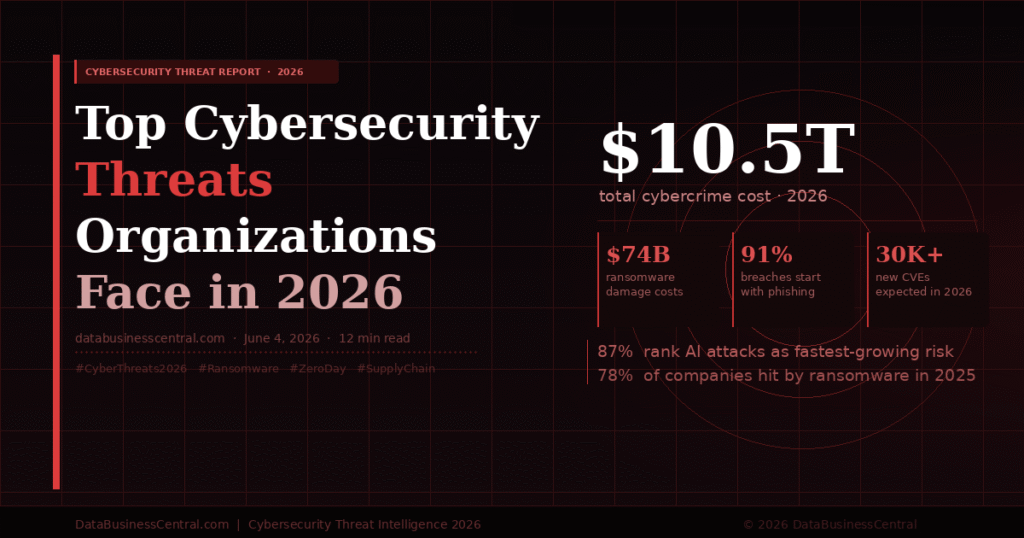
Over 7.5 million cyber incidents were recorded in 2025. Ransomware strikes a new victim every two seconds. Phishing starts 91% of all successful breaches. And for the first time in history, attackers and defenders are using the same AI tools — with one crucial difference: attackers only need to win once.
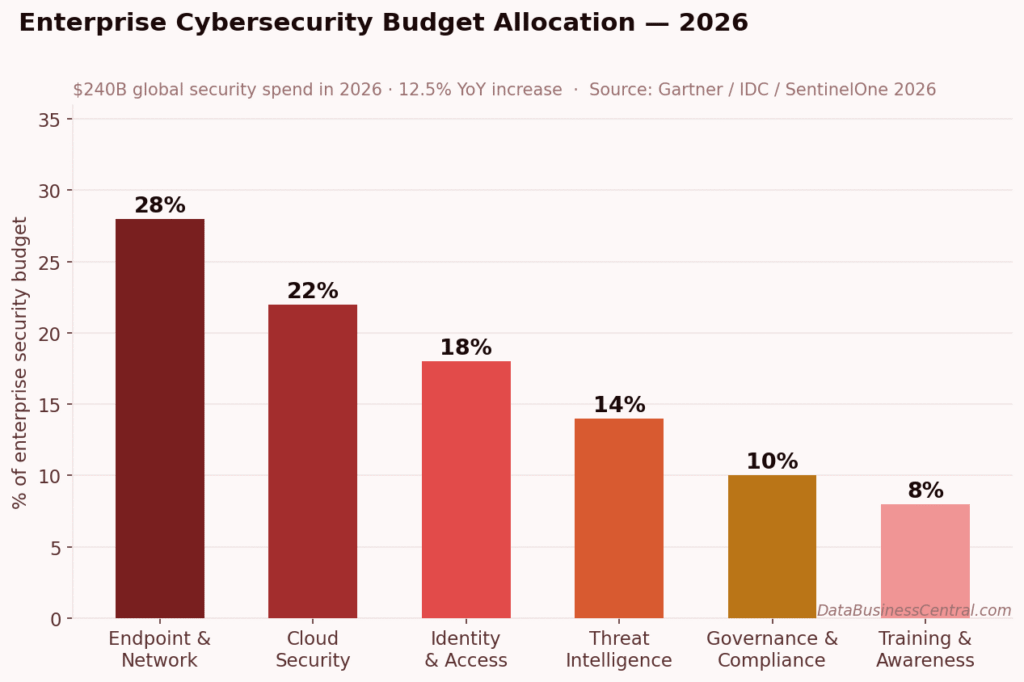
Cybersecurity in 2026 is no longer just an IT concern. It is a board-level mandate, a regulatory obligation, and a daily operational risk for organizations of every size and sector. Total cybercrime costs are forecast to surpass $10.5 trillion this year. Global security spending is racing to $240 billion trying to keep pace. And the threat actors driving those numbers are not slowing down — they are professionalizing, automating, and weaponizing AI at a speed that makes the threat landscape of 2023 look almost quaint by comparison.
This is not a catalog of every threat that exists. It is a focused intelligence briefing on the threats causing the most documented damage to organizations right now — with real incident data, verified statistics, and the defense priorities that follow from both.
1. The 2026 threat landscape: what the numbers reveal
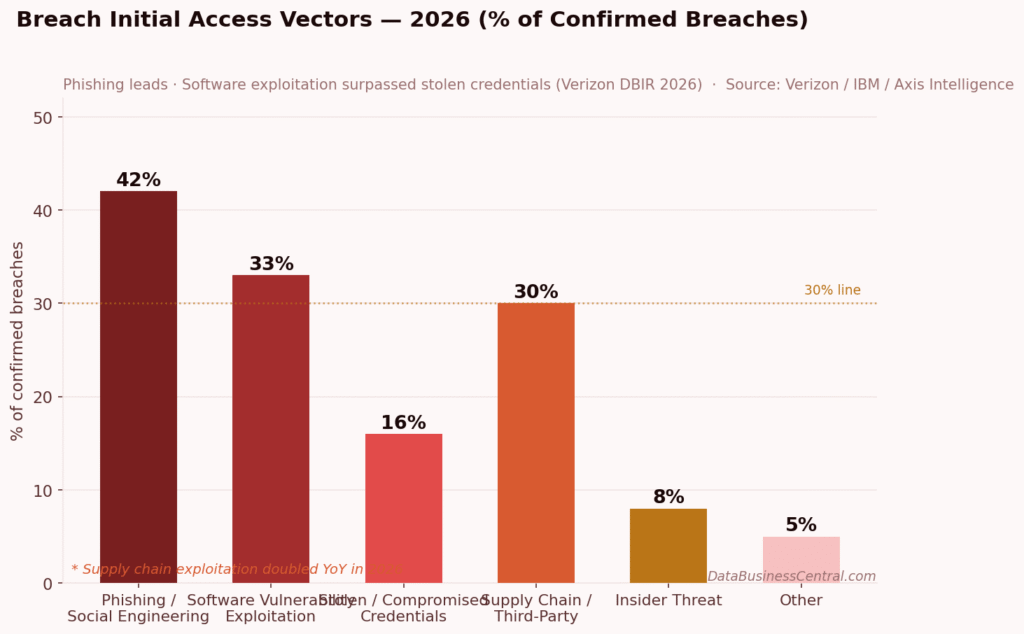
The Verizon 2026 Data Breach Investigations Report, published this week, confirms the structural shift security teams have been warning about for years. Software vulnerability exploitation has overtaken stolen credentials as the top initial access vector — a signal that attackers are increasingly moving from “trick a human” to “exploit a system.” Yet social engineering remains devastatingly effective, accounting for the majority of human-initiated breaches. The CVE database now holds over 305,000 recorded vulnerabilities, with more than 30,000 new disclosures projected for 2026 alone.
$10.5 Total forecast cybercrime cost in 2026 (SentinelOne)
7.5M+ Cyber incidents recorded globally in 2025 (ECCU)
91% of successful breaches started with phishing (Lazarus Alliance)
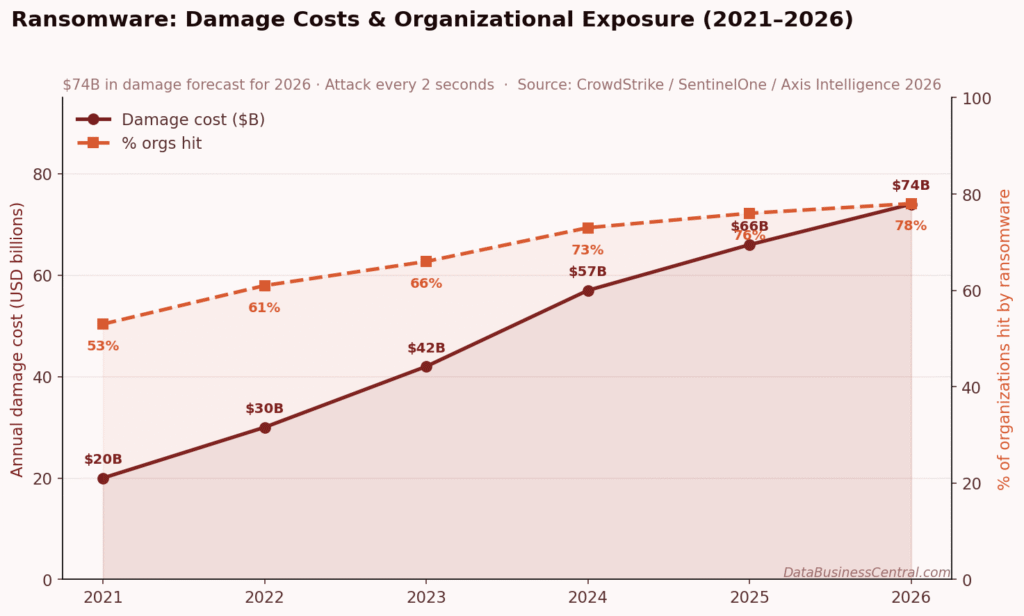
78% of companies hit by ransomware in the past year (CrowdStrike 2026)
87% of organizations rank AI attacks as fastest-growing risk (ECCU)
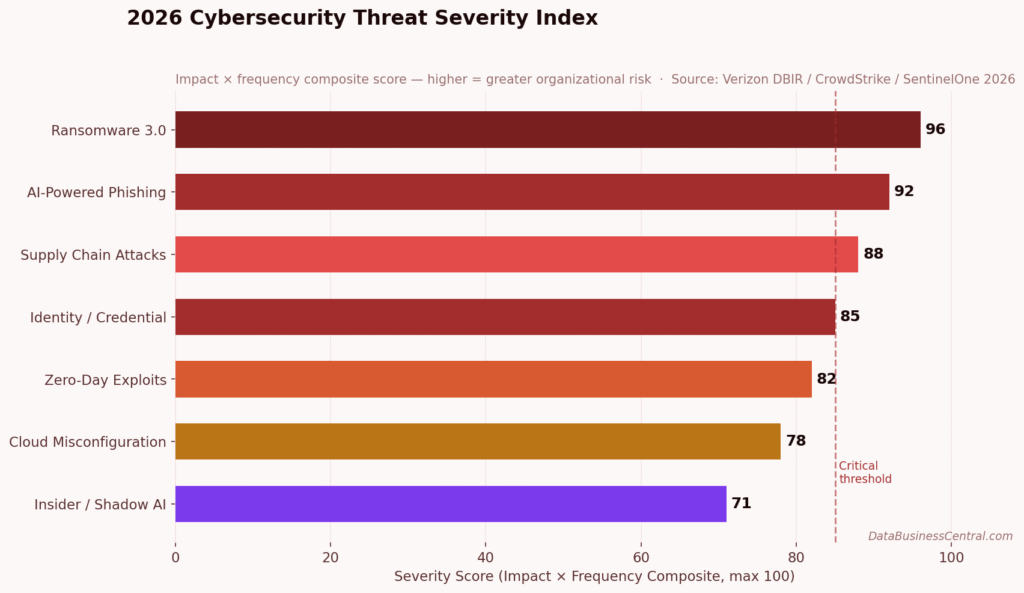
2. Ransomware 3.0: extortion without encryption
01 Ransomware is no longer about locking your files. It is about owning your data.
The ransomware playbook has fundamentally changed. Where ransomware 1.0 encrypted data and demanded payment for decryption, and ransomware 2.0 added double extortion by threatening to publish stolen data, ransomware 3.0 in 2026 skips encryption entirely in 50% of attacks. Attackers exfiltrate sensitive data first, then threaten public release — a strategy that bypasses even the most robust backup and recovery infrastructure. Paying the ransom no longer guarantees data protection, because the leverage is not the key to your encrypted files. It is the threat of publication itself.
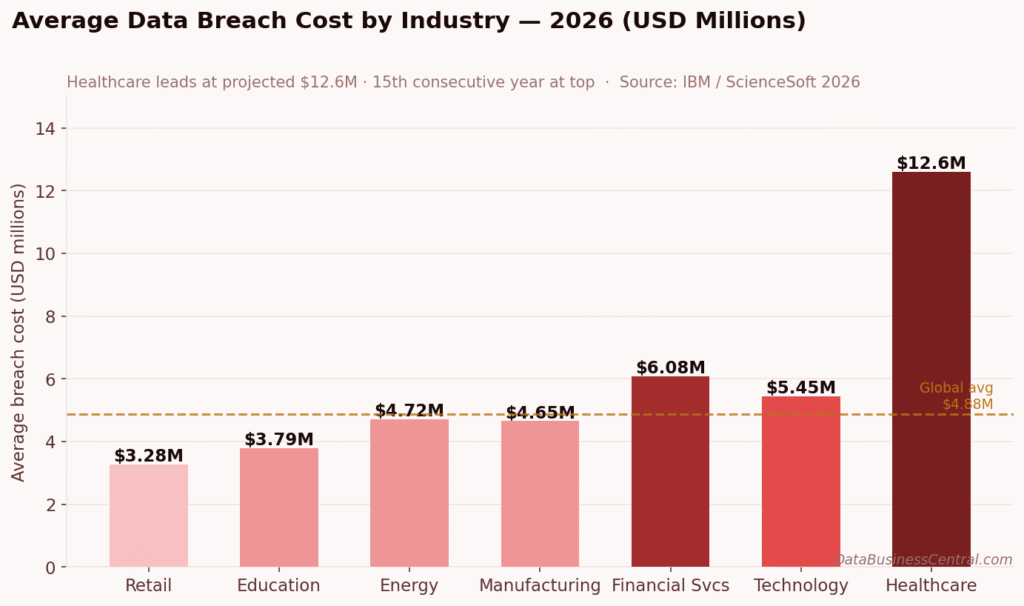
Annual ransomware damage costs are forecast to reach $74 billion in 2026. A business or consumer will be struck every two seconds. Healthcare faces the highest per-incident cost at a projected $12.6 million average — a figure that captures not just ransom payments but downtime, regulatory exposure, and patient safety consequences. The ransomware payment landscape has also shifted: in 2024, the average ransom payment reached $2 million, with 94% of victims paying the initial demand in full.
78% of companies hit by ransomware in the past year — CrowdStrike 2026
The backup strategy is no longer enoughThe shift from encryption-only to data theft plus extortion means organizations that rely on “we have good backups” as their ransomware defense are protecting against last decade’s attack. In 2026, the real leverage is the threat of regulatory fines, reputational damage, and customer notification obligations that follow a public data leak — whether you restore from backup or not.
AI-Powered phishing and social engineering
02 Phishing was already the most effective attack vector. AI made it scalable and nearly undetectable.
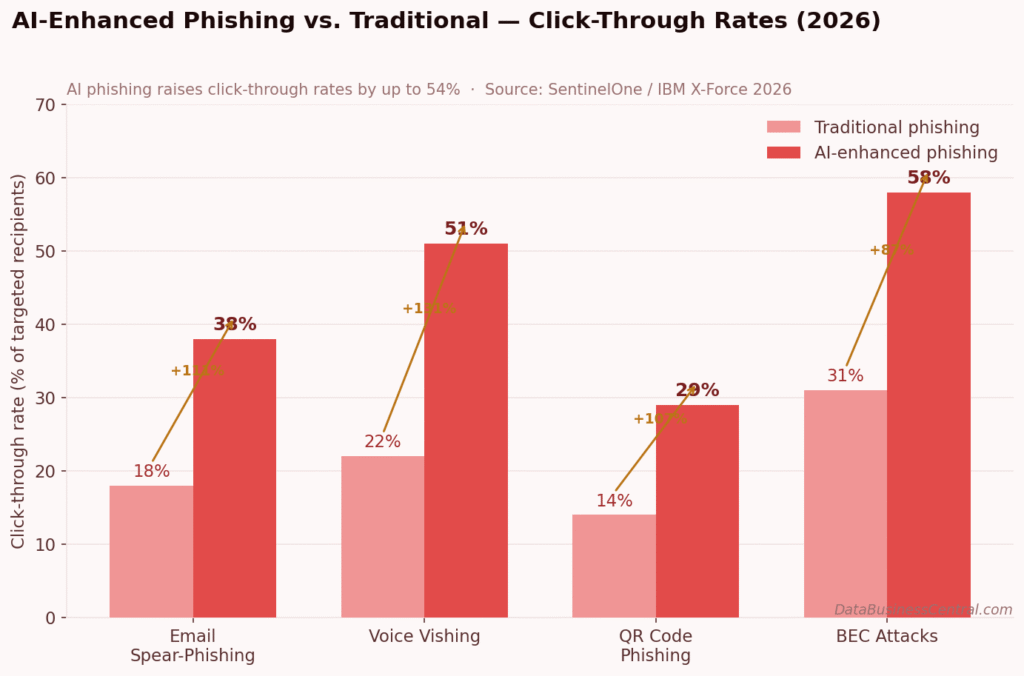
Phishing accounts for 42% of all global breaches in 2026, and it starts 91% of successful intrusions. But 2026 phishing is not the poorly worded email of 2015. AI-generated phishing lures increase click-through rates by up to 54%, eliminating the grammar errors, awkward phrasing, and inconsistent formatting that employees were trained to spot. LLMs can now generate perfectly personalized spear-phishing emails at scale — incorporating a target’s writing style, recent activities, and organizational context scraped from LinkedIn, company websites, and public repositories.
Beyond email, AI-powered social engineering now includes deepfake voice cloning (requiring just seconds of audio), synthetic video for business email compromise, and QR code phishing that bypasses traditional email security gateways. The attack surface extends to every human communication channel simultaneously — voice calls, SMS, Teams, Slack, and video conferencing alike.
AI phishing raises click-through rates up to 54% — SentinelOne 2026
03 .Supply chain and third-party attacks
In 2026, if your vendors are insecure, so are you.
Third-party involvement in breaches doubled in a single year, reaching 30% of all confirmed incidents (Axis Intelligence 2026). Supply chain attacks exploit the interdependencies that modern organizations depend on — software update pipelines, managed service providers, shared SaaS platforms, code libraries, and identity management systems. The attack surface is not your perimeter. It is every trusted third party with access to your environment.
Confirmed 2026 incidents at Cognizant’s Intuitive platform, TriZetto, CIBM, and Taiwan High Speed Rail Corporation all followed a consistent pattern: attackers exploited inter-organizational dependencies to gain access through trusted channels. The SolarWinds SUNBURST attack of 2020 — which distributed trojanized updates to approximately 18,000 organizations — is no longer the exception. It is the template. May 2026 alone saw supply chain attacks involving Instructure, Foxconn, and Grafana.
Third-party breach involvement doubled YoY — now 30% of all breaches (Axis Intelligence)
The zero-trust supply chain imperativeTrust becomes a double-edged sword in supply chain security: once an attacker bypasses a trust mechanism, they have near-free rein over your connected systems. Zero-trust principles applied specifically to third-party access — with continuous verification, just-in-time provisioning, and behavioral monitoring — are no longer optional security architecture. They are the minimum viable defense against this attack class.
5. Identity-based and credential attacks
04 Identity has become the most valuable attack surface in the enterprise — and non-human identities are the blindspot.
Identity attacks have dominated the threat landscape for over a decade, but 2026 introduces a structural escalation: non-human identities. Modern environments are populated with service accounts, API keys, CI/CD pipeline tokens, microservice credentials, bot identities, and AI agent permissions — the vast majority unmonitored and over-permissioned. Attackers who compromise a service account or API key often gain access equivalent to a privileged human user, but with none of the behavioral monitoring applied to human accounts.
The Verizon 2026 DBIR confirms software vulnerability exploitation has overtaken stolen credentials as the primary initial access vector — but credential theft through phishing, adversary-in-the-middle attacks, and AI-assisted credential harvesting remains the dominant second step after initial access. AI-driven credential attacks now incorporate stolen data enriched with behavioral analytics to create “intelligent combo lists” that defeat rate limiting and anomaly detection.
Non-human identities are the fastest-growing attack surface in 2026 (Lazarus Alliance)
6. Zero-day vulnerabilities and unpatched systems
05 The CVE database crossed 305,000 vulnerabilities. The old assumption that organizations have days to patch before exploitation no longer holds.
The old security assumption — “we have a few days to patch before exploitation begins” — was already weakening before 2026. AI has broken it entirely. Generative AI is now boosting 15+ distinct attack techniques, including automated vulnerability scanning, exploit script generation, and prioritized targeting based on CVE severity and organizational exposure (Verizon DBIR 2026). The time from CVE publication to active exploitation in the wild has compressed from days to hours.
The Microsoft SharePoint zero-day CVE-2026-32201, disclosed in May 2026, allowed remote code execution and was actively exploited against over 1,300 servers before patches were widely applied. Google’s Threat Intelligence team has documented state-sponsored actors from multiple nation-states using AI to discover and exploit vulnerabilities at a pace that outstrips organizational patch cycles. In cloud environments, zero-day response is complicated further by containers and serverless functions that can disappear before forensic evidence is collected.
30,000+ new CVE disclosures expected in 2026 — CVE database now holds 305,000+
7. Cloud misconfiguration and API abuse
06 Most cloud breaches in 2026 are not caused by provider failures. They are caused by customer misconfigurations.
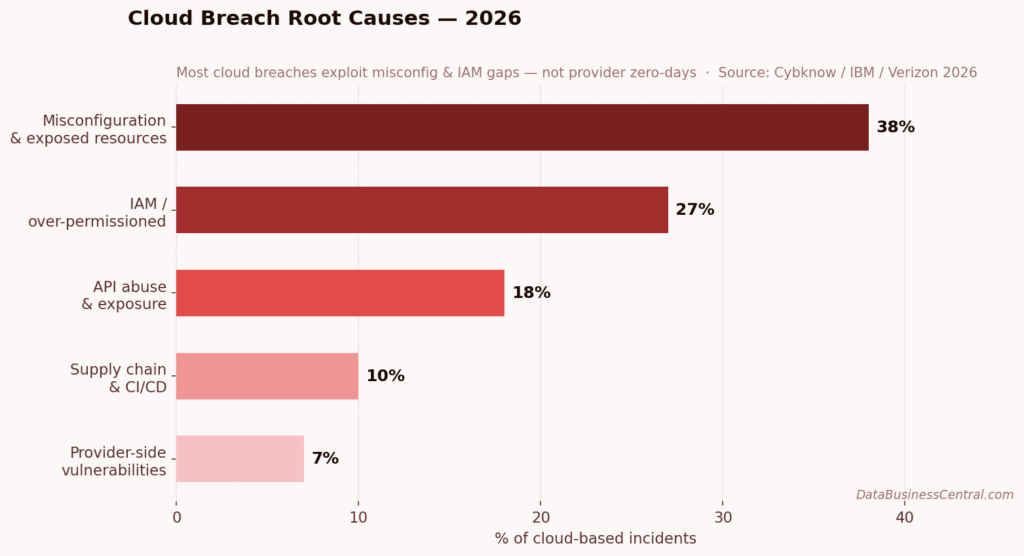
Cloud adoption continues to accelerate, and so does the exposure it creates. The most dangerous pattern in cloud security is not a sophisticated exploit — it is an over-permissioned IAM role, an exposed storage bucket, inconsistent policies across multi-cloud environments, or an API endpoint that was never properly secured. Most cloud breaches exploit gaps in IAM, exposed storage, stolen credentials, and inconsistent policies — not provider-level zero-days (Cybknow 2026).
API abuse is emerging as a distinct and growing threat category. As organizations expose more functionality through APIs — to partners, customers, mobile apps, and AI systems — each endpoint represents a potential entry point. Kubernetes misconfiguration and CI/CD supply chain attacks are now established attack vectors in cloud-native environments, with attackers targeting the pipeline that builds and deploys software rather than the software itself.
Cloud misconfig and IAM abuse drive majority of cloud-based breaches — Cybknow / IBM 2026
8. Insider threats and shadow AI risk
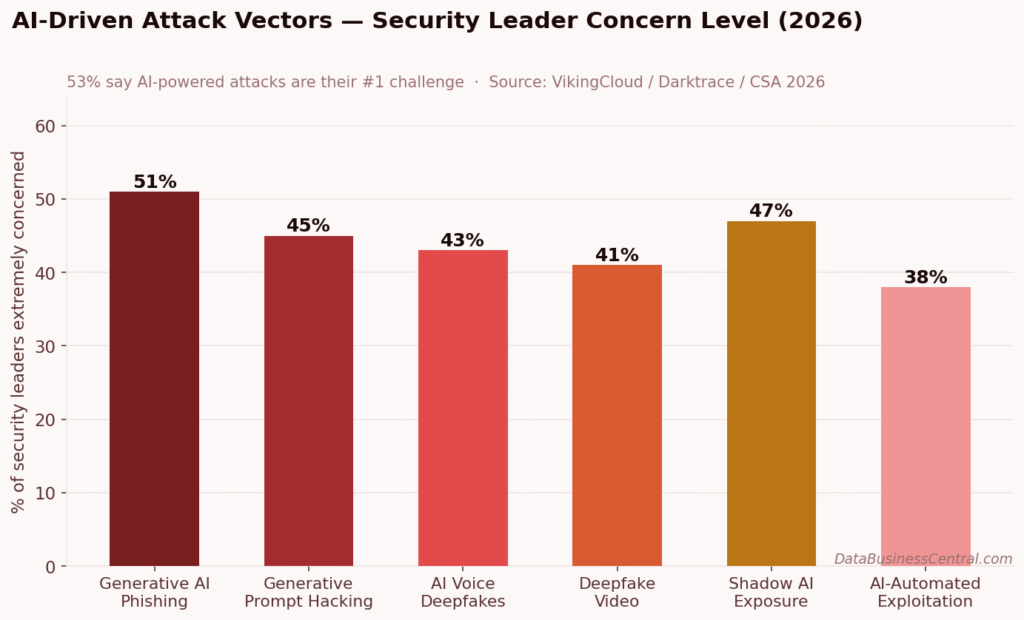
07 The insider threat has a new dimension in 2026: 70% of employees use AI weekly, with a third operating outside IT oversight.
Insider threats — whether malicious, negligent, or simply uninformed — have always been a difficult category to address. In 2026, shadow AI has added a new and structurally undermonitored dimension. Nearly 47% of generative AI users access tools through personal accounts, bypassing enterprise data controls entirely. The average enterprise experiences 223 AI data policy violations per month. Shadow AI added an average of $670,000 to breach costs in incidents where unauthorized AI usage was implicated.
The threat is not primarily malicious. Employees are using AI tools because they are genuinely useful and their approved alternatives are inadequate. But the consequence is sensitive customer data, proprietary strategy documents, and regulated health or financial information being processed by consumer AI services with no enterprise data protection, no audit trail, and no governance oversight. When a violation becomes a breach, the regulatory exposure falls entirely on the organization — not the employee or the AI provider.
Shadow AI added avg $670K to breach costs per incident — Netskope 2026
9. Real-world incidents: May 2026
The following are confirmed incidents from May 2026, illustrating how these threat categories manifest in practice across sectors.
Supply Chain
Foxconn, Grafana, Instructure — multi-sector supply chain breach cluster
May 2026 saw a cluster of supply chain-linked incidents affecting Foxconn (manufacturing), Grafana (observability tooling used across thousands of enterprise stacks), and Instructure (learning management SaaS). In each case, attackers exploited inter-organizational dependencies — targeting systems that connected into larger enterprise environments. The pattern mirrors the Cognizant and TriZetto incidents from March 2026, confirming supply chain attacks as a sustained and systematic campaign strategy, not isolated incidents.
Sectors affected: manufacturing, SaaS, education technology
Zero-Day
Microsoft SharePoint CVE-2026-32201 — 1,300+ servers actively exploited
A critical remote code execution zero-day in Microsoft SharePoint was disclosed in May 2026 and immediately exploited against over 1,300 internet-facing servers before widespread patching. SharePoint administrators were urged to patch immediately and restrict internet exposure. The incident demonstrates the compressed exploitation window that AI-assisted vulnerability scanning has created: by the time the CVE was publicly disclosed, active exploitation was already underway.
CVE: CVE-2026-32201 · Impact: Remote code execution · Servers affected: 1,300+
Social Engineering
Robinhood — phishing sent from legitimate company addresses via account creation flaw
A flaw in Robinhood’s account creation process allowed attackers to send phishing emails from legitimate Robinhood email addresses — giving campaigns the sender authenticity that makes AI-generated lures even harder to detect. The incident illustrates how attackers layer AI-generated content with legitimate brand infrastructure to bypass both technical filters and human skepticism simultaneously.
Attack type: Trusted-sender phishing · Technique: Account creation abuse + social engineering
Ransomware
NYC Health + Hospitals — healthcare sector ransomware targeting critical infrastructure
New York City Health + Hospitals was among the significant May 2026 incidents, consistent with the continued targeting of healthcare by ransomware groups. Healthcare breach costs are projected to hit $12.6 million average in 2026 — driven not just by ransom payments but by the regulatory, operational, and patient safety consequences unique to the sector. The healthcare sector recorded 460 ransomware attacks and 182 data breaches in 2025 alone — the highest of any critical infrastructure sector.
Sector: Healthcare · Projected avg breach cost 2026: $12.6M
10. Defense priorities: what the data says to do
The threat data for 2026 is not ambiguous about where defenses should be concentrated. The incidents that are causing the most damage share a consistent set of enablers — and the organizations mitigating them successfully share a consistent set of controls.
Zero Trust architecture
Never trust, always verify — for humans, machines, APIs, and AI agents. Least-privilege access with continuous verification is the structural response to identity and supply chain attacks.
Compressed patch cycles
AI-assisted exploitation has eliminated the days-long patch window. Organizations need automated vulnerability prioritization and same-day patching capability for critical CVEs in internet-exposed systems.
AI-powered threat detection
Fighting AI-powered attacks requires AI-powered detection. Behavioral analytics, UEBA, and ML-based anomaly detection at machine speed — not weekly SIEM review cycles.
Human identity + non-human IAM
Govern every identity — including service accounts, API keys, and AI agent permissions. Apply PAM, just-in-time access, and behavioral monitoring to machine identities at the same standard as human users.
Cloud security posture management
CSPM tools with automated policy enforcement are essential for multi-cloud visibility. Manual configuration review cannot keep pace with the speed and scale of cloud infrastructure changes.
Vendor security assessments
Third-party involvement in 30% of breaches demands supply chain security programs with continuous vendor monitoring, contractual security standards, and access controls tied to verified compliance posture.
The one number that frames all defense investmentsOrganizations that identify breaches within 200 days save approximately $1 million compared to those with longer detection times. AI-enabled security platforms detect breaches 108 days faster than traditional methods, translating to $1.8 million in average savings per incident (ORDR / IBM 2026). The ROI on detection investment is the clearest number in enterprise security economics.
The threat landscape in one paragraph
In 2026, the organizations losing to cyberthreats are not losing because they were ignorant of the risks. They are losing because the speed of attacker innovation — AI-accelerated, professionally organized, and precisely targeted — has outpaced the speed of their defensive adaptation. Ransomware groups have abandoned encryption for pure extortion. Phishing campaigns are indistinguishable from legitimate communication. Supply chain attackers are inside the perimeter before the first alert fires. The answer is not more budget in the same direction. It is a structural shift toward detection over prevention, zero trust over perimeter defense, AI-matched automation over manual processes, and governance that treats every identity — human or machine — as a potential attack surface. The organizations that make that shift are finding that the same intelligence landscape that makes 2026 dangerous also makes it possible to defend more effectively than at any point in security history — for those willing to match attacker sophistication with defender discipline.
