The boardroom debate is over. AI is no longer a “should we?” conversation — it’s a “how fast and how well?” one. Yet despite near-universal adoption headlines, the data tells a far more nuanced story: record investment, explosive uptake, and a widening gap between the companies capturing real value and those drowning in pilot purgatory.
We’ve combed through reports from McKinsey, Gartner, Deloitte, Forrester, BCG, PwC, and the U.S. Federal Reserve to bring you the most comprehensive AI adoption statistics roundup of 2026. These aren’t vanity metrics — they’re the numbers that should shape your AI strategy today.
The Big Picture: AI Adoption Has Crossed the Tipping Point
The headline numbers are staggering, but the story underneath them is what matters.
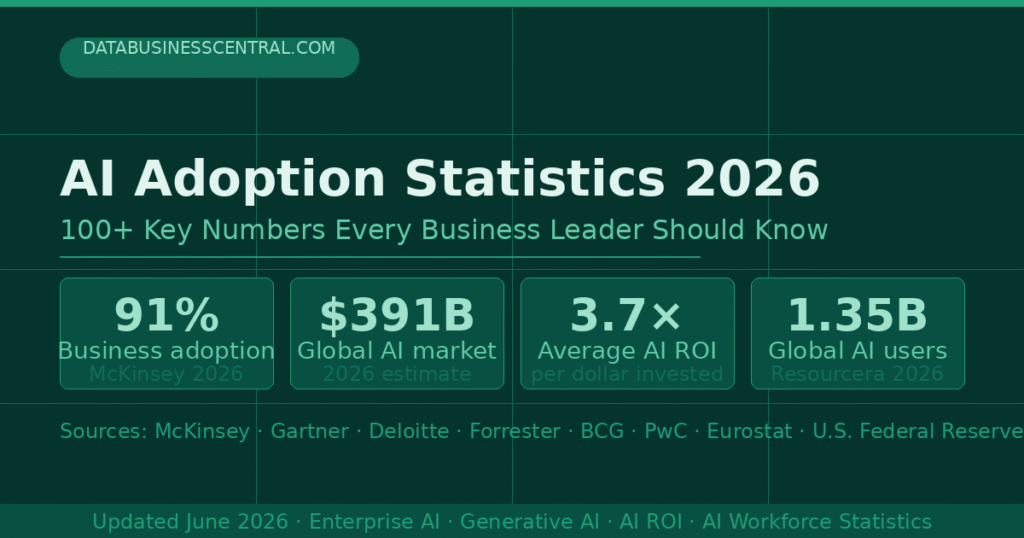
- 91% of businesses now use AI in at least one capacity in 2026, up from 78% in 2024 and 55% in 2023 (Azumo / McKinsey)
- 88% of organizations report regular AI use in at least one business function (McKinsey State of AI 2025)
- 65% of organizations use generative AI in at least one business function in Q1 2026 — double the rate from just ten months earlier (McKinsey)
- 72% of large enterprises have at least one AI workload running in production in 2026, up from 55% in 2024 and just 20% in 2020 (Companies History)
- Only 8% of organizations have no AI initiatives planned or underway in 2026, down from 35% in 2021 (Medha Cloud)
- 1.35 billion people worldwide actively use AI tools — roughly 16.3% of the global population (Resourcera)
- ChatGPT reached 900 million weekly active users in February 2026, processing over 2 billion daily queries (Companies History)
The signal: AI has moved from competitive advantage to baseline infrastructure. The question is no longer adoption — it’s execution depth.
AI Market Size & Investment Statistics 2026
Money talks, and it’s saying one thing very loudly: AI is the defining technology investment of this decade.
- The global AI market currently stands at approximately $391 billion with analysts projecting a fivefold increase over the next five years (Netguru)
- The generative AI market is worth $67 billion in 2026, expected to reach $1.3 trillion by 2032 (Bloomberg Intelligence)
- The generative AI market was valued at $103.58 billion in 2025, projected to hit $161 billion in 2026 at a CAGR of 39.6% (Fortune Business Insights)
- By 2028, global AI spending is expected to reach $632 billion, nearly doubling from 2026 levels (Medha Cloud)
- U.S. private AI funding reached $109.1 billion in 2024 — nearly 12x China’s $9.3 billion and 24x the UK’s $4.5 billion (Netguru)
- China’s AI market reached $170 billion in 2025
- $252 billion in total AI funding flowed worldwide in 2024 (AmplifAI)
- 92% of companies plan to invest in generative AI over the next three years (McKinsey)
- 59% of companies are already investing over $1 million annually in AI technology (WRITER)
Enterprise AI Adoption by Company Size
Not all companies are adopting at the same pace. Size is one of the most reliable predictors of AI maturity.
- 83% of companies with 5,000+ employees have deployed AI, compared to 42% of firms with 50–499 employees (Medha Cloud)
- The average enterprise now runs 4.2 AI models in production, up from 1.9 in 2023 (Gartner)
- Only 28% of enterprises describe their AI adoption as “mature” with AI embedded across multiple business functions
- 42% of enterprise-scale organizations (1,000+ employees) have AI actively in use, while 40% remain in the exploration/experimentation phase (IBM)
- EU enterprise AI use reached 19.95% in 2025 — with a stark size divide: 55% of large enterprises vs. 17% of small businesses (Eurostat)
- 62% of SMB leaders say their business will not remain competitive within three years without AI (Omniflow)
- OECD firms reporting AI use reached 20.2% in 2025, up from 8.7% in 2023 — a 132% increase in two years (Alice Labs / OECD)
AI ROI & Business Impact Statistics
Here’s where the story gets complicated — and where business leaders must pay close attention.
- Companies report a 3.7x ROI for every dollar invested in generative AI (Netguru)
- Organizations report an average 340% ROI within 18 months of generative AI implementation (Hashmeta)
- 5.8x average ROI on AI investment within 14 months of production deployment (McKinsey Global AI Survey 2025)
- 44% of AI projects that move to production achieve positive ROI within 12 months (Forrester)
- Financial services companies lead AI ROI at 4.2x, with media and telecom close behind at 3.9x (AmplifAI)
- $7,800 per employee per year — the average productivity value of generative AI tools for knowledge workers (Accenture)
- 66% of organizations report productivity and efficiency gains from enterprise AI (Deloitte State of AI 2026)
- Only 20% of organizations are already growing revenue through AI — while 74% still see it as a future aspiration (Deloitte)
The Paradox: Despite the ROI potential, execution is failing most companies:
- 56% of CEOs report zero measurable ROI despite deployment (PwC, January 2026)
- Only 29% see significant organizational ROI from generative AI (WRITER 2026 Survey)
- 97% of enterprises struggled to demonstrate business value from early generative AI efforts (Netguru)
- More than 80% of organizations report no tangible impact on enterprise-level EBIT from gen AI (AmplifAI / MIT)
- 74% of generative AI pilots fail to move to scaled production — stuck in “pilot purgatory” (BCG)
- 79% of organizations face challenges in adopting AI — a double-digit increase from 2025 (WRITER)
The signal: AI delivers ROI — but only for companies that invest in evaluation infrastructure, governance, and integration depth, not just tool deployment.
AI Productivity & Workforce Statistics
The productivity story in 2026 is more nuanced than the vendor pitches suggest.
- Knowledge workers using production AI agents recover a median 6.4 hours per week (McKinsey Global AI Survey 2026 / Slack Workforce Index Q1 2026)
- Senior practitioners save 10–12 hours weekly; customer service reps save 8–9 hours (McKinsey)
- 38% of knowledge workers use generative AI tools daily — up from 11% in 2024 (Medha Cloud)
- 70% of employees and 94% of the C-suite use AI tools for at least 30 minutes daily (WRITER 2026)
- 45% of workers report regular AI usage in 2026, up 13% year-over-year (ManpowerGroup Global Talent Barometer 2026)
- Workers with advanced AI skills earn 56% more than peers in the same roles without those skills (PwC)
- Productivity growth has nearly quadrupled in industries most exposed to AI since 2022 (PwC)
- Employees proficient with AI across multiple use cases are 2x as likely to be highly productive and 3.2x more likely to drive effective process improvements (Gartner)
- Worker access to AI rose by 50% in 2025 (Deloitte State of AI in the Enterprise 2026)
- 43% of workers fear automation may replace their job within two years — up 5 percentage points from 2025 (ManpowerGroup)
- 56% of the global workforce reported receiving no AI training recently (ManpowerGroup)
Industry-Specific AI Adoption Statistics
Different sectors are moving at very different speeds.
Healthcare
- Physician AI adoption crossed the 63% threshold — past the early majority inflection point (aibusinessweekly.net)
- 95% of retail and CPG respondents reported AI decreased their annual costs (NVIDIA 2026)
Financial Services
- Financial services leads production AI agent deployment at 47% (aibusinessweekly.net)
- Financial services sees the highest ROI from AI at 4.2x (AmplifAI)
Marketing & Media
- 87% of marketers use generative AI in at least one workflow (Salesforce State of Marketing 2026)
- Content creation is the #1 generative AI use case at 71%, followed by code generation at 58% and customer interaction at 54% (Medha Cloud)
Customer Service
- Cisco projects 56% of customer support interactions will involve agentic AI by mid-2026
- Gartner predicts 80% autonomous resolution in customer service by 2029
- AI agent cost-per-ticket: $0.46 vs. $4.18 for human-handled tickets — a 9x cost reduction (Forrester)
Software Development
- 92% of Fortune 500 companies use OpenAI products (aibusinessweekly.net)
- Microsoft Copilot adoption among M365 enterprise customers reached 41% by Q1 2026 (Medha Cloud)
- Only 29% of developers trust AI coding output — down from 40% in 2024 (Uvik Software)
- Process automation leads enterprise AI adoption at 76%, followed by customer service at 56%, IT operations at 51%, and marketing at 48% (Second Talent / Medha Cloud)
Agentic AI: The 2026 Frontier
Agentic AI — systems that plan, execute, and adapt autonomously — is the fastest-moving category right now.
- 97% of executives say their company deployed AI agents in the past year (WRITER 2026)
- 52% of employees are already using AI agents (WRITER 2026)
- 23% of organizations are scaling an agentic AI system; another 39% are experimenting (McKinsey 2025)
- 52% of enterprises actively deployed AI agents as of September 2025, with 39% launching more than 10 agents (Google Cloud)
- 40% of enterprise apps will include task-specific AI agents within two years, up from under 5% (Gartner)
- 30% of enterprises are creating new roles specifically to manage their AI agent workforce (AmplifAI)
- 75% of executives expect AI agents will be part of their company’s C-suite within five years (WRITER 2026)
- Code-review agents complete a routine PR for $0.72 vs. $48 for senior engineer time (Forrester / Anthropic)
- Median payback period for AI agent deployment: 4.1 months (customer service), 6.7 months (marketing), 9.3 months (engineering) (Bain Agentic AI Benchmark 2026)
- Gartner predicts more than 40% of agentic AI projects will be canceled by 2027 due to governance failures
AI Adoption Barriers: Why Most Companies Are Struggling
The data on failure is just as instructive as the data on success.
- 52% of businesses cite data quality and availability as the biggest barrier to AI adoption (Process Excellence Network)
- 70.9% of EU enterprises cited lack of relevant expertise as the primary reason for not adopting AI (Eurostat 2025)
- 79% of organizations face AI adoption challenges — a double-digit increase from 2025
- 54% of C-suite executives admit that adopting AI is “tearing their company apart” (WRITER 2026)
- 67% of executives believe their company has already suffered a data breach due to unapproved AI tools (WRITER 2026)
- Only 27% of executives have a comprehensive AI strategy, and just 20% believe their workforce is truly AI-ready (Gartner)
- Only 1% of companies have reached true AI “maturity” (McKinsey)
- 88% of employees with enterprise AI access also use personal AI tools for business tasks, increasing shadow AI risk (Gartner)
Geographic AI Adoption Leadership
Where in the world is AI being adopted most aggressively?
- The UAE leads global workforce AI adoption at 64% of working-age adults using AI tools (Microsoft AI Diffusion Report, January 2026)
- Singapore follows at 60.9%
- The US, China, and Singapore lead global enterprise AI adoption, followed by UK, Germany, and Israel (Second Talent)
- India contributes 9.78% of ChatGPT’s global traffic and leads Meta AI usage with 142 million monthly active users
- 92% of Fortune 500 companies (predominantly U.S.-based) use OpenAI products
The Leadership Gap: AI Strategy at the C-Suite Level
AI strategy has become a board-level priority — but execution gaps persist.
- Chief AI Officer (CAIO) roles are now present in 61% of enterprises (Azumo)
- 74% of executives say AI is critical to their organization (G-P, AI at Work 2025)
- 91% of executives say they are scaling AI (G-P, AI at Work 2025)
- 42% of companies believe their AI strategy is highly prepared — but feel less prepared on infrastructure, data, risk, and talent (Deloitte 2026)
- Gartner predicts that by 2027, 50% of enterprises without a people-centric AI strategy will lose their top AI talent
- Gartner also predicts that through 2026, 20% of organizations will use AI to flatten their organizational structure, eliminating more than half of current middle management positions
- Enterprises where senior leadership actively shapes AI governance achieve significantly greater business value (Deloitte)
- BCG’s “10–20–70 rule”: 10% effort on algorithms, 20% on technology and data, 70% on people and processes (BCG)
What Separates AI Winners from Laggards
The data consistently points to five differentiators between organizations capturing AI value and those stuck in pilot purgatory:
- Governance first. Programs that scope governance from day one ship 31% faster overall (Gartner). Companies with formal generative AI governance policies: 52%; still developing them: 31% (Medha Cloud).
- People over tools. BCG’s data confirms: 70% of AI transformation effort should go toward upskilling people, updating processes, and evolving culture — not the technology itself.
- Buy, don’t always build. Organizations that buy from specialized vendors succeed at double the rate of those building in-house (67% vs. 33%) (AmplifAI).
- Measure rework, not just output. Forrester estimates that unmeasured rework absorbs 22–38% of self-reported time savings in mature programs, rising to 50%+ in early-stage programs.
- Amplify, don’t replace. The highest-ROI organizations use AI for “people amplification” — making workers more productive — rather than outright workforce reduction (Gartner / Fortune).
The Verdict for Business Leaders
The numbers are clear: AI adoption in 2026 is nearly universal at the surface level, but profoundly uneven at the value-capture level. The 91% who use AI in some capacity and the 1% who have reached maturity tell two very different stories.
The competitive divide isn’t forming between companies that have AI and those that don’t — it’s forming between those executing AI with rigor, governance, and a people-first strategy, and those deploying tools without the organizational infrastructure to compound the results.
Three questions every business leader should be asking right now:
- Are we measuring net productivity gains (accounting for rework and correction time) — not just gross output metrics?
- Do we have governance frameworks in place before scaling, or are we retrofitting them after incidents occur?
- Are we investing the 70% (people and process) that BCG identifies as the actual driver of AI transformation value?
The organizations that answer “yes” to all three are building durable competitive moats. The ones that can’t will be reading about AI winners in their competitor press releases.
Sources: McKinsey State of AI 2025/2026, Gartner Research 2025–2026, Deloitte State of AI in the Enterprise 2026, BCG AI Transformation Studies, WRITER Enterprise AI Survey 2026, Forrester AI Research 2025–2026, PwC Global AI Economic Report, AmplifAI Generative AI Statistics 2026, Medha Cloud AI Adoption Statistics March 2026, ManpowerGroup Global Talent Barometer 2026, Alice Labs Global AI Adoption Index 2026, Eurostat Enterprise AI Survey 2025, U.S. Federal Reserve FEDS Notes April 2026, Fortune Business Insights, Microsoft Work Trend Index Q1 2026, Salesforce State of Marketing 2026, Bain Agentic AI Benchmark 2026.
DataBusinessCentral.com covers enterprise data strategy, AI implementation, and business intelligence for data-driven leaders. Bookmark this page — we update our statistics quarterly
