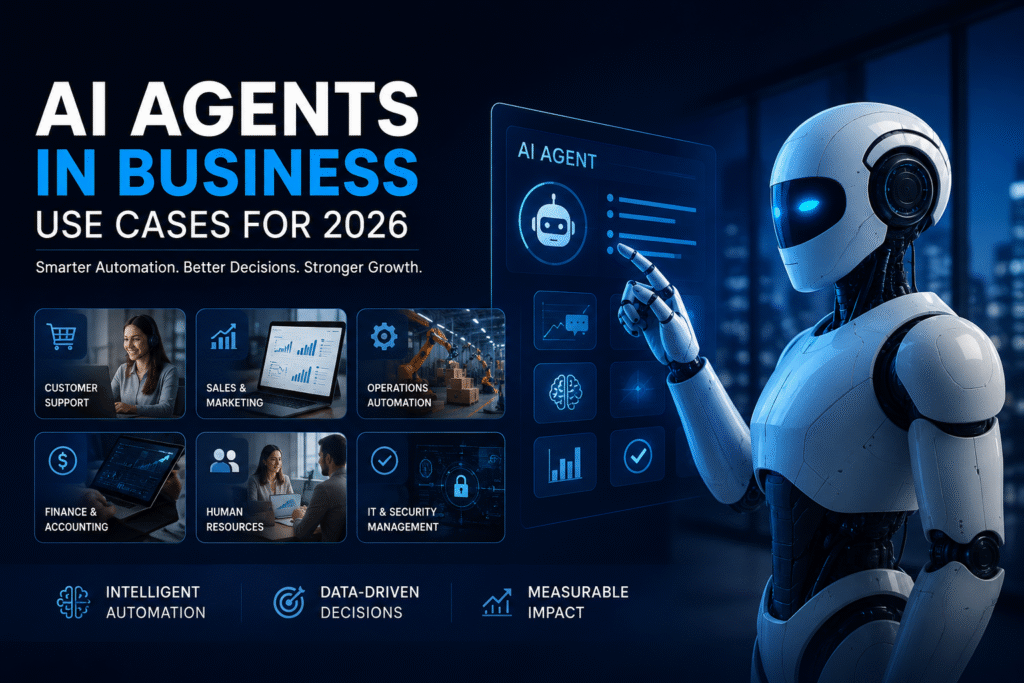
Something fundamental shifted in the enterprise AI landscape between 2024 and 2026. Businesses stopped asking “Should we use AI agents?” and started asking “Where do we deploy them first?”
The numbers are striking. According to Gartner, 80% of enterprise applications shipped or updated in Q1 2026 now embed at least one AI agent — up from just 33% in 2024. Enterprise AI spending hit $37 billion in 2025, more than tripling from $11.5 billion the year before. And organizations that successfully deploy autonomous AI systems are reporting an average 171% ROI — rising to 192% in the United States.
This isn’t a trend on the horizon. AI agents in business are operating infrastructure today — planning, executing, and optimizing workflows that once required entire departments.
Here are 25 real-world use cases showing exactly how enterprise AI agents are transforming organizations across every major industry in 2026.
What Are AI Agents in Business? (Quick Definition)
Unlike traditional AI tools that respond to single prompts, autonomous AI systems plan multi-step tasks, call external tools, access memory, and complete complex workflows end-to-end — often without human intervention at each step. Think of them as digital employees that execute entire job functions, not just answer questions.
According to Anthropic’s 2026 State of AI Agents report, 57% of enterprises are already running multi-step workflows through agentic AI, and 77% of business API calls show full-automation patterns — meaning companies aren’t using agents as co-pilots. They’re handing off entire operations.
Customer Service & Support
1. Autonomous Tier-1 & Tier-2 Support Resolution
Enterprise AI agents now handle customer queries across chat, email, and phone — resolving issues, processing refunds, updating accounts, and escalating complex cases, all without human handoff. Financial services leads this space, with 91% adoption in the sector. The result: average handle times drop by 60%, and agents work 24/7 without burnout.
2. Intelligent Complaint Routing & Sentiment Analysis
Agentic AI systems analyze incoming complaints in real-time, detect customer sentiment, assess urgency, and route tickets to the right human team — or resolve them autonomously. Enterprises using these systems report a 35–50% reduction in escalations reaching senior agents.
3. Proactive Customer Outreach
Instead of waiting for customers to call, AI agents in business now monitor usage patterns, detect churn signals, and trigger personalized outreach automatically. Telecom and SaaS companies are deploying this at scale, cutting churn by 15–25% in early deployments.
Finance & Accounting
4. Accounts Payable & Invoice Processing Automation
Enterprise AI agents extract data from invoices, match purchase orders, flag discrepancies, and process payments — end-to-end. What once took a finance team three days now runs in three hours. Finance and ops agents have a median payback period of 8.9 months, per Forrester’s 2026 benchmark.
5. Real-Time Fraud Detection & Response
Autonomous AI systems in banking don’t just flag suspicious transactions — they investigate them. Agents cross-reference behavioral history, geolocation data, and peer accounts, then block, allow, or escalate transactions in milliseconds. JPMorgan, HSBC, and dozens of regional banks have deployed agentic fraud systems as a core defense layer.
6. Regulatory Compliance Monitoring
AI agents continuously scan internal transactions, communications, and external regulatory updates to ensure compliance with frameworks like SOX, GDPR, and AML regulations. They generate audit trails, flag violations, and draft remediation plans — cutting compliance team workloads by up to 40%.
7. Financial Forecasting & Scenario Modeling
Agentic AI use cases in finance now include fully autonomous financial modeling: pulling real-time market data, running Monte Carlo simulations, and generating board-ready scenario reports — without a financial analyst typing a single formula.
Human Resources & Talent
8. AI-Powered Recruiting & Candidate Screening
Enterprise AI agents screen thousands of resumes, rank candidates, schedule interviews, and send follow-ups — reducing time-to-hire by over 50% in high-volume industries like logistics and retail. They cross-reference job requirements against skills databases and even generate personalized outreach messages.
9. Employee Onboarding Orchestration
Autonomous AI systems manage the entire onboarding journey: provisioning IT accounts, enrolling employees in training modules, scheduling manager introductions, and answering HR questions through intelligent chat — all triggered on day one without human project management.
10. Performance Review & Learning Path Generation
AI agents analyze performance data, peer feedback, and business goals to generate individualized development plans for each employee. HR teams at Fortune 500 companies are using agentic AI to run continuous feedback cycles that previously only happened annually.
Sales & Marketing
11. SDR (Sales Development Representative) Agents
Among the fastest-ROI agentic AI use cases, autonomous SDR agents research prospects, craft personalized outreach, follow up across channels, and book meetings — with a median payback period of just 3.4 months, per BCG’s 2026 survey. Early enterprise deployments are reporting 3x the meeting volume with the same sales team headcount.
12. Dynamic Content Personalization at Scale
Marketing AI agents create individualized content experiences for millions of customers simultaneously — personalizing website landing pages, email campaigns, product recommendations, and ad creative in real-time based on behavioral data. Retail and eCommerce lead adoption, with 72% of the sector deploying agentic tools in marketing workflows.
13. Campaign Performance Optimization
Autonomous AI systems monitor ad campaigns across Google, Meta, LinkedIn, and programmatic channels — adjusting bids, pausing underperforming creatives, and reallocating budgets in real-time, 24 hours a day. Enterprises using these agents report 20–30% better ROAS compared to human-managed campaigns.
Supply Chain & Operations
14. Demand Forecasting & Inventory Management
Supply chain AI agents analyze sales history, seasonality, supplier lead times, and external market signals to predict demand and automate purchase orders. Companies like Walmart and Unilever have deployed agentic inventory systems that cut overstock by 18% and stockouts by 23%.
15. Logistics Coordination & Last-Mile Optimization
Autonomous AI systems coordinate carrier selection, route optimization, real-time delivery tracking, and exception management — all without dispatcher involvement. Freight companies deploying enterprise AI agents report 15% fuel savings and 12% faster delivery times.
16. Supplier Risk Monitoring
AI agents continuously scan news feeds, financial filings, geopolitical data, and supplier performance metrics to flag supply chain risks before they materialize. This proactive, always-on monitoring was previously impossible at scale for most procurement teams.
IT & Cybersecurity
17. Autonomous IT Helpdesk & Incident Resolution
IT AI agents handle password resets, software provisioning, network diagnostics, and common infrastructure issues — resolving up to 70% of helpdesk tickets without human involvement. Enterprises with 10,000+ employees are saving $2–4 million annually on IT support costs alone.
18. Threat Detection & Security Response
Cybersecurity is among the highest-value enterprise AI agent use cases in 2026. Autonomous systems monitor network activity, detect anomalies, investigate alerts, and contain threats — in seconds rather than the hours it typically takes human analysts. Given that 1 in 8 enterprise data breaches is now linked to AI agents (BeyondTrust, 2026), the irony is that AI agents are also the best defense.
19. Automated Code Review & Vulnerability Scanning
Development teams are deploying AI agents that scan pull requests, identify security vulnerabilities, check for compliance violations, and even auto-remediate issues — reducing the security review cycle from days to minutes. Over 80% of enterprise databases are now built with AI agent involvement, per Databricks’ 2026 State of AI Agents report.
Healthcare & Life Sciences
20. Clinical Documentation Automation
Healthcare AI agents listen to doctor-patient conversations (with consent), generate structured clinical notes, update EHR records, and flag coding errors — giving physicians 2–3 hours back per day. Healthcare sector adoption sits at 74%, driven largely by administrative burden reduction.
21. Drug Discovery & Research Acceleration
In pharmaceuticals, autonomous AI systems are accelerating R&D by analyzing molecular databases, identifying compound candidates, and generating hypotheses for lab testing. What once took five years of preliminary research is being compressed into months.
22. Patient Follow-Up & Care Coordination
Agentic AI systems track post-discharge patients, send medication reminders, monitor symptom reports, and escalate concerns to care teams — dramatically improving outcomes for chronic disease management without adding clinical staff.
Legal, Compliance & Knowledge Work
23. Contract Review & Due Diligence
Legal AI agents review thousands of contracts simultaneously — extracting key terms, flagging non-standard clauses, comparing against legal templates, and generating risk summaries. Large law firms and corporate legal departments are cutting contract review time by 80%.
24. Knowledge Management & Enterprise Search
Autonomous AI systems index internal documents, emails, meeting transcripts, and databases — then answer employee questions with sourced, accurate answers in seconds. Instead of 20 minutes hunting through SharePoint, employees get an answer in 20 seconds.
Executive & Strategic Functions
25. Board Reporting & Strategic Intelligence
At the executive level, AI agents are compiling competitive intelligence, synthesizing market data, generating board presentations, and flagging strategic risks — tasks that previously required entire strategy and research teams. C-suite adoption is accelerating: 61% of CEOs globally confirmed in IBM’s 2026 survey they are actively adopting AI agents and preparing to implement at scale.
The Enterprise AI Agent Landscape in 2026: Key Data Points
| Metric | 2024 | 2026 |
|---|---|---|
| Enterprise apps embedding AI agents | 33% | 80% |
| Enterprise AI spending | $11.5B | $37B+ |
| Avg. ROI on successful deployments | — | 171% |
| Companies with agents in production | 14% | 31% |
| Multi-agent system growth | Baseline | +327% in 4 months |
| SDR agent payback period | — | 3.4 months |
Sources: Gartner, McKinsey, BCG, Forrester, Databricks, Anthropic — 2026
The Gap Problem: Why Most Enterprises Are Leaving Value on the Table
The most important number in enterprise AI right now isn’t adoption — it’s the production gap. While 79% of enterprises have adopted AI agents in some form, only 11% are running them in production and capturing real value. That’s a 68-percentage-point gap — the largest deployment backlog in enterprise technology history.
The primary blockers? Infrastructure gaps (41%), governance and security barriers (38%), and ROI measurement failures (33%).
The companies winning this cycle aren’t building general-purpose AI assistants. They’re building domain-specific agents that know one process deeply and execute it reliably — starting with customer service, finance, and sales operations, where the ROI case is proven and the workflow is repeatable.
What Separates High-Performing Enterprise AI Deployments?
Based on the data from Bain, BCG, and Forrester’s 2026 benchmarks, enterprises achieving the highest ROI from agentic AI share three characteristics:
- Clean data foundations. Agents are only as capable as the data they access. IDC warns of a 15% productivity loss by 2027 for companies that fail to build AI-ready data infrastructure first.
- Governance from day one. Only 21% of enterprises currently have a mature governance model for autonomous agents — yet governance is the single biggest predictor of whether a deployment scales or gets cancelled.
- Targeted deployment. Successful enterprises start with one high-ROI use case (customer service, SDR, finance automation), prove value, then expand. Companies that try to deploy broadly without clear ROI metrics are behind the 40% of agentic AI projects at risk of cancellation by 2027.
The Bottom Line
AI agents in business have moved from science project to strategic infrastructure. The enterprises deploying autonomous AI systems thoughtfully — starting with proven use cases, building governance frameworks, and fixing data foundations — are generating 171% ROI and competitive advantages that compound over time.
The ones waiting are falling further behind with every quarter.
The question in 2026 is no longer whether AI agents work. The market has answered that. The question is whether your organization will close the production gap before your competitors do.
DataBusinessCentral.com covers enterprise AI strategy, data infrastructure, and digital transformation for business leaders. Explore more on AI automation, enterprise AI agents, and agentic AI use cases in our resource library.
Tags: AI agents in business | enterprise AI agents | AI automation examples | autonomous AI systems | agentic AI use cases | AI agents for enterprises | digital transformation 2026

1 thought on “AI Agents in Business: 25 Real-World Use Cases Transforming Enterprises in 2026”
Pingback: AI Agents in Customer Service: 2026 Guide